The Real Guide to Data Scraping on LinkedIn
You've got a scraper, you’ve got a proxy, and you’re still getting blocked. Constant CAPTCHAs, shadow-bans, and wasted spend on proxies that don't work—it’s the standard story for anyone trying to extract data from LinkedIn. Most guides offer surface-level advice like "use a proxy" but completely fail to explain why your operation is failing at a fundamental level.

Gunnar
Last updated -
Feb 11, 2026
Tutorials
The reason is simple: your scraper is tripping sophisticated anti-bot alarms that go far beyond your IP address. This guide cuts through the fluff. We operate proxy networks at scale, and we see the common failure points every day. We'll show you why your current setup is fragile and provide an operator-level framework for building a resilient LinkedIn scraping architecture that actually works.
What is LinkedIn Data Scraping?
LinkedIn data scraping is the automated process of extracting public data from LinkedIn profiles, company pages, and job listings. In practice, it’s a constant battle against sophisticated anti-bot systems designed to detect and block automated activity. Success isn't about brute-force requests; it's about mimicking human behavior so convincingly that your scraper becomes indistinguishable from a real user.
How LinkedIn Scraping Actually Works (And Fails)
To scrape LinkedIn without getting immediately shut down, your architecture has to be built on two pillars: a headless browser to render JavaScript-heavy pages and a proxy network to manage your digital identity. Frameworks like Playwright or Puppeteer handle the browser automation, but the real point of failure is almost always the proxy logic.
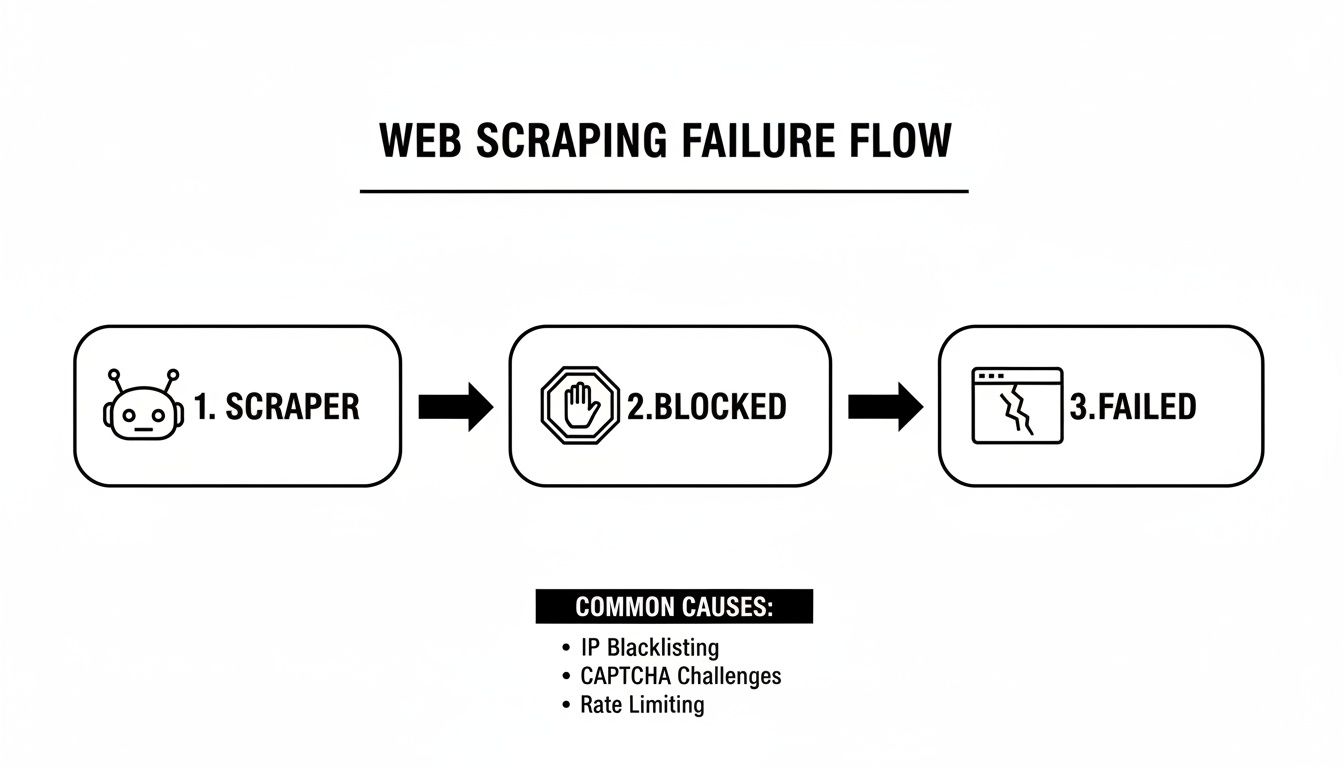
The single biggest mistake engineers make is naive, per-request IP rotation. Sending every request from a new IP is a massive red flag. No real user browses from a different city every millisecond. This instantly destroys session integrity and triggers security protocols.
The goal is session persistence. You must maintain the same exit IP for the entire duration of a logical user task—like viewing a profile, then clicking to their company page. This is where "sticky" sessions become critical. High-quality proxy providers allow you to hold the same IP for a defined period (e.g., 10-30 minutes), which is essential for mimicking legitimate user behavior. Overlooking this detail is the primary reason why teams constantly struggle with what causes proxy bans.
Concurrency and rate limits are also key constraints. Sending too many parallel requests from a single IP or a small pool will get you rate-limited instantly. Your architecture must intelligently distribute requests across a large, clean IP pool, respecting both per-IP and global rate limits to avoid detection. For a deeper look at the mechanics, our operator's guide on rotating proxies for web scraping at scale breaks down these operational realities.
LinkedIn's User Agreement explicitly prohibits scraping. While the legality of scraping public data is often debated, violating the platform's terms of service is a surefire way to get your accounts terminated and IPs blocked.
Proxy Types & Tradeoffs for LinkedIn Scraping
Choosing the right proxy type is the most critical decision you'll make. Get it wrong, and you'll burn your budget on a strategy that was doomed from the start.

Datacenter Proxies
These IPs come from servers in a data center. They are cheap and fast, but for LinkedIn, they are a trap. LinkedIn can easily identify the commercial Autonomous System Number (ASN) of a data center. Since no real user browses from a server farm, these IPs are flagged and blocked almost immediately.
When it works: Almost never for serious LinkedIn scraping. They might survive a few test requests but will fail at any meaningful scale.
When it fails: The moment you try to scale. Their commercial ASN is a dead giveaway, making them useless for authenticated scraping or reliable data collection.
Cost vs. Success Tradeoff: Very low cost, extremely low success rate. The money saved is quickly lost to failed requests and engineering time.
Residential Proxies
These are IP addresses assigned by Internet Service Providers (ISPs) to real homes. Your traffic is routed through a legitimate user's device, making it appear completely organic to LinkedIn's servers.
When it works: For sensitive, account-based scraping where detection is not an option, or large-scale anonymous scraping where authenticity is paramount. Their traffic is nearly indistinguishable from real users.
When it fails: Can be slower and more expensive than other types. Lower-quality providers may have unstable IPs that drop sessions unexpectedly. Learning how to effectively use residential proxies is crucial.
Cost vs. Success Tradeoff: High cost, very high success rate. The best choice when the cost of getting blocked is higher than the cost of the proxy.
ISP (Static Residential) Proxies
ISP proxies are the hybrid sweet spot. They are datacenter-hosted IPs, giving them exceptional speed and stability, but they are officially registered under residential ASNs from legitimate ISPs. This gives you the performance of a datacenter with the trust and legitimacy of a residential IP.
When it works: The majority of LinkedIn scraping use cases, including lead generation, market research, and competitive analysis. They offer the ideal balance of speed, stability, and a clean reputation.
When it fails: They are more expensive than datacenter proxies and the IP pools are typically smaller than massive residential networks, which can be a constraint for hyper-scale operations.
Cost vs. Success Tradeoff: Medium-high cost, high success rate. This is the optimal balance for most professional scraping operations.
Proxy Type | When It Works | When It Fails | Cost vs. Success Tradeoff |
|---|---|---|---|
Datacenter | Low-volume, non-critical tests. | Immediately flagged by commercial ASN at scale. | Low Cost, Very Low Success. |
Residential | Account-based scraping; large-scale anonymous scraping. | Slower; more expensive; potential for IP instability. | High Cost, Very High Success. |
ISP Proxies | Most professional scraping scenarios. | Higher cost than datacenter; smaller IP pools. | Medium-High Cost, High Success. |
Why You're Still Getting Blocked (Even With Good Proxies)
You invested in premium residential or ISP proxies, but you're still getting CAPTCHA'd and blocked. This is where most teams hit a wall. A clean IP is just the entry ticket; LinkedIn's defenses are layered, and you are failing one of the deeper checks.
Your scraper is tripping alarms because its entire digital identity—not just its IP—screams "automation."

Advanced Bot Detection Signals
Browser Fingerprinting: LinkedIn analyzes dozens of browser attributes to create a unique signature. If this signature matches a known automation tool or looks inconsistent, you're flagged. This includes everything from your User-Agent and screen resolution to WebGL and Canvas rendering outputs.
TLS/JA3 Signatures: The very first "handshake" your scraper makes with LinkedIn's servers reveals the underlying tech stack. The TLS signature of a standard Python
requestslibrary or a default headless browser is fundamentally different from a real Chrome browser on Windows. This is one of the easiest ways to get caught.Header Entropy: The combination, order, and values of your HTTP headers create a distinct pattern. Automation tools often send a minimal or non-standard set of headers, which stands out immediately against millions of legitimate user sessions.
ASN Reputation: Every IP belongs to an Autonomous System Number (ASN) that identifies the network provider (e.g., Comcast vs. AWS). LinkedIn heavily scrutinizes ASN reputation. IPs from commercial or data center ASNs are treated with extreme suspicion, which is why datacenter proxies fail so catastrophically.
Bad Rotation Logic: How you use your proxies is as critical as their quality. Switching IPs for every single request or making illogical geographic jumps (e.g., Dallas to Frankfurt in two seconds) is textbook bot behavior that will get your entire IP pool burned.
To bypass these checks, you must use an anti-detect browser in conjunction with your proxies. Tools like Incogniton are designed to manage and randomize these fingerprinting parameters, making your scraper's traffic appear authentic. Our guide on how to use Incogniton with HypeProxies details how to implement this critical layer of defense.
Real-World Use Cases (With Constraints)
The right proxy architecture depends entirely on your mission. A one-size-fits-all approach guarantees failure.
Lead Generation and Sales Intelligence
This requires logging into specific accounts to access contact details and profile information. Consistency and session integrity are paramount.
Whatproxy type actually works: Static Residential (ISP) Proxies. This is non-negotiable. You need one clean, stable IP per LinkedIn account to maintain session integrity and avoid constant security verifications or shadow-bans.
What fails at scale: Rotating residential or datacenter proxies. Per-request rotation will get your accounts locked almost instantly. Datacenter IPs will be blocked outright or, worse, served polluted data.
What teams underestimate: The need for account "warm-up." You can't just connect a new account to an ISP proxy and start blasting requests. You must build a credible activity history first, ramping up views and actions slowly to mimic human behavior.
Large-Scale Market Research
The goal here is collecting broad, anonymous data from public profiles and job postings. Volume and anonymity are the priorities.
What proxy type actually works: A massive pool of Rotating Residential Proxies. By distributing requests across thousands of legitimate, geographically diverse residential IPs, your scraper's traffic blends in with organic user activity. This allows you to fly under rate-limiting thresholds while collecting data at scale.
What fails at scale: ISP or datacenter proxies. A limited pool of static ISP IPs will hit rate limits quickly. Datacenter proxies will be blocked before you collect any meaningful data. Understanding the nuances of proxies for social media automation is essential here.
SEO and Competitive Analysis
This involves tracking competitor activity, monitoring industry trends, and identifying influencers. Data accuracy is critical for making sound strategic decisions. For a deeper look, tools for LinkedIn Monitoring often build on this kind of data collection.
What proxy type actually works: A hybrid approach using both ISP Proxies and a smaller pool of Rotating Residential Proxies. Use the stable ISP proxies for consistent, daily tracking of key competitors or keywords. Use the rotating residential pool for broader, ad-hoc analysis without risking your primary IPs.
What fails at scale: Using cheap datacenter proxies. This is a classic mistake. LinkedIn is known to serve throttled, incomplete, or garbage data to suspicious IPs. You might get a 200 OK response but be collecting flawed data, rendering your entire analysis useless.
How to Choose the Right Setup
Making the right decision comes down to a few key rules and understanding the tradeoffs.
If you are managing specific accounts: Use one Static Residential (ISP) Proxy per account. Do not rotate IPs for that account's session.
If you are scraping public data anonymously at scale: Use a large pool of Rotating Residential Proxies with sticky sessions configured for 10-30 minutes.
If budget is your primary constraint: Re-evaluate your project. Using cheap datacenter proxies for LinkedIn will result in failure and wasted engineering hours. The cost of failure is higher than the cost of proper infrastructure.
When NOT to use rotating proxies: For any task that requires a stable identity or login session. Per-request rotation is the fastest way to get an account banned.
A common buying mistake is choosing a provider based on the sheer number of IPs instead of their quality, ASN reputation, and rotation logic. For a deep dive, check out the tools and techniques for LinkedIn scraping that successful teams rely on.
FAQ
Is it legal to scrape data from LinkedIn?
Scraping publicly available data is generally considered legal, supported by court rulings like the hiQ Labs v. LinkedIn case. However, it is a direct violation of LinkedIn's User Agreement. This means while you are unlikely to face legal action for scraping public profiles, LinkedIn will aggressively ban your accounts and block your IPs. Always consult with legal counsel regarding your specific use case.
Can LinkedIn detect headless browsers like Puppeteer or Playwright?
Yes, easily. A default headless browser has a distinct digital fingerprint that is trivial for anti-bot systems to detect. To avoid this, you must use a patched or "stealth" version of the browser framework combined with an anti-detect browser to randomize fingerprinting parameters and appear human.
What is the difference between a proxy and a VPN for scraping?
A VPN is designed for user privacy, encrypting all your device's traffic through a single server. It provides one IP from a known commercial provider, making it useless for scraping at scale. A proxy is an intermediary for individual requests, giving you granular control over millions of IPs and the ability to manage sessions intelligently. Using a VPN for scraping is a fundamental mistake.
Are free proxies safe for LinkedIn scraping?
No. Free proxies are a security and operational nightmare. They are slow, unreliable, and often run by malicious actors looking to inject ads or steal data. Furthermore, their IPs are already blacklisted by virtually every major website, including LinkedIn. Using them guarantees failure.
How many profiles can I scrape per day without getting banned?
There is no fixed number. The limit is dynamic and depends on account age, activity history, and proxy reputation. For account-based scraping, a conservative starting point is 80-100 profile views per day. For anonymous scraping with rotating proxies, the focus is on keeping the request rate per IP extremely low by using a massive IP pool.
At HypeProxies, we build high-performance ISP and residential proxy networks designed specifically for the grind of large-scale data collection. If you're done fighting with blocks and want infrastructure that just works, check out our solutions at https://hypeproxies.com.
Share on

$1 one-time verification. Unlock your trial today.
Stay in the loop
Subscribe to our newsletter for the latest updates, product news, and more.
No spam. Unsubscribe at anytime.