
Why Hype Proxies
ISP Vs Datacenter Proxies For Ticket Sites: Why ASN Beats Speed
Most advice about buying tickets with proxies starts with speed. Get a faster proxy, shave off some milliseconds, click before everyone else. It sounds right, and it costs people real money every year, because on a modern ticket site speed is not the first thing that decides whether you get through. The site decides whether to trust your connection at all, and it does so before your request ever reaches the part where speed matters. It comes down to one thing first: the network your IP sits on, its ASN.

1
min read

Why Hype Proxies
Google Disrupts NetNut: What It Means If You Rely On Residential Proxies
If you run web scraping, ad verification, AI data collection, price monitoring, or any data pipeline on residential proxies, you have a single point of failure most buyers never check. The story behind the headline isn't really about NetNut. It's about where proxy IPs come from, and what happens to your operation when that source becomes a problem.
1
min read

Why Hype Proxies
6 Things To Look For In A VPS Server For Scraping And Automation
If your scraper slows down the moment the box gets busy, or your bot loses a drop by a few hundred milliseconds, or a run dies overnight with no way back into the machine, the cause usually isn't the script. It's the VPS server underneath it. For scrapers, bots, and the AI agents that now run both, the server you pick decides whether the job finishes or stalls, and most of that is set before you write a line of code.
1
min read

Why Hype Proxies
6 Things To Look For In SEO Proxies Before You Buy One
If your rank tracker reads the wrong positions, or your SERP scraper gets blocked halfway through a run, every decision you build on that data is wrong in a way you cannot see. The proxies you pick decide whether that data is real, and what counts as that data has shifted. In 2026 many Google results open with an AI Overview, and its AI Mode now reaches more than a billion users a month. Tracking where you stand increasingly means reading those AI answers, not just the ten links beneath them.
1
min read
Tutorials
How To Build A SEO Rank Tracker Using Python & SEO Proxies
If you do SEO rank tracking at scale, your own browser shows you only your own personalized view. Google personalizes the search results mostly by location, and to a smaller degree by your search history and the account you are signed into. Because of this, a keyword that you see at position 3 may be at position 8 for a user in another city.
1
min read
Why Hype Proxies
IPRoyal vs NetNut vs HypeProxies: The Best ISP Proxy Provider
You need ISP proxies for production. The job might be price intelligence, ad verification, retail automation, AI training data collection, or sneaker and ticket releases. Three providers come up most often: IPRoyal, NetNut, and HypeProxies.
1
min read

News
HypeProxies at Prague Crawl 2026: ISP Proxies & Anti-Bot Defenses
On 20th May 2026, I, Gunnar, founder of HypeProxies, will be attending Spojka Events in Prague for Prague Crawl, bringing seven years of building experience to the table. It's a one-day event for engineers and teams working on web scraping, automation, and AI data extraction.
1
min read

Why Hype Proxies
How To Monitor Walmart Prices In Python With ISP Proxies
Reliable Walmart price monitoring in Python usually comes down to two things: the TLS fingerprint of the request, and the reputation of the IP making it.
1
min read
Proxies
How to Monitor Amazon Product Price with Python using ISP Proxies
In this tutorial, we have built a system to manage Amazon pricing. Behind the scenes, we have used ISP proxies.
1
min read

Why Hype Proxies
How to Set Up Proxies in MostLogin – HypeProxies Integration Guide
In this blog, we have used MostLogin, which is an anti-detect browser and integrated HypeProxies' ISP proxies with it.
1
min read

Why Hype Proxies
Sneaker Reselling Statistics 2026: Market Size, Growth, Platforms & Demand
A complete breakdown of the sneaker resale market in 2026. We cover market size, platform growth, pricing trends, bot activity, and buyer demographics with verified stats and sources.
1
min read
Why Hype Proxies
10 Best ISP Proxies in 2026 (Ranked on Basis of Scalability, Pricing & Infrastructure)
In this blog, we have listed out best ISP proxies, we have evaluated & ranked them on the basis of scalability, pricing & infrastructure stability.
7
min read

Why Hype Proxies
7 Best Residential Proxy Provider in 2026
In this blog, we have listed down some of the best residential proxy providers available in market today. Before committing to any provider do test them out.
1
min read
Why Hype Proxies
Bright Data vs Oxylabs vs HypeProxies: ISP proxy comparison (2026)
If you're comparing Bright Data and Oxylabs for ISP proxies (also called static residential proxies), here's the short version. Bright Data covers most countries with 700K+ ISP IPs. Oxylabs offers ISP proxies across 17 countries on 6 continents with SOCKS5/UDP support. We're HypeProxies. We built our infrastructure on hardware we own. Both Bright Data and Oxylabs source their ISP proxy IPs from internet service providers and host them on servers. The following sections compare how the 3 providers differ on block rates, bandwidth costs, and support.
1
min read
Why Hype Proxies
9 Quick Tips to Reduce Proxy Bandwidth Cost (Comprehensive Guide) in 2026
A headless browser transfers 1.5-8 MB per page, a direct HTTP request gets the same data in 50-200 KB, and finding the underlying API drops it to 15-50 KB. If you run web scrapers in production, proxy bandwidth is one of the biggest costs you can reduce. But what your HTTP client shows isn't what your proxy provider charges. These nine techniques reduce how much data actually goes through the proxy.
1
min read
Why Hype Proxies
State of ISP Proxies in 2026: What Providers Hope You Never Test
Most ISP proxies are shared, oversubscribed, or repackaged. In this article, we are going to discuss what actually matters.
1
min read
Product updates
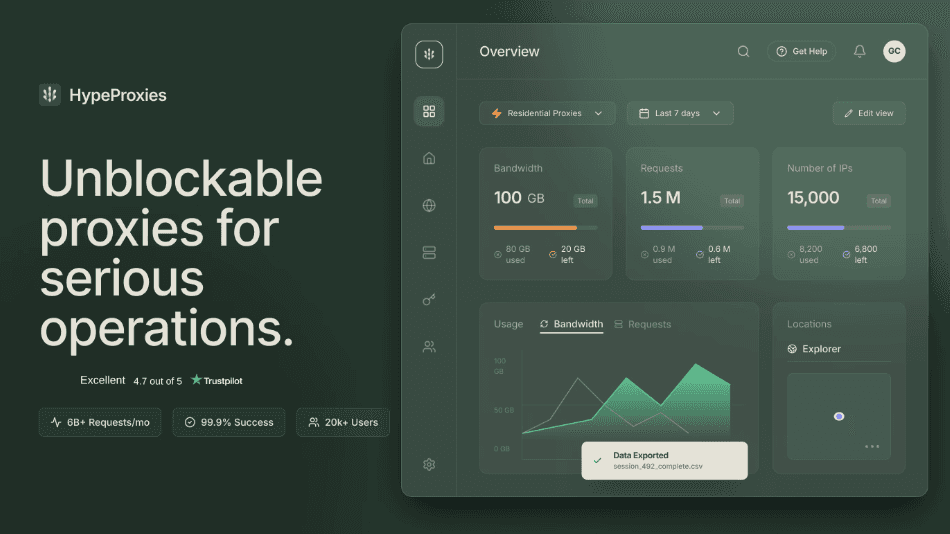
HypeProxies rebrand: new look, same hype [2026]
If you've been around HypeProxies for a while, you probably noticed something different today. We're rebranding. New logo, new visuals, everything refreshed.
11
min read
Why Hype Proxies
Google Disrupted One of the World's Largest Residential Proxy Networks. What Every Data Team Needs to Know
On January 28, 2026, Google Threat Intelligence Group, working with Cloudflare, Spur, and Lumen's Black Lotus Labs, disrupted IPIDEA, believed to be one of the largest residential proxy networks in the world.
13
min read
Why Hype Proxies
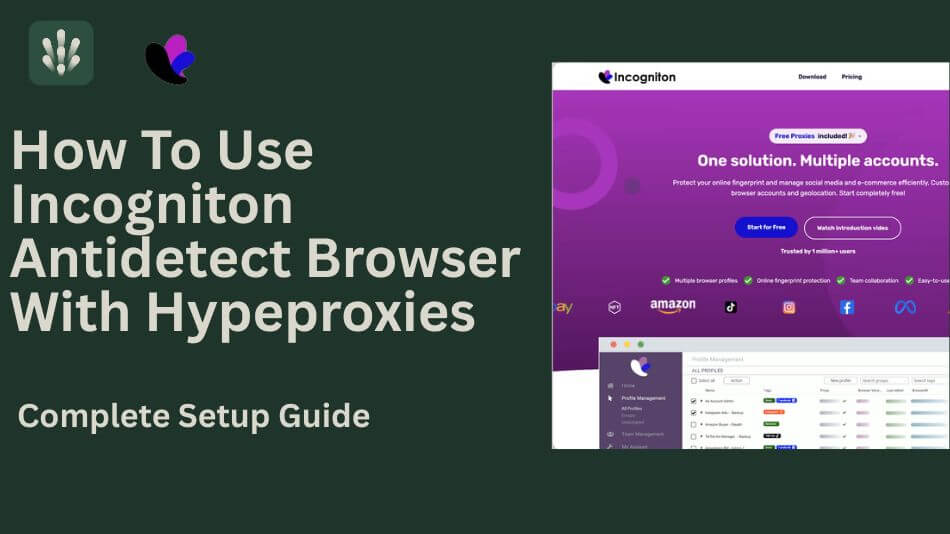
How to Use Incogniton Antidetect Browser with HypeProxies: Complete Setup Guide
If you've been running multiple accounts with just proxies, you've probably hit the wall already. Accounts flagged out of nowhere. Profiles suspended within days of creation. Verification loops that never end. And the frustrating part? Your IPs were clean. Your setup looked solid. So what went wrong?
18
min read
Tutorials
Amazon API Scraping: The Operator's Guide to Not Getting Blocked
If you've tried scraping Amazon, you know the cycle: your script runs for an hour, hits a wall of CAPTCHAs, and your IP gets blacklisted. You’re burning time, money, and your data pipeline is unreliable from the start. Most guides on this topic are dangerously incomplete. They recommend basic Python scripts and datacenter proxies—techniques Amazon’s anti-bot systems were designed to crush years ago. This guide is different. We operate large-scale proxy networks, and we're going to explain what actually works, what fails at scale, and why you're still getting blocked even with "good" proxies.
15
min read