IPRoyal vs NetNut vs HypeProxies: The Best ISP Proxy Provider
You need ISP proxies for production. The job might be price intelligence, ad verification, retail automation, AI training data collection, or sneaker and ticket releases. Three providers come up most often: IPRoyal, NetNut, and HypeProxies.

Gunnar
Last updated -
Why Hype Proxies
All three look good on their homepages, but the headline numbers don't line up. Vendor claims and independent benchmarks differ in places, and the pricing units don't match: NetNut charges per gigabyte, while IPRoyal and HypeProxies charge per IP. The right pick depends on workload, geography, and how you're billed.
This comparison uses Proxyway's ISP proxy testing for performance numbers and each provider's current pricing page for product details.
TL;DR
IPRoyal wins on flexibility, with ISP coverage in 31+ countries, day-rentals from $1.80, and four rental durations from 24 hours to 90 days.
NetNut has the broadest country reach among these three, with a 1,000,000+ static ISP pool, account-managed sales, and per-GB pricing that fits teams with many low-bandwidth requests.
HypeProxies leads on raw performance in Proxyway's USA testing, with 500,000+ dedicated IPs across all 50 US states, unlimited bandwidth, and 100% success rate in Proxyway's ISP testing.
At a glance
Here's how the three providers compare:
Dimension | HypeProxies | IPRoyal | NetNut |
ISP pool size (advertised) | 500,000+ | 500,000+ | 1,000,000+ |
Geographic coverage (advertised) | US (50 states) | 31+ countries | 195 countries |
Infrastructure success rate (ISP test) | 100% | 94.75% | 100% |
Response time (ISP test) | 0.06s | 0.46s | 0.21s |
Download speed (ISP test) | 52.39 MB/s | 5.31 MB/s | 4.39 MB/s |
Pricing unit | Per-IP | Per-IP | Per-GB |
Term / billing period | Monthly or quarterly | 24 hours to 90 days | Monthly |
Entry price | $65 / 50 IPs ($1.30/IP) | From $1.80 / IP (24 hr) | $99 / 7 GB ($14.14/GB) |
Protocols | HTTP(S) | HTTP(S), SOCKS5 (TCP and UDP) | HTTP(S), SOCKS5 |
Bandwidth model | Unlimited | Unlimited | Metered (per-GB) |
Best fit | High-performance USA workloads | Multi-country workloads with flexible rental terms | High-volume global enterprise workloads |
If you are also weighing these options against the market's largest providers, you can read our full ISP proxy infrastructure provider to see how these tiers stack up against top-scale networks.
What "ISP proxy" actually means
An ISP proxy is a static residential IP hosted in a data center. The IP is allocated to a real consumer carrier (Comcast, AT&T, Frontier, RCN, BT) and announces through that carrier's ASN (Autonomous System Number, the network identifier anti-bot systems check). IP databases like MaxMind, IPinfo, IP2Location, and IP Quality Scores classify the IP as residential based on that ASN, and anti-bot systems read the same signal.
The physical box sits in a data center, with data-center bandwidth and routing, but the residential ASN classification is what separates an ISP proxy from a plain datacenter proxy (which announces from a datacenter ASN and gets blocked far more often on sites with bot protection). That ASN check is the first gate on the hardest targets, which we break down in ISP vs datacenter proxies for ticket sites.
So you get the trust profile of residential and the throughput of data center, with IPs staying assigned to you for the full billing cycle. Compared to residential proxies, the trade-off is detection-resistance versus session stability: residential pools win on the hardest anti-bot targets (where fresh consumer IPs outperform), while ISP wins on speed, session persistence, and predictable behavior. Pool size and country coverage are smaller on ISP, because IPs come from carrier deals rather than consumer devices.
HypeProxies: US ISP proxies infrastructure provider
HypeProxies launched in 2019 in Mississippi. Its core ISP product covers the USA for general scraping, enterprise data, and sneaker/ticket/retail automation; residential proxies are also offered.
The product:
Pool: 500,000+ dedicated ISP IPs distributed across all 50 US states
Hosting: Ashburn, Virginia datacenter (10 Gbps servers, 200 Gbps network capacity)
Pricing: per-IP with unlimited bandwidth
Trial: Free trial
Protocols: HTTP(s) only
Targeting: country-level on ISP
IP carriers: RCN, Frontier, AT&T, etc.
Throughput: 52.39 MB/s downloads; 100% success rate including against Amazon and Google; response time 0.06s on synthetic benchmark, ~2.1s on Amazon and Google.
Plan | IPs | Monthly | Per IP/month | Quarterly per IP |
Pro | 50 | $65 | $1.30 | $1.16 |
Business | 100 | $125 | $1.25 | $1.12 |
Enterprise | 254 (/24 subnet) | $300 | $1.18 | $1.06 |
Strengths: In Proxyway's testing, response time and throughput were the best of the three, so the proxy is rarely the bottleneck on USA jobs. Per-IP pricing with unlimited bandwidth means a 10M-request SERP run pulling 500 GB to 1 TB doesn't add a per-GB line to the invoice. The pool itself comes from direct partnerships with US ISP carriers. Support runs 24/7 across live chat, Discord, and tickets.
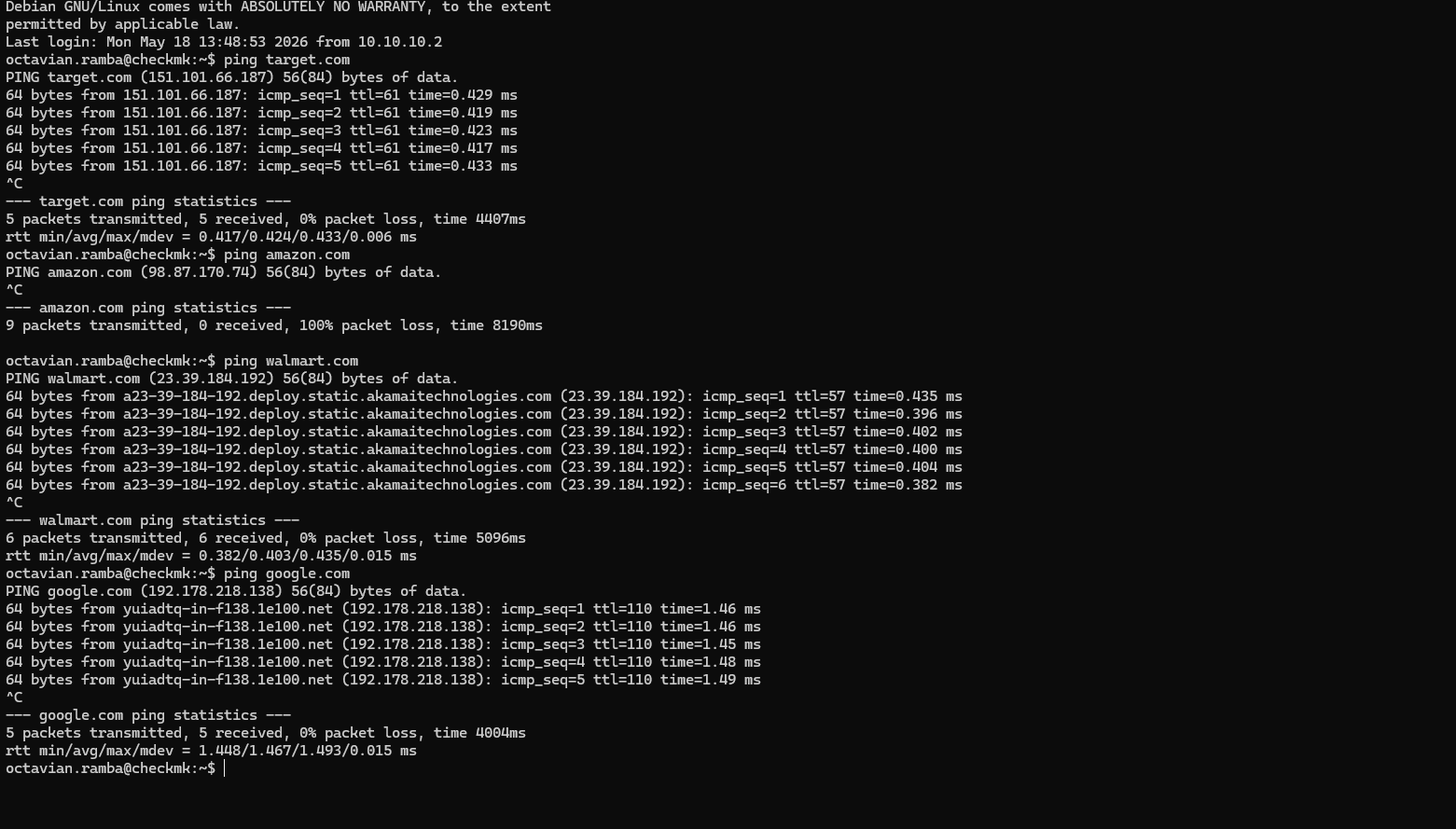
Live latency check from our newly opened datacenter in Dallas showing <1ms response times to major retail platforms like Walmart, Amazon, and Target. Lower latency means quicker requests during checkouts, queue entries, and high-demand drops.
Weaknesses: The product covers the USA only, with no support for Europe, Asia, or LATAM. The protocol is HTTP(S) only, so tools that require SOCKS5/UDP need a different provider.
IPRoyal: the flexible mid-market option
IPRoyal launched in 2020 in Lithuania. It covers residential, mobile, datacenter, and ISP proxies, the broadest product menu in this comparison.
The product:
Pool: 500,000+ dedicated ISP IPs across 31+ countries
Top concentrations (per IPRoyal): US (~135K), UK (~78K), France (~46K), Germany (~45K)
Pricing: per-IP with unlimited bandwidth. From $1.80 for 24 hours, $2.70 at 30 days, $2.55 at 60 days, $2.40 at 90 days
Protocols: HTTP(S), SOCKS5 over TCP and UDP
Targeting: country, state, and city-level
Throughput: ~5.31 MB/s in Proxyway's testing
Strengths: The rental options are unusual in the ISP proxy market. A 24-hour rental is enough for a one-day test, and longer rentals go up to 90 days. Country coverage spans 31+ markets with state and city-level targeting where supported, and one dashboard covers multiple proxy types. Live chat runs 24/7.
Weaknesses: Proxyway's independent ISP test recorded 94.75% on the infrastructure benchmark, with 60.73% success against Amazon and 86.70% against Google in the target-specific tests. IPRoyal's published pricing shows no volume tier beyond the standard rate. Note too that in July 2026 Google and the FBI disrupted NetNut's network, which we covered in the Google disrupts NetNut.
NetNut: the enterprise-scale option
NetNut launched in 2017 in Israel and is part of Alarum (publicly traded). It focuses on enterprise web-data and high-volume scraping workloads.
The product:
Pool: 1,000,000+ static ISP IPs (NetNut's broader network spans 195 countries; ISP-specific country breakdown not published)
Pricing: per-GB, monthly (annual plans run 15-17% lower per NetNut's pricing page)
Connection: gateway with HTTP(S) and SOCKS5
Targeting: country, state, city, and ASN-level in the US and Europe
Included: dedicated account expert on every tier (not just enterprise)
Trial: free, requires KYC
Throughput: ~4.39 MB/s in Proxyway's testing
Plan | Bandwidth | Monthly cost | Effective $/GB |
Starter | 7 GB | $99 | $14.14 |
Advanced | 20 GB | $250 | $12.50 |
Production | 50 GB | $499 | $9.98 |
Semi-Pro | 125 GB | $999 | $7.99 |
Professional | 350 GB | $1,999 | $5.71 |
Master | 1 TB | $4,500 | $4.50 |
Strengths: The pool covers 195 advertised countries, the widest country list in this comparison. Volume pricing drops from $14.14/GB at entry to $4.50/GB at the 1 TB tier. Account-managed onboarding comes with every plan, not just enterprise. Specific-ASN selection (for ad verification or carrier-targeted SEO work) is supported in the US and Europe.
Weaknesses: Without published per-country breakdowns, you'll need to ask sales for IP counts in the specific countries your workload targets before signing. Plans have no pay-as-you-go option, and the minimum spend is $99/month. Average download throughput measured 4.39 MB/s in Proxyway's 2025 testing, the slowest of the three. Sales live chat operates on Israel business hours (24/7 technical support for existing customers). Since NetNut's July 2026 seizure, this option is off the table for new buyers. If you landed here mid-migration, here is our NetNut alternative guide.
What the numbers mean in practice
Small speed gaps compound at scale. For request-bound jobs, response time is the bottleneck. On synthetic benchmarks, the slowest (IPRoyal, 0.46s) lagged the fastest (HypeProxies, 0.06s) by 0.4 seconds. At moderate concurrency (100-1,000 parallel workers), that synthetic-benchmark gap projects to roughly 1 to 11 hours of added clock time on a 10-million-request job. Enterprise teams now routinely run 100M+ requests per day across 200-500 TB monthly. Real-world response on protected targets is slower for all three providers, so gaps will narrow on production workloads.
For bandwidth-bound jobs, throughput matters more, and the spread is wider: HypeProxies at 52.39 MB/s, IPRoyal at 5.31 MB/s, NetNut at 4.39 MB/s. A 1 TB job (single sustained stream at benchmark speed) takes around 5 hours on HypeProxies, 52 hours on IPRoyal, and 63 hours on NetNut.
Your bill depends on the pricing model, not the unit cost. For example, take a team pulling 30 TB of bandwidth per month. At published rates, the invoice looks very different on each provider:
NetNut: at the published 1 TB tier rate ($4.50/GB), a 30 TB month lists near $135,000 at list pricing, with enterprise discounts typical at this volume; bandwidth still dominates the bill.
IPRoyal: per-IP and bandwidth-uncapped. 200 IPs at $2.70 each is $540/month, whether you push 1 TB or 30 TB through them.
HypeProxies: per-IP with unlimited bandwidth. 254 IPs on Enterprise is $300/month flat, no matter how much data you pull.
At AI training scale (100 TB to multi-PB/month), the per-GB cost gap multiplies further. The shape is what matters. Per-GB bills scale with bandwidth, per-IP bills don't.
Which one to pick
Decide by workload, not by ranking.
Pick IPRoyal if
Your workload covers countries outside the USA.
You also need residential, mobile, or datacenter from the same vendor.
Your team needs short-term IP rentals (from $1.80 for 24 hours) or no monthly minimum.
Your traffic is moderate, and peak throughput per IP is not the constraint.
Pick NetNut if
Your workload spans many countries at enterprise volume.
Your team buys through procurement and expects account-managed onboarding.
Your traffic shape works with per-GB pricing (many requests, low bandwidth per request).
Your workload needs ASN-level targeting for ad verification or SEO.
Pick HypeProxies if
Your workload is USA-bound.
Throughput per IP matters (high concurrency, large pages, low latency requirements).
Your team prefers per-IP with unlimited bandwidth over per-GB metering.
Your stack doesn't need SOCKS5 with UDP.
What to test before you commit
Four tests will tell you what your workload actually needs:
Run a session-stability test. Hold the same IP through a 30-minute session on your target using a sticky-session token or one of your dedicated IPs. Track whether anti-bot signals fire mid-session by logging status codes and any CAPTCHA, 403, or Cloudflare/DataDome/Kasada/HUMAN/Akamai challenge HTML; a clean run is all 200s with no challenge interstitials. Rotating residential proxies breaks more often and Isp usually holds, but in 2026 even ISP can fail when the target fingerprints ASN + TLS (JA4/JA4+) + browser signals together. Pair the proxy with a stealth-capable browser stack (Playwright/Patchright/Camoufox + Botright or curl-impersonate / curl_cffi) for representative testing.
Measure end-to-end latency on your actual pages. Don't trust the homepage benchmark alone. Use a load-testing harness that carries a realistic browser fingerprint (Playwright or Patchright for full browser, curl-impersonate / curl_cffi or k6 for headless HTTP) to pull a real page of the size and complexity you care about, 10,000 times, then sort the per-request timings and check p50, p95, and p99 (p95 is the 9,500th-slowest, the latency that 95% of requests come in under). The provider that wins on the benchmark sometimes loses on your page.
Check the bill shape, not the headline price. Run a representative day of traffic on a small plan. Pull bandwidth from each provider's dashboard usage page, or measure transferred bytes client-side (your HTTP client's response-size counter) if the dashboard lags. Multiply by 30. Add any bandwidth charges. Compare the total against your monthly budget. The cheapest entry tier rarely produces the cheapest monthly bill.
Check the burned-IP replacement policy. When an IP gets flagged mid-month, can you swap it for a fresh one, and how fast? Read each provider's replacement terms before signing; in 2026, this is one of the real operational differentiators on ISP.
For a quick fraud-score, ASN, residential-classification, and reputation audit on individual IPs, HypeProxies maintains a free proxy-checker that works on any provider's IPs. For deeper reputation checks, Spur, IPinfo Privacy Detection, and GreyNoise are the references anti-bot vendors themselves license.
All three let you run these tests without a long-term contract: IPRoyal's 24-hour rental from $1.80, HypeProxies free trial and NetNut's free trial with KYC verification.
Next steps
Start with the workload before picking a vendor. Sketch a one-page profile:
Target countries
Expected daily request volume
Average page size
Session length (minutes)
Peak concurrency (simultaneous requests)
Budget ceiling
For USA workloads where throughput and session stability matter, HypeProxies fits that shape. For global enterprise ISP across many countries, NetNut is the strongest fit. For mixed proxy types and flexible rental terms, IPRoyal is the most flexible option. If your shortlist runs wider than these three, we've also compared Rayobyte, Decodo, Webshare, and Bright Data.
Run all three tests in week one, and don't sign an annual contract before week one ends. Whichever provider you pick, success rate at your volume matters more than pool size.
FAQ
How do ISP and residential proxies differ?
Residential proxies route through real consumer devices and rotate constantly. ISP proxies are static residential IPs hosted in a data center: they keep the trust profile of a residential IP (real carrier ASN) and add data-center speed, stable bandwidth, and long-lived sessions.
Which provider has the largest ISP proxy pool?
NetNut publishes the largest pool at 1,000,000+ IPs. IPRoyal and HypeProxies each publish 500,000+ (IPRoyal in 31+ countries, HypeProxies in the USA). Past ~200K IPs in a target market, pool size stops being the constraint; allocation model (dedicated vs gateway) and burn-replacement policy matter more.
Does HypeProxies work outside USA?
Not in 2026. HypeProxies' ISP product covers the US (all 50 states) only. For Europe, Asia, or LATAM on the static residential tier, choose IPRoyal or NetNut.
Can I run ISP proxies against Google or Amazon?
Results vary. HypeProxies: 100% against Amazon and Google. NetNut: 97.75% Amazon, 100% Google. IPRoyal: 60.73% Amazon, 86.70% Google. All per Proxyway's 2025 ISP testing.
How much do ISP proxies cost in 2026?
Entry pricing varies by model. HypeProxies starts at $1.30 per IP per month (50 IPs for $65) with unlimited bandwidth. IPRoyal starts at $2.70 per IP per month. NetNut prices per gigabyte at $14.14/GB on entry plans, dropping to $4.50/GB at 1 TB volume.
What should I check on compliance and sourcing?
Ask each provider for their consent-based sourcing attestation, SOC 2 / ISO 27701 status, and a GDPR DPA before signing. In 2026, ethically sourced IPs and documented compliance posture are procurement requirements, not optional.
Are IPv6 ISP proxies supported?
Currently rare across all three. The bulk of ISP-tagged IPv4 inventory remains the practical default; ask each provider directly if your workload requires IPv6 endpoints.
Share on

No credit card required. Request your free trial today.
Stay in the loop
Subscribe to our newsletter for the latest updates, product news, and more.
No spam. Unsubscribe at anytime.