What is a Proxy Server? A Practical Guide to How It Works
A proxy server is your secure middleman on the internet. Think of it as a gateway that sits between you and every website you visit, handling all your requests on your behalf. Instead of your computer talking directly to a website, the proxy steps in. It takes your request, forwards it using its own IP address, and then passes the website's response back to you. This simple hand-off is the secret sauce to a massive boost in privacy and security.

Gunnar
Last updated -
Tutorials

What Is a Proxy Server in Simple Terms
Let's ditch the tech-speak for a moment.
Imagine you need to send a confidential letter, but you don't want the recipient to know your home address. You could hire a trusted courier. You'd give them the letter, they'd place it in a new envelope with their return address, and mail it. When your friend replies, it goes back to the courier, who then safely delivers it to you.
In this scenario:
You are the user.
Your letter is your web request (like loading a website).
The courier is the proxy server.
The courier's address is the proxy's IP address.
That’s exactly how a proxy works. It intercepts your web traffic and sends it out for you. To the rest of the world, it looks like all your activity is coming from the proxy server, not your personal computer. This fundamental redirection unlocks a world of possibilities for security, privacy, and unrestricted access.
Why This Middleman Matters
This intermediary role isn't just a clever trick; it's a core concept in modern networking. The idea of proxies actually goes way back to the early 1990s, when labs and universities needed a way to manage the explosive growth of internet traffic.
By 1994, CERN had already released the first popular HTTP proxy software, which helped networks save precious bandwidth by caching (or temporarily storing) frequently visited websites. Fast forward to today, and that same basic technology is absolutely essential for businesses and individuals doing any kind of large-scale online work.
To simplify it even further, here's a quick breakdown of what a proxy fundamentally does for you.
Core Functions of a Proxy Server at a Glance
Function | Simple Explanation | Key Benefit |
|---|---|---|
Mask Your IP Address | Hides your real IP and shows the proxy's IP instead. | Anonymity and privacy. |
Bypass Restrictions | Lets you appear to be in a different location. | Access geo-blocked content. |
Filter Content | Can be set up to block access to certain websites. | Enhanced security and control. |
Improve Performance | Caches data to speed up access to frequent sites. | Faster loading times and less bandwidth use. |
These core functions are why proxies are so powerful. They create a clean separation between you and the web.
A proxy server is your digital representative. It makes requests, receives data, and interacts with the internet for you, ensuring your own identity remains private and your connections remain secure.
This separation is the foundation for almost every proxy use case you can think of. Whether you're a business scraping market data or just someone trying to get around frustrating content blocks, the proxy acts as your stand-in online.
To really get the full picture, you'll want to dive into our guide on the different types of proxy servers. Understanding the options is the first step to choosing the right tool for any project, from automating social media to monitoring SEO performance without getting blocked.
How a Proxy Server Actually Works
Knowing what a proxy is feels good, but seeing how it works is where things really click. Let's walk through the journey of a single web request, from your keyboard to a website and back again, to see exactly what the proxy is doing for you.
Think about what happens when you visit a website to check competitor pricing. Without a proxy, your computer sends a request straight to their server. The website sees your real IP address, logs it, and sends the data right back. Simple enough, but it leaves a clear digital footprint.
Now, let's slot a proxy into that process. The whole game changes.
The Step-by-Step Request Flow
Your data’s journey now has a critical middleman that handles all the back-and-forth. This simple rerouting is the foundation of how proxies give you anonymity and access.
You Send the Request: You type a URL into your browser or fire up a data-gathering script. Instead of heading directly out to the internet, that request is first sent to the IP address of the proxy server you’re set up with.
The Proxy Takes Over: The proxy server catches your request. It then strips away your personal IP address and slaps its own in its place. This is the magic trick—your real identity is now officially masked.
The Proxy Forwards the Request: Using its own IP, the proxy sends your request on to the target website. As far as that website’s server is concerned, a completely normal visitor is asking for information. It has no idea the request actually came from you.
The Website Responds: The website’s server processes the request and sends the response (all the webpage data) back to the proxy server’s IP, thinking it’s the original source.
The Proxy Returns the Data to You: Finally, the proxy server gets the website's response and forwards it back to your computer. You see the website load just like normal, but the entire conversation happened anonymously.
This flow diagram breaks down that simple but powerful path your request takes.
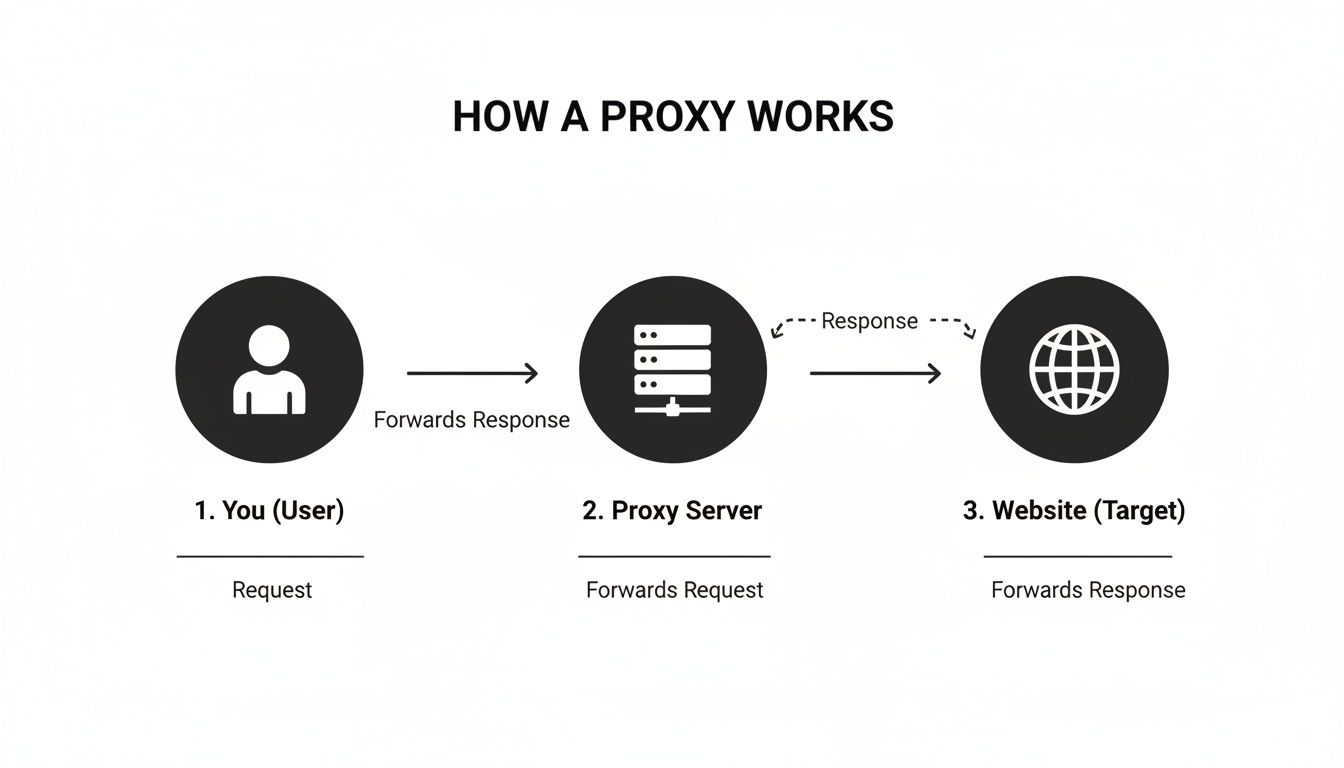
As the visual shows, the proxy acts as a clean buffer, preventing any direct contact between your device and the target website.
What This Process Achieves
This whole interception and forwarding process happens in milliseconds, but its impact is huge. By swapping your IP address with its own, the proxy essentially becomes your digital stand-in. It’s the core mechanism that powers everything from secure web scraping to getting around frustrating geographic content blocks.
At its core, a proxy server is just a request-and-response handler. It takes your traffic, repackages it under a new identity, and manages the entire conversation with the target server so you don't have to.
Every time you use a proxy, this multi-step dance happens behind the scenes. It’s what allows you to make thousands or even millions of requests from different IP addresses, making you look like countless unique users. That capability is absolutely essential for any serious data collection or automation project where staying under the radar is the key to success. Understanding this flow is the first real step to mastering proxies for any task you throw at them.
A Look at the Main Types of Proxy Servers
Not all proxies are created equal, and understanding the core differences is make-or-break for any serious project. The type of proxy you choose directly impacts your speed, anonymity, and ultimately, your success rate. The whole game comes down to one simple question: where does the proxy get its IP address?
That single detail determines everything, from how a target website sees your traffic to how much the service is going to cost you. Let's break down the three most common and powerful proxy types you’ll run into: Residential, ISP, and Datacenter. Each one has a unique origin story for its IPs, making them the right tool for very different jobs.
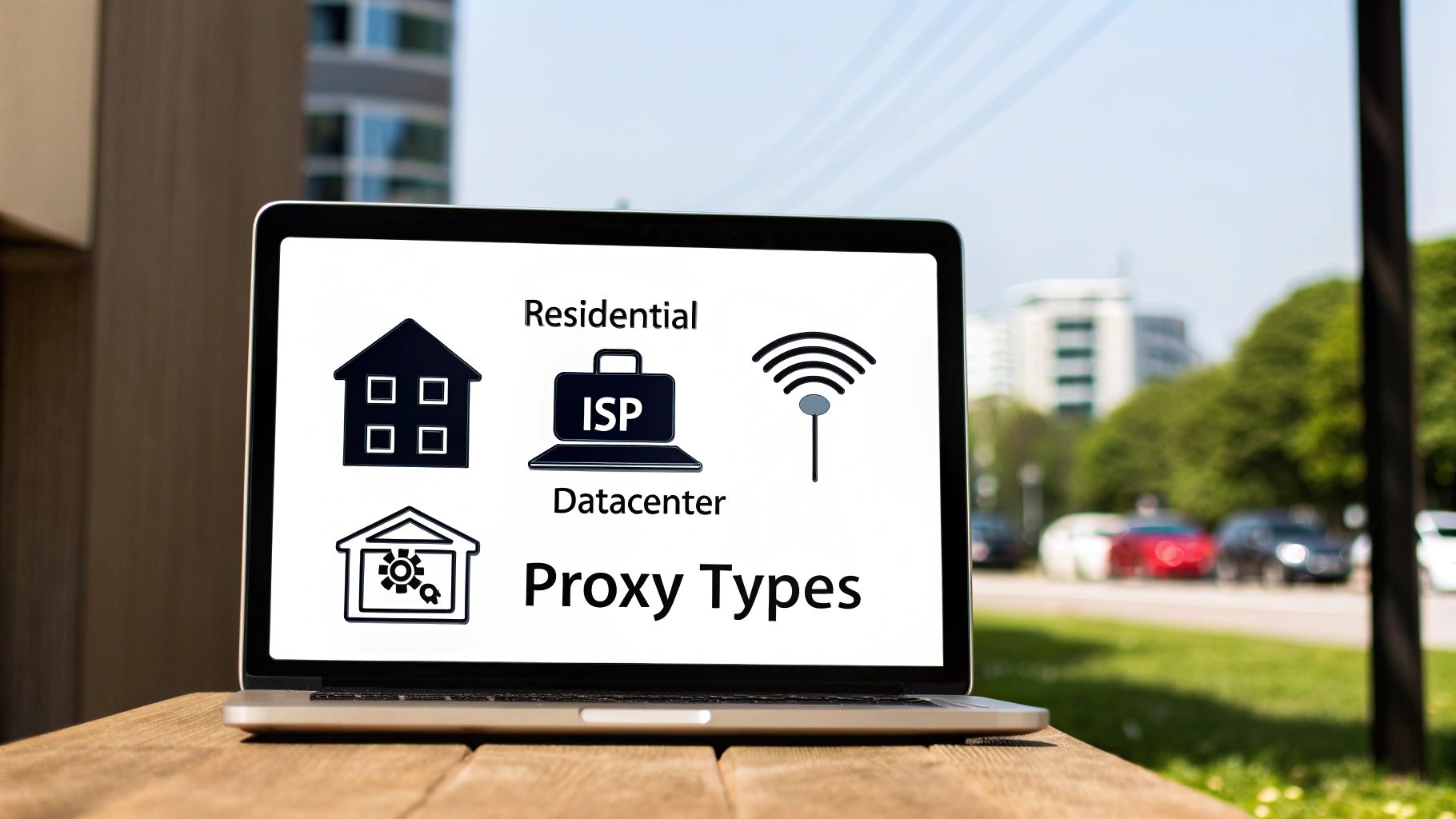
Residential Proxies: The Gold Standard for Anonymity
Residential proxies are the ninjas of the proxy world. They route your traffic through IP addresses assigned by Internet Service Providers (ISPs) to real, everyday homes. Think of your own Wi-Fi connection—that’s a residential IP. Because these IPs are tied to physical locations and actual devices, they look like 100% genuine, organic users to any website.
This authenticity makes them nearly impossible for websites to detect and block. It’s why they're the top choice for tasks that demand the highest level of legitimacy and stealth.
Best For: Scraping sensitive e-commerce sites, managing multiple social media accounts, and ad verification where blending in as a real user is non-negotiable.
Key Strength: Unmatched authenticity and the lowest block rates you can get.
Weakness: All that power comes at a cost. They can be slower and more expensive than other types due to their premium nature.
The demand for these legitimate IPs is exploding. The residential proxy market is projected to climb from USD 122.03 million in 2025 to over USD 148.33 million by 2030. This growth is all about their crucial role in ethical data gathering across a global network. You can find more details on the booming residential proxy market if you're curious.
Datacenter Proxies: Built for Pure Speed
Unlike their residential cousins, Datacenter proxies don't come from home internet connections. Instead, their IP addresses are artificially generated and housed in massive, powerful datacenters. These IPs are created purely for commercial use and have no connection to a real-world home.
Because they originate from known commercial servers, they are easier for websites to spot. But what they lack in stealth, they more than make up for in raw performance.
Datacenter proxies are the workhorses of the proxy world. They are engineered for one thing: processing a staggering volume of requests at incredible speeds, thanks to their direct connection to high-speed internet backbones.
Their main advantage is blistering speed and affordability. This makes them perfect for high-volume tasks where the risk of getting blocked is lower and you just need to get the job done fast.
ISP Proxies: The Best of Both Worlds
ISP proxies, sometimes called static residential proxies, offer a powerful hybrid solution that hits the sweet spot. Like residential proxies, their IPs are officially registered with consumer ISPs, giving them a high degree of legitimacy and trust.
But here’s the twist: like datacenter proxies, they are hosted on dedicated servers, giving you far better speed and stability. You get the authority of a real residential IP with the performance of a datacenter connection. They’re perfect for long-session tasks where you need to maintain the same clean, trustworthy IP for an extended period.
For a deeper dive into how these types stack up, check out our guide on Datacenter vs. Residential proxies.
Residential vs ISP vs Datacenter Proxies Compared
To make the choice crystal clear, let's put these three proxy types head-to-head. This table breaks down the key differences to help you pick the right tool for your specific needs.
Proxy Type | IP Source | Best For | Performance | Anonymity Level | Cost |
|---|---|---|---|---|---|
Residential | Real home Wi-Fi connections | Web scraping, social automation | Moderate | Highest | High |
ISP | ISP-registered, server-hosted | Long-session tasks, e-commerce | Very Fast | High | Medium |
Datacenter | Cloud data centers | High-volume, speed-critical tasks | Fastest | Low | Low |
Choosing the right proxy type is the first—and most important—step in setting up a successful project. A residential proxy gives you the camouflage for sensitive missions, a datacenter proxy delivers the raw power for bulk operations, and an ISP proxy strikes an effective balance between the two. Your goal will always determine which tool is right for the job.
Proxy Use Cases That Drive Business Results
Knowing the technical details of a proxy server is one thing. Seeing how they actually make a business money is another game entirely. Proxies aren't just abstract network tools; they're the engines powering some of the most critical—and profitable—online operations running today.
Whether it's getting a leg up on e-commerce competitors or making sure a global ad campaign is running correctly, businesses lean on proxies to gather data, manage digital assets, and execute strategies at a scale that would be impossible otherwise.
Proxies are the solution to the big roadblocks that stop automated tasks dead in their tracks, like IP blocks, geo-restrictions, and rate limits. Let's dig into a few real-world scenarios where proxies stop being a technical concept and start being a core part of the business plan.
E-commerce and Large-Scale Web Scraping
Imagine you're running an online store. To have any chance of competing, you need to know what your rivals are charging, what they have in stock, and what sales they're running. Checking hundreds of product pages by hand every single day is a non-starter.
This is where web scraping comes in. You can use automated bots to visit competitor sites and pull this public data for you. The big problem? Any website that sees thousands of requests pouring in from the same IP address will flag it as a bot and shut it down. Permanently.
The Solution: A rotating residential proxy network. By sending each request through a different IP address tied to a real home internet connection, your scraper looks less like a single bot and more like thousands of individual, legitimate shoppers.
The Result: You get a steady stream of accurate, real-time pricing and stock information without getting blocked. This lets you pivot your own strategy on the fly to maximize sales.
By mimicking genuine user traffic, residential proxies give e-commerce businesses the camouflage they need to collect vital market intelligence. This isn’t just data—it’s a direct path to a stronger competitive position.
This exact principle works for any kind of large-scale data collection, from scraping real estate listings to tracking financial market data.
SEO Monitoring and Ad Verification
If you work in Search Engine Optimization (SEO), you live and die by rankings. You have to know how your websites rank on Google from different spots around the globe. A keyword might be #1 in New York but sink to #25 in London. The only way to verify that is to make search queries that look like they're coming from those specific cities.
It's the same story for global brands. If you're running a digital ad campaign, you have to confirm your ads are actually showing up correctly to the right audiences in different countries. Trying to check this from your office in one location will only show you local results, giving you a totally incomplete and misleading picture.
Proxies solve this by giving you a virtual presence anywhere you need to be.
The Challenge: Getting accurate, location-specific search rankings and ad placements without flying around the world.
The Proxy Solution: Using residential or ISP proxies with precise geo-targeting. An SEO analyst in Chicago can instantly use a proxy based in Tokyo to see the exact same search results as a user in Japan.
This allows for dead-on performance tracking and makes sure every dollar of the marketing budget is being spent effectively. To see just how deep this rabbit hole goes, you can explore a wide range of proxy use cases and applications that businesses depend on every day.
Social Media Management and Automation
Managing a bunch of social media accounts for marketing is a massive headache. The platforms are built for one person, one account. They are incredibly quick to flag or ban multiple accounts running from a single IP address, assuming it's spam or bot activity.
For a marketing agency handling dozens of client profiles, this is a recipe for disaster. To operate safely, every single account needs its own unique digital identity.
Static residential or ISP proxies are the perfect fix. By assigning one clean, dedicated IP address to each social media account, you create a stable and legitimate digital footprint for every profile. This lets you:
Run multiple accounts without setting off the platform's alarm bells.
Safely automate posting, engagement, and other growth tasks.
Make sure each account looks like a distinct, real user.
This simple change transforms social media management from a high-wire act into a scalable, reliable marketing machine. In fact, proxies are even fundamental to advanced IT practices, like managing traffic in modern software releases detailed in this guide on what Blue Green Deployment Explained is.
How to Choose the Right Proxy Server for Your Project
Picking the right proxy server isn't just a tech chore—it's a strategic move that can make or break your entire project. Go with the wrong provider, and you'll be wrestling with constant IP blocks, sluggish performance, and ultimately, a failed mission. The key is to look past the flashy marketing and size up providers based on what actually matters.
It really boils down to matching the proxy's strengths to your specific goals. A speedy datacenter proxy that’s perfect for one job might be completely useless for another that needs the genuine footprint of a residential IP. Let's walk through the essential factors so you can find a solution that just plain works.
Performance and Reliability Are Non-Negotiable
First things first: your proxies have to be fast and they have to be reliable. End of story. In a world of real-time data and automated tasks, there's no room for lag. Two simple metrics tell you almost everything you need to know about performance: speed and latency. Speed is about how fast the data moves, while latency is the delay before it even starts moving. For jobs like copping sneakers or scraping fast-updating websites, low latency is everything.
Reliability is just as crucial, and it comes down to two things:
Uptime: Look for providers who guarantee high availability—ideally 99.9% or better. Any downtime means your operation grinds to a halt, and that costs you time and money.
IP Pool Quality: The size of an IP pool is way less important than its quality. A provider with a clean, well-maintained pool of ethically sourced IPs will get you far fewer blocks than one with a massive, abused network.
A great proxy service is defined by consistency. It delivers the speed you need with the uptime you can count on, ensuring your projects run smoothly without constant interruptions or firefighting.
This is what turns a proxy from a simple tool into a core piece of your infrastructure.
Security and Scalability for Future Growth
Security has to be a top priority. A proxy sits right between you and the internet, so you need a provider who takes protecting your connection seriously. Look for solid authentication methods like IP whitelisting or username/password credentials. This ensures only you can use your proxy network. Steer clear of free or shady providers—they might be logging your data or leaving you open to major security risks.
And think about the future. As your projects get bigger, so will your proxy needs. Check out the provider’s limits on bandwidth and concurrent connections right from the start. A service like HypeProxies that gives you unlimited threads and unmetered bandwidth offers the freedom to scale up without hitting a surprise paywall. That kind of flexibility means your proxy setup can grow with your ambitions.
Ethical Sourcing and Support
Last but not least, the integrity of your proxy provider matters. A lot. Always ask where their IPs are coming from. Good providers are completely transparent about how they source their IPs, making sure residential proxies are obtained with full consent from the end-user. Using ethically sourced proxies isn't just about avoiding legal trouble; it also means you get higher-quality, more stable IPs.
This is becoming a huge deal in an industry that's blowing up. The global proxy server market hit around USD 1 billion in 2024 and is on track to nearly double by 2033, thanks to huge demand from AI companies and security teams. As more businesses jump in, they're demanding higher standards. Providers who focus on transparency and quality, rotating millions of clean IPs daily, are setting the new gold standard. You can dig into more data on this rapidly expanding market to see where things are headed.
Finally, don't forget about customer support. When you’re running a time-sensitive operation, you can't afford to wait hours for an email response. A provider with 24/7 support through live chat or Discord can be an absolute lifesaver. By weighing all these factors—performance, security, scalability, and ethics—you can confidently pick a proxy partner that will actually help you succeed.
Got Questions? We've Got Answers.
We've covered a lot of ground, but you probably still have a few questions rattling around. Let's tackle some of the most common ones we hear to clear up any lingering confusion and get you on the right track.
Are Proxies Actually Legal to Use?
Absolutely. Using proxy servers is 100% legal. They are standard, legitimate tools used by individuals and Fortune 500 companies alike for everything from security to business intelligence.
But here’s the critical part: legality is all about how you use them. If you use a proxy to do something illegal, like hacking or stealing copyrighted content, that activity is still illegal. The proxy is just a tool.
The key is to stick to ethical uses—like gathering public web data, verifying your ads are running correctly, or conducting market research. Always respect the terms of service of any site you visit and make sure you partner with a reputable provider that sources its IPs ethically.
What's the Real Difference Between a Proxy and a VPN?
This is a classic question. While both proxies and VPNs route your traffic through another server, they aren't interchangeable. They're built for different jobs.
A proxy server usually works at the application level. Think of it as a specialist you hire for a specific task, like telling your web browser or a particular software tool to use a different IP address. All your other internet traffic flows normally.
A VPN (Virtual Private Network), however, is more of a general contractor. It works at the operating system level, grabbing all the internet traffic from your device—every app, every background process—and encrypting it through a secure tunnel.
Think of it this way: VPNs are for general privacy and securing your entire device on public Wi-Fi. Proxies are specialized tools built for high-volume, precision tasks like web scraping, SEO monitoring, or managing dozens of accounts where you need to rotate IPs and target specific locations.
Can I Get By with Free Proxies for My Project?
Honestly? No. Using free proxies for any project you care about is a recipe for disaster. It might seem tempting, but the hidden costs are enormous.
These proxies are "free" because they're public, which means they're overused, incredibly slow, and unreliable. You'll spend more time dealing with failed connections and blocked IPs than getting any real work done. It's a project-killer.
Worse yet, some free proxy operators are malicious. They might be monitoring your traffic, injecting ads into your browser, or even stealing your data. For any serious task—data scraping, running an e-commerce bot, or managing social media accounts—you need performance and security. Investing in a premium proxy service isn't just a good idea; it's the only way to guarantee the stability and clean IPs you need for success.
Ready to power your projects with the speed and reliability they deserve? HypeProxies provides premium ISP and residential proxies built for scale and performance.
Explore our high-performance proxy solutions today and see the difference for yourself.
Share on

$1 one-time verification. Unlock your trial today.
Stay in the loop
Subscribe to our newsletter for the latest updates, product news, and more.
No spam. Unsubscribe at anytime.