ISP Proxies vs Residential Proxies a Head-to-Head Comparison
Deciding between ISP and residential proxies really boils down to your specific goal. Think of it this way: ISP proxies give you raw speed and rock-solid stability because they run on data center hardware. This makes them the go-to for anything that's time-sensitive. On the other hand, residential proxies are all about stealth and authenticity, routing your traffic through real home internet connections to keep block rates incredibly low.

Hype Proxies
Last updated -
Jan 26, 2026
Proxies
Deciding Between ISP and Residential Proxies
The choice in the ISP vs. residential debate is a classic trade-off: do you need pure performance, or do you need to look like a completely genuine user? Neither one is "better" across the board. Instead, one will be the perfect tool for your specific job. Getting a handle on their core differences is the first step to making the right call.
ISP proxies are a bit of a hybrid. They're hosted in data centers, giving them incredible speed and uptime, but their IPs are assigned by actual Internet Service Providers. This unique setup means they have the horsepower of a data center proxy but appear far more legitimate to websites. They're the clear winner for tasks where every millisecond counts. You can learn more about the edge our premium ISP proxies give you for high-frequency operations.
Residential proxies get their power from a completely different source: real, consumer-grade internet connections. Every request you make is funneled through an actual device in someone's home, making your traffic completely indistinguishable from that of a regular person browsing the web. This is why they're so ridiculously effective at getting past even the toughest anti-bot systems.
Key Takeaway: Your decision really hangs on one question: Do you need maximum speed and stability (ISP) or maximum anonymity and authenticity (Residential)? Your answer points directly to the right proxy type.
Making the right choice here is as critical as any other infrastructure decision, much like when you're weighing a detailed VPS vs Dedicated server comparison for hosting. Picking the wrong tool can lead to frustrating performance bottlenecks and wasted money.
To make this a bit easier, let’s break down the key differences at a glance.
Quick Comparison ISP vs Residential Proxies
Here’s a simple table to quickly see how these two proxy types stack up against each other.
Attribute | ISP Proxies | Residential Proxies |
|---|---|---|
IP Source | Data Center (with ISP-assigned IPs) | Real User Devices (Peer-to-Peer) |
Primary Strength | Speed, Stability, and Uptime | Anonymity and Low Block Rate |
Typical Speed | Very High (Sub-millisecond latency) | Moderate (Variable based on user's connection) |
Best For | High-frequency tasks, sneaker bots, ticketing | Social media, ad verification, complex scraping |
Cost Model | Usually per IP (unlimited bandwidth) | Usually per GB of data used |
As you can see, they’re built for entirely different purposes. An ISP proxy excels where speed is king, while a residential proxy is your best bet when blending in is the top priority.
To really get the ISP vs. residential proxy debate, you first have to understand how they’re built. They both mask your IP, sure, but their DNA is completely different. This isn't a Ford vs. Chevy situation; it's more like comparing a race car to an all-terrain vehicle. Each one is engineered for a totally different environment.
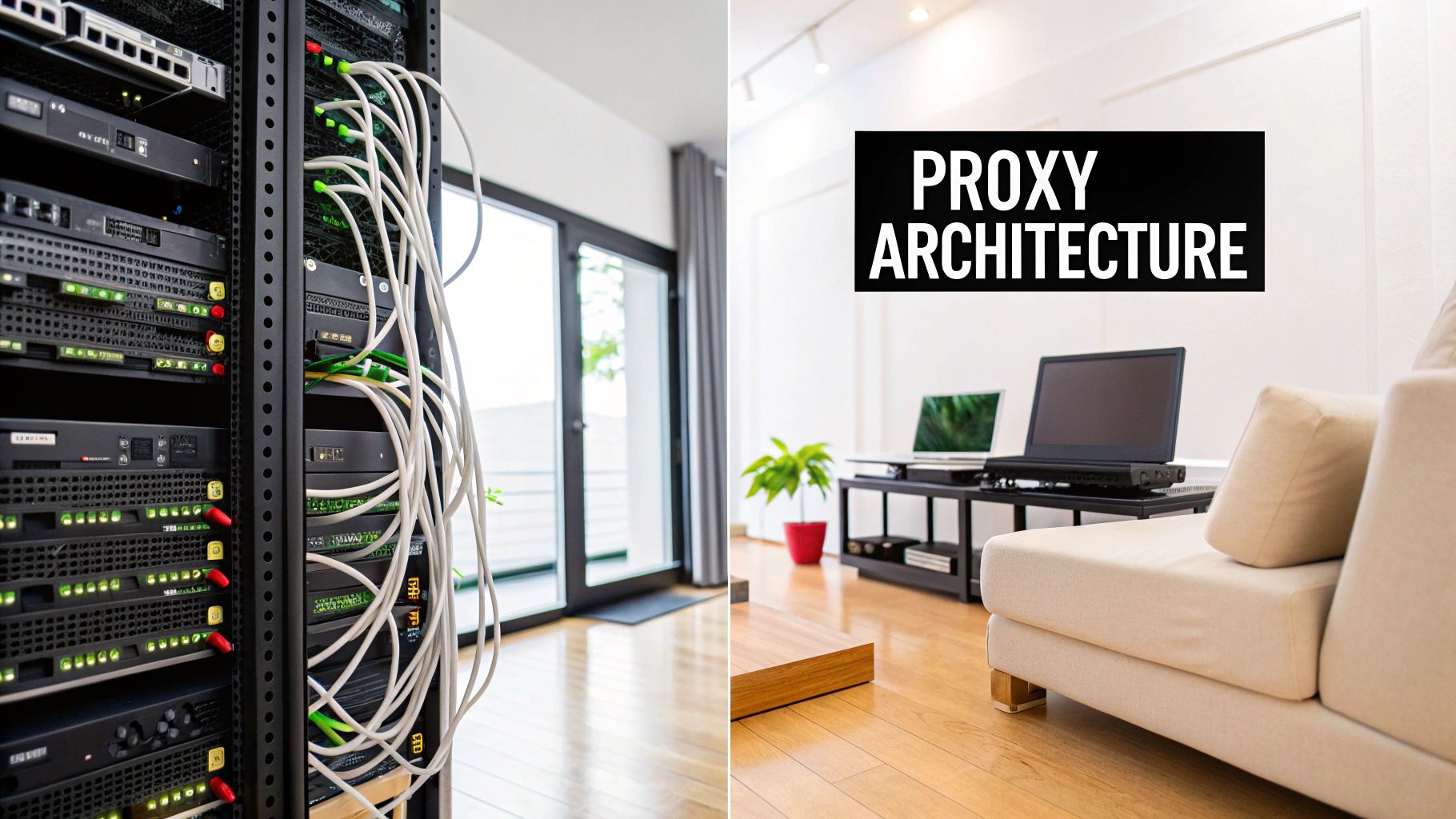
The secret to an ISP proxy's speed and reliability is right there in its structure. Think of it as the best of both worlds, rolled into one powerful package.
The Anatomy of an ISP Proxy
ISP proxies live on high-performance servers inside commercial-grade data centers. This is where they get their blistering speed, huge bandwidth, and rock-solid uptime—often backed by a 99.9% SLA. But here’s the crucial part: the IP addresses themselves are officially registered with and assigned by major Internet Service Providers (ISPs).
So, while the hardware is in a data center, the IP address looks like a premium, legitimate connection from a well-known carrier. This unique setup gives you two massive advantages:
Raw Performance: Being plugged directly into the internet's backbone inside a data center means minimal latency and no bandwidth throttling.
High Trust: An ISP-assigned IP address has way more street cred than a generic data center IP, making it far less likely to get flagged right out of the gate.
An ISP proxy gives you the raw horsepower of a data center server but cloaks it with the legitimacy of an ISP-registered address. It's a killer combination for any job where performance is king.
What you end up with is a static, highly dependable IP address that you have complete control over. It’s perfect for any operation that needs a consistent online identity and an unwavering connection for long periods.
The Peer-to-Peer Nature of Residential Proxies
Residential proxies are a whole different beast. Forget centralized servers; these operate on a massive, sprawling peer-to-peer (P2P) network made up of real devices in real homes all over the world. When you connect through a residential proxy, your request is routed through someones's home Wi-Fi and out to the internet from their desktop or phone.
This is the magic behind their incredible anonymity. To a website, your traffic is completely indistinguishable from an everyday user browsing from their couch. It looks 100% organic, making it incredibly tough to spot and block.
But this decentralized approach comes with some obvious trade-offs:
Variable Performance: The speed and stability are at the mercy of the end-user's home internet connection, which can be unpredictable.
IP Rotation: Because people are constantly connecting and disconnecting their devices, the IPs naturally rotate. This makes holding a long, static session a challenge without specific configurations.
At its core, the choice between ISP and residential proxies boils down to this fundamental architectural difference. Do you need the controlled, centralized power of a data center, or the authentic, decentralized footprint of a P2P network? Getting this straight is key as we dig into performance, detection risks, and exactly which proxy to use for which job.
Analyzing Speed, Latency, and Reliability
When you're weighing ISP against residential proxies, performance metrics like speed, latency, and reliability are often the tie-breakers. These aren't just abstract numbers; they directly influence the success of your project, especially for tasks where every millisecond counts. The architectural differences between these two proxy types create a huge performance gap.
ISP proxies are built for one thing: raw, unadulterated speed. They live in Tier-1 data centers with direct lines to the internet's backbone. Picture it as a private, multi-lane highway for your data—no traffic jams, no slowdowns, just pure speed.
Residential proxies, on the other hand, route your traffic through someone's home internet connection. This path is full of variables—their internet plan, local network congestion, and even the performance of their device. It's the equivalent of navigating winding neighborhood streets instead of hitting that open highway.

The Latency and Throughput Divide
Latency, the tiny delay before a data transfer actually starts, is where ISP proxies really flex their muscles. Their data center home is engineered to slash this delay, giving you near-instantaneous response times. For any high-frequency task where immediate action is a must, this is non-negotiable.
Throughput, or how much data you can push through over time, is another clear win for ISP proxies. Providers like HypeProxies build their networks on a 10 Gbps fiber backbone with unlimited bandwidth. That means you can run massive data operations without ever worrying about speed caps or throttling, a common headache with other proxy types.
Residential proxies simply can't play in the same league. Their throughput is bottlenecked by the end-user's consumer-grade internet, which usually tops out between 10-100 Mbps. For any kind of bandwidth-heavy automation, this quickly becomes a major roadblock. You can check out our guide on proxy speed to get a deeper understanding of how these factors impact performance.
Recent industry benchmarks drive this point home. In early 2025 tests, ISP proxies clocked a stunning 3-4x speed advantage over their residential cousins. Average response times were 0.3-0.5 seconds for ISPs, while residential proxies lagged behind at 0.8-2.3 seconds. For data teams pushing billions of monthly requests, that difference is absolutely monumental.
Uptime and Connection Stability
Speed is great, but what about reliability? An unstable connection can bring an entire operation to a screeching halt, leading to lost data, missed opportunities, and wasted money.
ISP proxies are engineered for rock-solid uptime. They're housed in secure, climate-controlled data centers with redundant power and network links, offering unmatched stability. HypeProxies, for instance, provides a 99.9% uptime guarantee backed by an enterprise-grade SLA, ensuring your tasks run 24/7 without a hiccup.
Key Performance Insight: The stability of an ISP proxy comes from its controlled environment. Unlike a residential proxy, which depends on a user's device being online, an ISP proxy server is always on, always connected, and always performing at its peak.
Residential proxies are, by their very nature, far more volatile. Their availability is completely at the mercy of the end-user. If that person turns off their computer, resets their router, or just walks out of Wi-Fi range, your proxy connection dies instantly. While large residential networks try to fix this by rotating to a new IP, the inherent instability can kill any long-running task that needs a persistent session.
The contrast in reliability is stark. Benchmark tests show ISP proxies maintaining 99.2% uptime over 24-hour periods, whereas residential networks often struggle to stay above 87.5%. For marathon tasks like continuous SEO monitoring or market research crawls, that 12% difference in uptime is the gap between success and failure. For any project demanding unwavering connection stability, the choice is clear.
When we move past pure speed and start talking about stealth, everything changes. The ISP vs. residential proxy debate gets really interesting when you dig into anonymity and detection risk. Your success often hinges not just on how fast you can send a request, but on how convincingly your traffic blends in with everyday users.
This is where residential proxies shine. They are, quite simply, in their natural habitat. By routing your requests through real, consumer-grade internet connections—think your neighbor's Wi-Fi—they make your activity look completely organic. To a website's security system, a request from a residential IP is indistinguishable from someone browsing from their couch at home.
This built-in legitimacy is precisely why residential proxies have the lowest block rates in the game. They're the go-to solution for getting past platforms with heavy-duty anti-bot measures, like social media sites, sneaker drops, and ad verification networks.
The Residential Edge: Playing the Part of a Real User
The real magic of a residential proxy is its authenticity. The IP address belongs to an actual device on a home network, making it incredibly difficult for automated systems to flag it. This organic digital footprint is non-negotiable for tasks that demand a high level of trust.
Social Media Management: Trying to run multiple accounts without residential IPs is a fast track to getting banned. Platforms can easily spot and block entire blocks of data center IPs.
Ad Verification: If you need to check that ads are displaying correctly in a specific city, you have to look like a genuine local user. Only a residential IP can pull this off reliably.
Tough Web Scraping: Targets with sophisticated bot detection can pick up on patterns common to data centers, but residential traffic just slips by unnoticed.
The core value of a residential proxy is its ability to perfectly mimic human behavior. It doesn't just change your location; it takes on a completely legitimate digital identity. This makes it the clear winner for any job where getting blocked simply isn't an option.
Where Do ISP Proxies Fit in the Stealth Game?
So, how do ISP proxies stack up in the anonymity puzzle? While they can't offer the same level of camouflage as their residential cousins, they are far from easy to spot. A high-quality ISP proxy, like those from HypeProxies, uses clean, ISP-registered IP addresses that are hosted in data centers.
This hybrid approach gives them a huge leg up over standard data center proxies. Since the IP is officially tied to a known Internet Service Provider, it naturally carries a higher trust score. For a lot of websites, this is more than enough to cruise past basic security checks. You can get a better sense of how sites judge an IP's trustworthiness by understanding your IP score and what it means.
But, their data center origin is still their Achilles' heel. The most advanced anti-fraud systems can sometimes figure out that an entire block of IPs is coming from a single commercial server, not from thousands of different homes. This is called subnet detection. If one IP in that subnet gets flagged, the whole range can get banned as a precaution.
This makes the ISP vs. residential proxy decision a game of calculated risk. For tasks aimed at less strict targets or where raw speed is the top priority, the high trust score of an ISP proxy is often perfectly fine. But when you're dealing with the most heavily fortified websites, the peer-to-peer authenticity of a residential network provides a layer of security that ISP proxies just can't match.
Let's talk about the bottom line. When you're weighing ISP against residential proxies, money and the ability to grow your operations are often the deciding factors. The two proxy types are priced in fundamentally different ways, and getting a handle on this is crucial for picking a solution that won't break the bank as you scale up.
ISP proxies are almost always sold on a per-IP basis and come with unlimited bandwidth. This is a huge win for anyone who needs predictable, fixed monthly costs. You know exactly what you’re paying, no matter how much data you push through them.
Residential proxies, on the other hand, are typically priced by data consumption—you pay for every gigabyte (GB) you use. This can seem cheap for small, quick tasks, but the costs can get out of hand fast when you're running large-scale operations.
The Real Cost of a "Per-GB" Model
That "per-GB" pricing on residential proxies ties your monthly bill directly to how much work you're doing. If a project suddenly needs to scrape a million pages or download a ton of high-res images, your proxy costs are going to shoot through the roof. That kind of unpredictability can be a real headache for teams trying to stick to a budget.
This is where the unlimited bandwidth from ISP proxies, like the ones we offer at HypeProxies, completely changes the game. It breaks the link between your data usage and your bill, making it a much smarter financial choice for any data-heavy work.
Think about it for use cases like:
High-Volume Web Scraping: Pulling data from thousands of e-commerce listings or market data sites.
SEO Monitoring: Running non-stop crawls to keep tabs on keyword rankings and site performance.
Intensive Data Research: Grabbing large datasets, images, or even video content for analysis.
For jobs like these, an ISP proxy plan gives you financial peace of mind. No more worrying about surprise overage fees eating into your profits.
A Quick Cost-Benefit Reality Check: Think of an ISP proxy's fixed cost as a strategic investment in your ability to scale. It lets you ramp up your operations aggressively without your proxy bill doing the same, clearing the path for a much better return on your data projects.
Scaling Your Work Without Scaling Your Bill
Scaling isn't just about handling more traffic; it's about doing it without your costs spiraling out of control. The pricing models for ISP and residential proxies create two very different paths for growth. With residential proxies, scaling up means your costs go up with every single gigabyte.
This effectively puts a financial brake on your growth. You might find yourself hesitating to expand a data collection project simply because the proxy costs would become too high. ISP proxies just obliterate that barrier. Since your bandwidth is unlimited, you can add more tasks, spin up more concurrent threads, and process mountains of data without your proxy bill budging an inch. At HypeProxies, we take this even further by offering unlimited threads and dedicated /24 subnets to make sure your expansion is totally seamless.
The wider market reflects this trade-off. While the residential proxy market is big—projected to hit USD 148 million by 2030—ISP proxies have carved out an essential niche for high-volume, performance-critical work. For businesses whose success hinges on acquiring massive amounts of data, the datacenter-grade benefits of an ISP proxy, like 99.99% uptime and uncapped bandwidth, simply offer better value and a more predictable way to scale. You can dig into more market growth projections and insights to see these trends for yourself.
Ultimately, when it comes to cost and scalability, the choice between ISP and residential proxies boils down to one thing: how much data do you plan to use? Your answer will point you to the right solution.
Matching the Right Proxy to Your Use Case
Alright, let's move from the technical specs to the real world. Deciding between an ISP and a residential proxy isn't just about picking features; it's about matching the right tool to the job you need done. Your choice here directly impacts your success rate, costs, and whether you fly under the radar or get blocked instantly.
For some jobs, speed is everything. We're talking about high-stakes, time-sensitive tasks where every millisecond counts. In these scenarios, the raw, unfiltered performance of an ISP proxy is your only real option. On the flip side, if your operation requires you to blend in and look like a regular user to avoid sophisticated detection, only the authenticity of a residential IP will do.
This decision tree breaks down the core trade-off: are you chasing lightning-fast execution, or do you need undetectable anonymity?
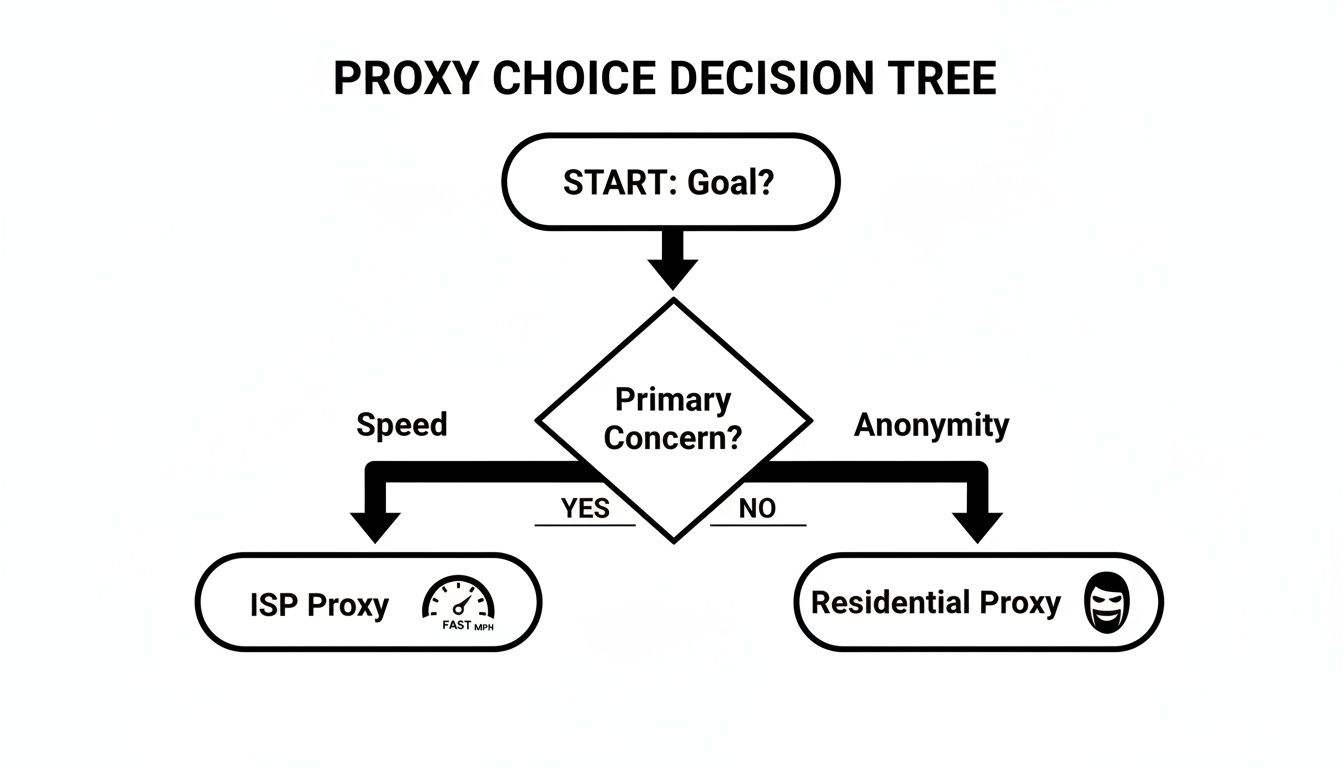
As you can see, the path is pretty clear. If speed is your game, ISP proxies are the way to go. If you need to stay invisible, residential proxies are your best bet.
When Speed Is Non-Negotiable
In a head-to-head sprint, ISP proxies leave residential proxies in the dust. For any application where latency is the enemy, there's no contest. Shaving off milliseconds isn't a luxury; it's the difference between winning and losing.
Sneaker Copping and Ticketing: Think about limited-edition drops or concert tickets for a huge artist—they sell out in seconds. The sub-millisecond latency of an ISP proxy gives your bot the edge it needs to blast through checkout before anyone else. A residential proxy, with its more variable speed, is just too big of a gamble.
Large-Scale Data Collection: If your goal is to hoover up massive public datasets as fast as possible, ISP proxies are built for the job. You get unlimited bandwidth and consistently high speeds, letting you run intense scraping jobs without ever hitting a data cap or getting throttled.
When Anonymity Is Everything
For any task where getting detected means game over, you need the genuine footprint of a residential proxy. These IPs make your traffic look completely organic, letting you operate on platforms that have seriously aggressive anti-bot systems.
Key Insight: The fundamental difference lies in your interaction with the target. If you need to hit a site hard and fast for public data, choose ISP. If you need to mimic a genuine user to maintain access, choose residential.
Social Media Account Management: Trying to run multiple accounts on platforms like Instagram or Facebook from one machine is a huge red flag. Residential proxies make each account appear as a unique user from a different home, drastically cutting your risk of getting banned.
Ad Verification: To check if ads are displaying correctly for a specific audience, you have to look like a real user from that exact location. A residential proxy with precise geo-targeting is the only way to pull this off and verify ad delivery without setting off alarms.
Navigating the Gray Areas
Of course, some jobs aren't so black and white. They fall into a middle ground where either proxy could work, but one usually offers a better balance of performance and reliability for that specific task.
SEO Monitoring: While residential proxies are great for checking localized rankings, monitoring hundreds of keywords or crawling entire sites is far more efficient with ISP proxies. Their rock-solid stability ensures your long-running tasks finish without a hitch, giving you more consistent data.
Price Aggregation: Scraping e-commerce sites is a classic use case. For smaller, less protected sites, the speed of an ISP proxy is perfect. But if you're going up against a fortress like Amazon, you'll need a residential proxy to avoid their anti-scraping measures.
To make this even clearer, here's a quick reference table matching common tasks to the best proxy type.
Recommended Proxy Type by Use Case
This table provides a straightforward guide to help you select the optimal proxy based on what you're trying to accomplish.
Use Case | Recommended Proxy | Primary Reason |
|---|---|---|
Sneaker Copping | ISP Proxy | Speed. You need the lowest possible latency to beat competitors. |
Ad Verification | Residential Proxy | Authenticity. Must mimic a real user from a specific location. |
Social Media Automation | Residential Proxy | Anonymity. Avoids account linking and bans by appearing as unique users. |
Large-Scale Web Scraping | ISP Proxy | Performance. Unlimited bandwidth and high throughput for massive data jobs. |
SEO Rank Tracking | ISP Proxy | Stability. Consistent connections are vital for reliable, long-term monitoring. |
E-commerce Price Scraping | Both (Situational) | ISP for speed on simple sites; Residential for avoiding blocks on complex sites. |
Market Research | Residential Proxy | Geo-Targeting. Accurately gather localized data by appearing as a local user. |
Ultimately, choosing the right tool for the job is the most important step. By thinking carefully about your project's specific needs—speed, stability, and anonymity—you can confidently pick the proxy that will get you the best results.
Frequently Asked Questions
When you're digging into the world of proxies, a few practical questions always seem to pop up. Let's clear the air on some of the most common ones.
Can You Use Both ISP and Residential Proxies Together?
Not only can you, but you probably should if your project has multiple stages. A hybrid strategy is one of the smartest ways to work, letting you play to the strengths of each proxy type exactly when you need them.
Imagine a huge e-commerce scraping job. You could blast through the initial data gathering—pulling thousands of product links—using speedy ISP proxies. Then, when it's time to hit individual product pages guarded by tougher security, you switch over to residential proxies to blend in and avoid blocks. It's the best of both worlds: speed upfront, stealth when it counts.
Are Residential Proxies Legal and Ethical?
This is a big one, and rightly so. The short answer is yes, ethically sourced residential proxies are completely legal. A legitimate provider will always have explicit, informed consent from the person whose IP address is being used. They know their connection is part of a proxy network and have agreed to it.
The trouble comes from shady operators who build their networks through malware or by tricking users with confusing app permissions. That’s why it's so important to partner with a provider who is totally transparent about how they source their IPs. Your operations are only as ethical as the network you're using.
The ethical line is clear: a legitimate residential proxy network is built on the informed consent of every participant. Always verify your provider's sourcing policies before committing.
Which Proxy Is Better for Beginners?
If you're just getting your feet wet, ISP proxies are generally the easier starting point. They give you a static, stable IP that's pretty much "set it and forget it." You configure it once, and it just works, holding a consistent session without you having to worry about the complexities of rotation.
Residential proxies can be a bit more to handle for a newcomer. With IPs that change on their own and billing often tied to data usage, there are more moving parts to manage. Kicking things off with the straightforward reliability of an ISP proxy is a great way to learn the ropes.
How Do I Choose Between Rotating and Static IPs?
This decision comes down to one thing: what does your task need to succeed?
Rotating IPs (Common with Residential): You'll want these when you're firing off a ton of requests at one target and can't risk being tracked. Every request looks like it's from a brand-new user, which is perfect for massive scraping runs or checking ad placements across different regions.
Static IPs (Standard for ISP): Go with these when you absolutely need to maintain the same identity. This is non-negotiable for things like managing a social media account or any other task where logging in from a new IP every time would get you flagged immediately.
Ready to harness the speed and stability of premium proxies for your projects? At HypeProxies, we offer enterprise-grade ISP and residential proxy solutions designed for performance and reliability at any scale. Explore our flexible plans and see the difference a high-quality network can make. Find your perfect proxy solution at HypeProxies today.
Share on

$1 one-time verification. Unlock your trial today.
Stay in the loop
Subscribe to our newsletter for the latest updates, product news, and more.
No spam. Unsubscribe at anytime.

![Sticky vs Rotating Proxies: When Each Type Actually Matters [2026]](https://framerusercontent.com/images/niUCJcnGDYczz6ugAbYodpK0kg.png?width=3840&height=2160)