Datacenter Proxies vs Residential Proxies The Definitive Guide
At its core, the difference between datacenter and residential proxies boils down to a simple trade-off: speed versus legitimacy. Datacenter and ISP proxies give you raw, unfiltered performance for high-volume jobs where every millisecond counts. On the other hand, residential proxies deliver the stealth and high success rates needed to bypass sophisticated security. The right choice isn't about which is "better"—it's about whether your mission needs speed or stealth.

Hype Proxies
Last updated -
Jan 26, 2026
Why Hype Proxies
A Strategic Guide to Proxy Selection
Picking the right proxy is less about finding a silver bullet and more about matching the tool to the task. With the proxy market projected to hit over $15 billion by 2033, the demand for automated data collection is exploding. But making the wrong choice here is costly. It leads to failed requests, wasted money, and a ton of operational headaches. The first step to making a smart decision is understanding where these proxies actually come from.
This guide will break down the real-world trade-offs between speed, anonymity, scale, and budget. We're going to shift the conversation from "which proxy wins" to "which proxy is right for your use case."
The Core Architectural Difference
The main distinction comes down to the origin of the IP address. This single factor dictates everything—its performance, its cost, and how it’s perceived by the websites you’re targeting.
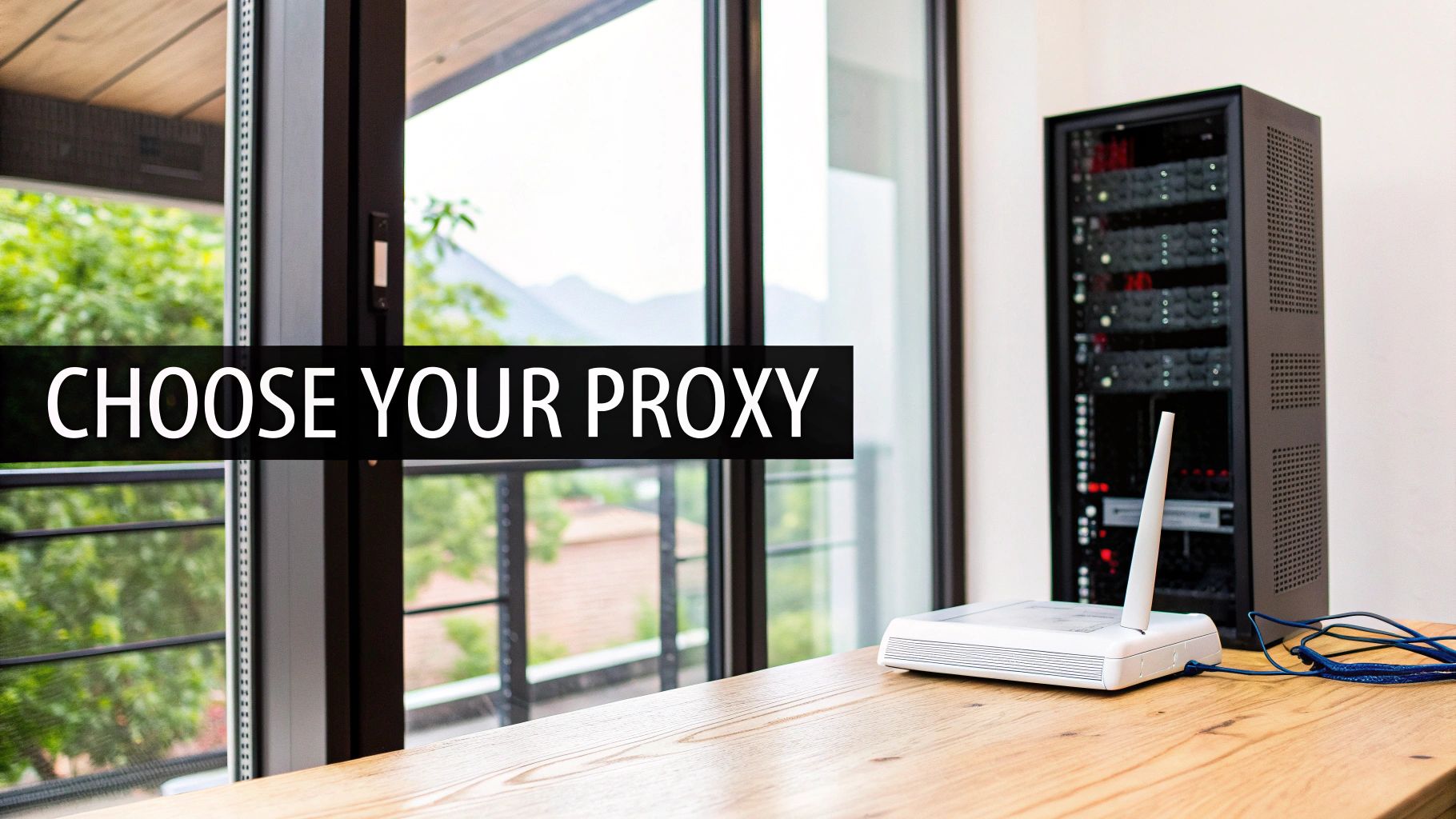
Datacenter Proxies: These IPs don't belong to a home internet connection. They are created and hosted in commercial data centers, owned by cloud giants, not consumer Internet Service Providers (ISPs). Because they aren't tied to real user devices, they’re much easier for websites to spot and flag.
Residential Proxies: These are the real deal. They are genuine IP addresses assigned by ISPs like Verizon or Comcast directly to homeowners. When your traffic is routed through one, it looks like it’s coming from a regular person's laptop or phone, giving it a very high "trust score" with web servers.
ISP Proxies: This is the hybrid that bridges the gap. ISP proxies are housed in blazing-fast data centers but use static IPs registered under legitimate consumer ISPs. You get the speed of a datacenter with the legitimacy of a residential IP.
Key Takeaway: Datacenter IPs are manufactured in server farms, while residential IPs belong to actual home internet connections. This one difference is the root of every pro and con in the datacenter proxies vs residential debate.
For more deep dives into proxy solutions and how they're being used, you can explore more proxy insights. The table below gives you a quick rundown of these core types.
Feature | Datacenter Proxies | Residential Proxies | ISP Proxies |
|---|---|---|---|
IP Source | Commercial Data Centers | Home Internet Connections | Data Centers (ISP-Registered) |
Primary Advantage | Speed & Low Cost | Legitimacy & Low Detection | Speed & Legitimacy |
Typical Use Case | Bulk Data Scraping | E-commerce, Social Media | Account Management, Sneaker Bots |
Detection Risk | Higher | Very Low | Low |
Understanding IP Origins and Architecture
To really get the datacenter vs. residential proxy debate, you first have to know where the IPs actually come from. The source of an IP is the single biggest factor that dictates its speed, how easily it gets blocked, and whether it’s the right tool for your job. The core difference isn't what they do, but where they're born.
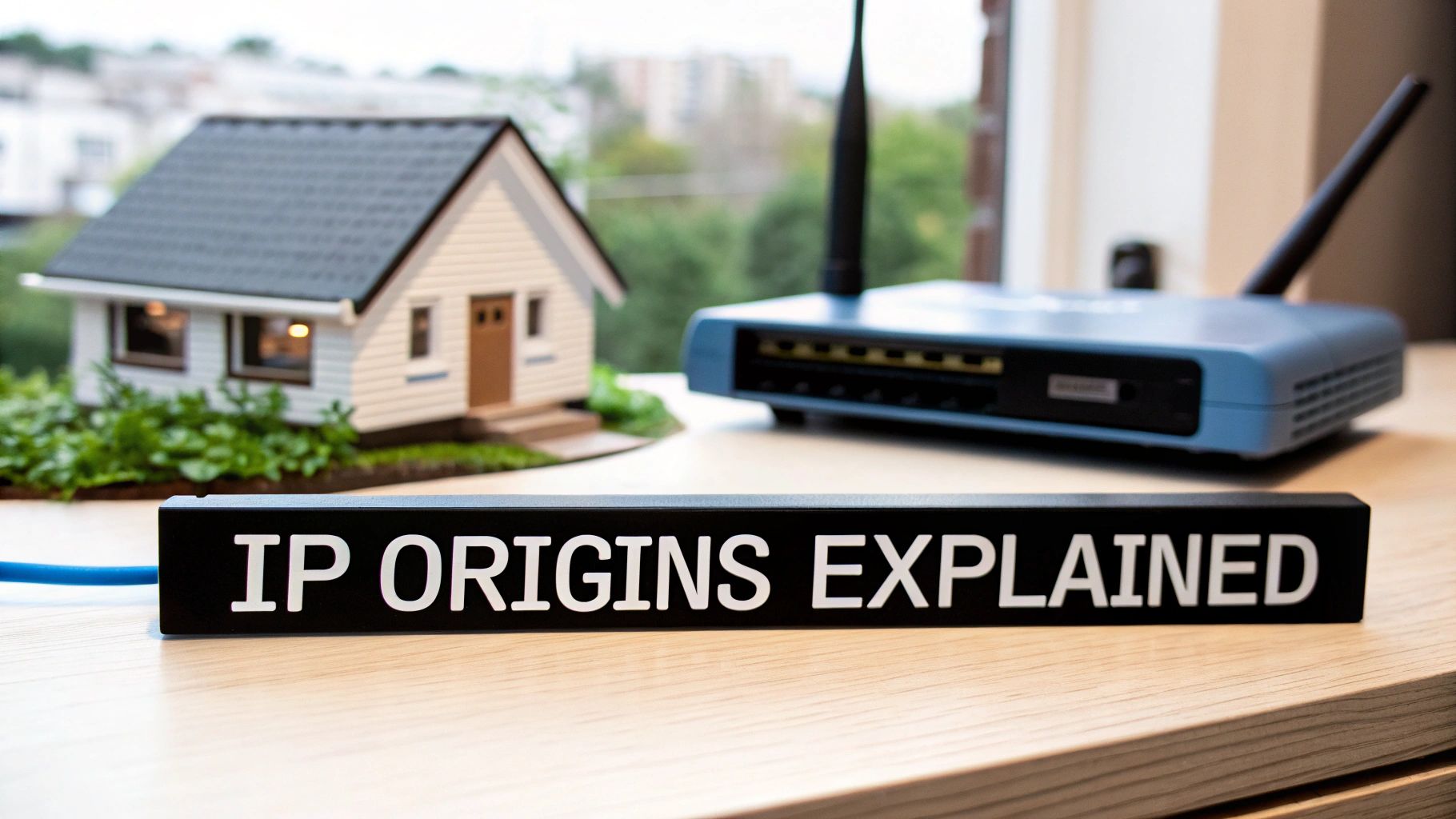
Datacenter proxies are just what the name suggests—IPs that live on servers inside commercial data centers. These are mass-produced by cloud hosting companies and have no connection to consumer Internet Service Providers (ISPs).
Because they’re created in big, sequential blocks from known commercial server farms, advanced security systems can spot them a mile away. A website’s firewall can instantly see the traffic isn't from a normal home internet connection, which immediately raises a red flag.
Residential Proxies: The Genuine Article
Residential proxies work on a totally different principle. These are 100% legitimate IP addresses assigned by an ISP—think Comcast, Verizon, or AT&T—to a real home. When you use a residential proxy, your request is literally routed through a real person's device connected to their home Wi-Fi.
This architecture gives residential proxies an incredibly high "trust score." To a target website, your traffic looks like it's coming from an everyday user, making it extremely difficult to detect or block. This is why they're the gold standard for any task that needs a high success rate against tough targets.
The Critical Distinction: A datacenter IP is commercially manufactured and lives on a server, while a residential IP is assigned to a physical home address. This origin story dictates how a website perceives and treats your connection.
ISP Proxies: The Hybrid Powerhouse
There's a third, crucial player in this game: the ISP proxy. Often called static residential proxies, these IPs are a brilliant hybrid. They are physically hosted on screaming-fast data center servers but are officially registered under legitimate consumer ISPs.
This unique setup gives you the best of both worlds. You get the raw speed and uptime of a datacenter connection but with the high trust and legitimacy of an ISP-assigned IP. For a deeper dive, check out our full guide on the differences between ISP and residential proxies.
This trio of architectures offers a spectrum of solutions for different needs:
Datacenter IPs: Best for high-volume, low-security tasks where speed and cost are everything.
Residential IPs: Absolutely essential for hitting sensitive targets, guaranteeing high success rates, and perfectly mimicking real user behavior.
ISP IPs: The premium choice for operations that demand both top-tier speed and a low ban risk, like managing high-value social or e-commerce accounts.
Grasping these fundamental differences is your first step toward building a smart, resilient, and cost-effective operation. Each proxy type has its place, and matching the right one to your project is the key to winning.
Analyzing Performance: Speed, Latency, and Scale
When you get down to the brass tacks of datacenter vs. residential proxies, performance is where the rubber really meets the road. We're not just talking about sterile tech specs; we're talking about speed, latency, and your ability to scale. These factors will make or break your project, dictating how fast you can work and how well your setup holds up under pressure.
Datacenter and ISP proxies are built for one thing: raw, unadulterated power. Think of them as high-performance engines. They live inside facilities with screaming fast 10 Gbps fiber networks, which translates to incredible speeds and next-to-zero latency. This kind of architecture is tailor-made for high-frequency, time-sensitive jobs where every millisecond counts.
For anyone in the sneaker copping game or running high-volume data harvests, that sub-millisecond latency is a massive competitive edge. It's the difference between winning and losing. This raw power lets you throw a huge number of requests at a target in a very short time without the connection even breaking a sweat.
The Trade-Off Between Raw Speed and Reliability
Of course, there's always a trade-off. While datacenter proxies are speed demons, that very strength is tied to their biggest weakness: legitimacy. Their high performance can be offset by a higher chance of getting flagged on more sophisticated websites, which can hurt your overall success rate.
Residential proxies play a completely different ballgame. Since they channel your traffic through actual home internet connections, their speed and latency are naturally more variable. Performance depends entirely on the end-user's local network, which could be anything from a blazing fiber line to a spotty Wi-Fi signal.
Key Insight: This is the core dilemma you face. Do you go for the consistent, high-octane speed of a datacenter proxy, or the variable but incredibly authentic connection of a residential proxy? The answer hinges on how sensitive your target is to being detected.
This is where the nuances of the datacenter proxies vs residential debate really come into play. For many jobs, a slight increase in latency from a residential proxy is a tiny price to pay for a nearly perfect success rate. It helps you avoid the hidden costs of failed requests, retries, and blocked IPs. When you're dealing with performance, understanding why data latency matters is key to picking the right tool for the job.
A Data-Driven Performance Comparison
Let's be clear: the performance gap isn't small. Speed is where datacenter proxies really flex their muscles, often outperforming their residential cousins by a massive 3-4x factor—all thanks to that enterprise-grade infrastructure. Their throughput can easily push 100 Mbps to 1 Gbps, a world away from the more modest 10-100 Mbps you'll see with most residential connections.
But here’s their Achilles' heel: detection. On heavily protected sites, success rates can drop to a frustrating 40-60%. Meanwhile, residential proxies cruise along with a stellar 95-99% success rate simply because they blend in perfectly with normal user traffic.
This is exactly why ISP proxies have become such a powerful middle ground. They give you the best of both worlds: the high-speed, low-latency performance of a datacenter environment, but with the trusted, legitimate IP address of a real Internet Service Provider. If you want to squeeze every last drop of performance out of your setup, check out our guide on how to improve your proxy speed.
To make it even clearer, here's a quick breakdown of the key performance differences:
Performance Metric | Datacenter Proxies | Residential Proxies | ISP Proxies |
|---|---|---|---|
Typical Speed | Very High (100+ Mbps) | Variable (10-100 Mbps) | Very High (100+ Mbps) |
Latency | Very Low (<20ms) | Moderate (50-200ms+) | Very Low (<20ms) |
Bandwidth | Often Unlimited | Metered (per GB) | Often Unlimited |
Stability | Extremely High | Variable | Extremely High |
Best For | High-volume, time-critical tasks on low-security targets. | High-success-rate tasks on secure targets. | Speed-critical tasks requiring high legitimacy. |
Navigating Detection Risk and Success Rates
When you're running a high-stakes project, the only metric that truly matters isn't speed or price—it's the success rate. A blazing-fast proxy that gets instantly blocked is worthless. A cheap one that fails half the time will cost you more in the long run through failed tasks and engineering headaches. This is where the real battle in the datacenter proxies vs residential debate is fought, and it all comes down to the IP's origin.
Datacenter proxies, by their very nature, are born with a target on their backs. They come from commercial cloud servers, with IPs often assigned in big, sequential blocks. Modern anti-bot systems are incredibly good at spotting these patterns. When a website sees a wave of requests from a known commercial IP range, it's a simple call to flag and block the entire subnet.
This is their fundamental weakness. It means datacenter proxies often hit a brick wall against heavily protected targets like major e-commerce sites, social media platforms, or search engines. Their artificial origin makes them stick out like a sore thumb.
The Residential Advantage: Blending In to Win
Residential proxies boast near-perfect success rates for one simple reason: they look human. By routing your traffic through legitimate, ISP-assigned IP addresses from real homes, they blend seamlessly into the sea of organic user activity. To a website's security system, a request from a residential proxy is indistinguishable from one made by a person browsing from their couch.
This inherent legitimacy is their superpower. It's what lets them glide past CAPTCHAs, IP-based rate limits, and the complex bot detection algorithms that would stop a datacenter proxy dead in its tracks. The IP has a history and a "trust score" tied to a real place and a reputable ISP, making it far less likely to be blacklisted. An IP's reputation is everything, which is why checking your proxy's IP score gives you a great read on its quality.
The chart below highlights a key performance trade-off, which is often directly tied to this detection risk.
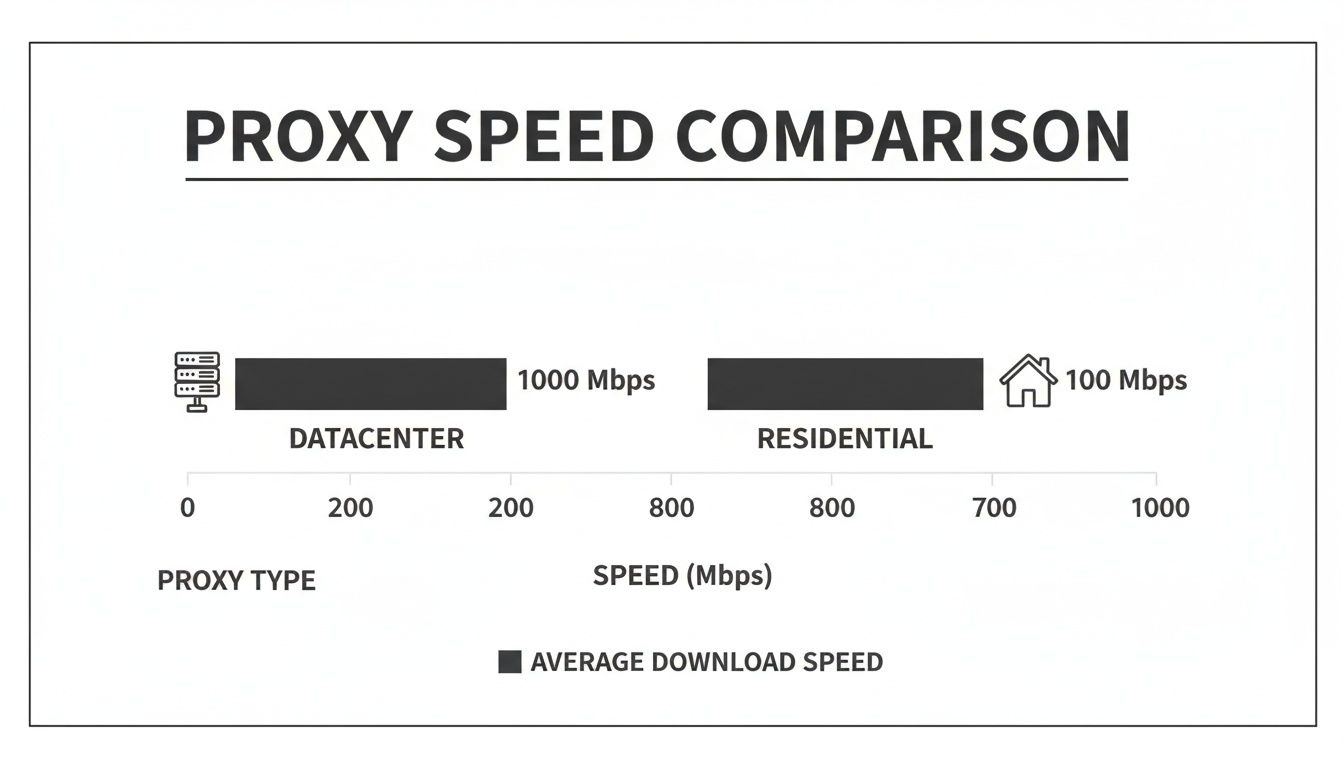
While datacenter proxies clearly win on raw speed, that power often comes at the price of getting flagged on the sites that matter most.
The ROI of a Higher Success Rate: Spending a bit more on high-quality residential or ISP proxies usually pays for itself. You slash the number of failed requests, ditch the need for complex retry logic, and free up your engineers from the endless cycle of managing blocked IPs.
Comparing Success Rates Across Different Targets
A proxy's effectiveness isn't universal; it depends entirely on the target's defenses. A datacenter proxy might work flawlessly for scraping an open government database but will fail spectacularly on a sneaker site during a high-demand drop.
The market reflects this reality. Residential proxies dominate the high-stakes game, capturing roughly 65-70% of the market for jobs like ad verification and scraping protected e-commerce sites. Datacenter proxies hold a solid 25-30% share, prized for their speed and cost on less-demanding tasks. The performance gap is stark: residential proxies can hit 85-95% success rates on heavily guarded platforms, while datacenter proxies often struggle to get past 20-40% on the very same targets.
To make this more concrete, the table below breaks down what you can realistically expect from each proxy type when targeting different kinds of websites.
Proxy Success Rate Comparison by Use Case
This table shows the typical success rates of Datacenter, ISP, and Residential proxies when targeting different types of websites, illustrating the trade-off between cost and reliability.
Target Website Type | Datacenter Proxy Success Rate | ISP Proxy Success Rate | Residential Proxy Success Rate |
|---|---|---|---|
Major E-commerce (e.g., Amazon, Walmart) | Low (20-40%) | High (85-95%) | Very High (95%+) |
Social Media Platforms | Very Low (10-30%) | High (90-98%) | Very High (98%+) |
Search Engine Scraping (e.g., Google) | Moderate (50-70%) | Very High (95-99%) | Very High (99%+) |
Sneaker & Retail Drops | Very Low (<20%) | High (80-95%) | Moderate-High (70-90%)* |
General Web Scraping (Low Security) | Very High (90-99%) | Very High (99%+) | Very High (99%+) |
*Residential proxies are highly successful but can be slower than ISP proxies, which is a disadvantage in time-sensitive drops.
The pattern is clear. The tougher the target's security, the more valuable a legitimate, ISP-backed IP address becomes. For any project where consistency and a high success rate are non-negotiable, residential and ISP proxies aren't just a better option—they're the only one that works.
Matching the Right Proxy to Your Use Case
All the technical specs and theory are great, but now it's time to make it practical. The differences in speed, architecture, and detection risk only mean something when you're trying to hit a specific goal. The "best" proxy isn't a one-size-fits-all solution; it’s a specialized tool you pick to solve a specific problem.
This is where we shift from comparing features to giving you a concrete game plan. Each common use case—from sneaker drops to scraping Amazon—throws a unique set of challenges at you. The key to building a successful and cost-effective operation is knowing exactly which proxy architecture to deploy against those challenges.

High-Stakes E-commerce and Sneaker Botting
In the cutthroat world of limited-edition drops, every millisecond counts. Success isn’t just about getting past security—it's about completing the checkout process faster than thousands of other people. This environment requires a killer combo of raw speed and high trust.
For these intense scenarios, ISP proxies are the undisputed champions. They give you the lightning-fast, sub-millisecond latency of a datacenter connection, which is absolutely critical for spamming checkout attempts. At the same time, they carry the full legitimacy of an ISP-registered IP, minimizing your chances of getting flagged by the sophisticated anti-bot systems on sites like Shopify or Nike.
Recommended Proxy: ISP Proxies
Why It Works: You get the insane speed of a server in a Tier-1 datacenter to beat competitors to the punch. Meanwhile, the ISP-registered IP address keeps you from getting blocked during the most critical moments of a drop.
Comprehensive SEO Monitoring
Good SEO analysis means looking at data from two completely different angles. First, you need to crawl massive amounts of pages for technical audits and backlink checks. Second, you have to check search engine results pages (SERPs) from very specific geographic locations to see what local rankings actually look like.
This dual need is a perfect fit for a hybrid strategy. For the bulk crawling where speed is everything and the targets are less fortified, datacenter proxies are a fantastic, budget-friendly option. But for pulling accurate, geo-targeted SERP data, residential proxies are non-negotiable. They let you see exactly what a real user in Chicago or London sees, cutting through all the personalization that search engines apply.
Strategic Insight: The smartest SEO operations never stick to just one proxy type. They route the high-volume, low-sensitivity crawling through cheaper datacenter IPs and save their premium residential IP pool for pinpoint-accurate, geo-specific SERP checks.
Social Media and Account Management
When you're managing multiple social media accounts, consistency and trust are everything. Platforms are hyper-sensitive to anything that looks like automation, and jumping between IPs is a massive red flag. One wrong move can get an account locked down fast.
The perfect tool for this job is a static residential IP. It provides a single, consistent, and trustworthy IP address assigned by a real internet service provider—and it never changes. From the platform's perspective, it just looks like the account is always being accessed from the same "home" connection. This builds a history of legitimate behavior and slashes the risk of triggering security alerts.
Large-Scale E-commerce Scraping
Scraping product data, prices, and reviews from giants like Amazon is a constant cat-and-mouse game against advanced anti-bot measures. These sites use complex fingerprinting and behavioral analysis to sniff out and block automated traffic. Your success depends entirely on your ability to perfectly mimic real shoppers.
For this kind of job, rotating residential proxies are the only way to go. By cycling through a massive pool of genuine, ISP-assigned home IP addresses, your requests blend in with the traffic from thousands of individual users. This constant rotation makes it nearly impossible for a site’s security to spot a pattern and block your scraper, ensuring you get a steady stream of clean data.
Here's a quick summary to help you match your task to the right proxy solution.
Use Case | Primary Challenge | Recommended Proxy Type | Key Benefit |
|---|---|---|---|
Sneaker Botting | Speed & Low Detection | ISP Proxies | Datacenter speed with residential legitimacy. |
SEO Monitoring | Bulk Crawling & Geo-Targeting | Hybrid (Datacenter & Residential) | Cost-efficiency for bulk and accuracy for local SERPs. |
Social Media Automation | Consistency & Trust | Static Residential IPs | A stable, trusted IP that avoids account flags. |
E-commerce Scraping | Bypassing Anti-Bot Systems | Rotating Residential Proxies | Blends in with real user traffic for high success rates. |
Finding the Right Proxy For Your Mission
So, how do you make the final call between datacenter and residential proxies? It boils down to one simple question: what are you trying to accomplish? Forget the spec sheets for a second. The best proxy isn't just the fastest or the most anonymous—it's the one that perfectly fits your specific goal.
Your choice is a balancing act between speed, stability, and scale. Each proxy type is built to win in a particular environment. The key is matching your needs with the right architecture to build a successful, high-performance operation.
A Goal-Oriented Decision Rubric
Instead of getting lost in endless pros and cons, let's simplify things. Use this goal-oriented rubric to make a clear decision. Just find your top priority on the list below, and the recommendation will point you straight to the right solution for your project.
This approach is designed to be direct and actionable, cutting through the noise to connect your objective with the right tool for the job.
Your Goal is Maximum Speed
If your operation is a race against the clock where every millisecond gives you an edge, the choice is simple. For things like copping sneakers or high-frequency data collection, where speed is the only metric that truly matters, nothing touches the raw performance of an IP hosted in a Tier-1 datacenter.
Your Solution is ISP Proxies: They deliver the sub-millisecond latency and unlimited bandwidth of a datacenter network but come with the legitimacy of an ISP-registered IP. This gets you the speed you need to win without the high detection risk that plagues traditional datacenter IPs.
Key Insight: When success is measured in fractions of a second, you have to prioritize an architecture built for raw speed. ISP proxies deliver that performance without sacrificing the IP quality you need to avoid getting instantly blocked on high-value targets.
Your Goal is Unwavering Stability
When you're managing valuable assets like social media profiles or e-commerce seller accounts, consistency is everything. Any little inconsistency in your IP address can trigger security alerts, leading to account locks or outright bans. You need an IP that’s not only legitimate but also completely stable for the long haul.
Your Solution is Static Residential IPs: These give you a single, unchanging IP address that comes directly from a real ISP. This consistency builds a trusted history, making your activity look completely natural and dramatically lowering the risk of detection for long-term account management.
Your Goal is Ultimate Control and Scale
For enterprise-level work that requires a massive, clean pool of IPs and total control over the network, standard proxy plans just won't cut it. When you need to manage a huge number of IPs without anyone else touching them, ensuring they stay pristine for your use only, a dedicated network is the only real answer.
Your Solution is a Dedicated /24 Subnet: This gives you an entire block of IPs for your exclusive use. You get unparalleled control, scale, and IP cleanliness, making it the definitive choice for large-scale web scraping and data intelligence where IP reputation is absolutely critical.
Got Questions? We've Got Answers
Even after breaking it all down, a few common questions always seem to surface in the datacenter proxies vs residential debate. Let's clear up the lingering details so you can move forward with total confidence.
Are Residential Proxies Legal and Ethical?
They absolutely are, but with a huge caveat: they must be sourced ethically. Legitimate providers operate on a foundation of explicit consent, meaning the person whose IP you're using knows and agrees to share their connection, often for compensation. Always, always vet your provider's sourcing policy. Sticking with a transparent company protects you from the serious legal and reputational fallout of using a shady, unethically built network.
Can I Use Both Datacenter and Residential Proxies Together?
Not only can you, but you probably should. This hybrid strategy is what the pros do. You can throw all your high-volume, low-sensitivity tasks at cheaper datacenter proxies. Then, you save your premium residential or ISP proxies for the high-value targets that demand near-perfect success rates. It's the smartest way to balance your budget without sacrificing performance.
Key Insight: The real game isn't about picking one proxy type and sticking with it. It’s about building a smart, flexible system that routes requests through the right network for the job, depending entirely on the target's defenses.
Which Proxy Is Best for Avoiding CAPTCHAs?
Hands down, residential proxies are significantly better at dodging CAPTCHAs. It all comes down to trust. Since these IPs originate from real user devices on legitimate home internet connections, websites see them as genuine human visitors. A connection that looks like a real person is far less likely to get hit with a challenge, meaning your automations run smoother with fewer frustrating interruptions.
Do I Need Rotating or Static IPs?
This one is completely dependent on your mission. There's no single right answer.
Rotating IPs are your best friend for large-scale scraping. By constantly cycling your IP address, you fly under the radar of rate limits and IP blocks.
Static IPs are non-negotiable for things like managing social media or e-commerce accounts. A consistent, unchanging IP builds trust with the platform and stops you from triggering security alerts every time you log in.
Ready to deploy the right proxy for your mission? HypeProxies offers elite ISP, static residential, and dedicated proxy solutions engineered for speed and success. Get the performance you need to win.
Share on

$1 one-time verification. Unlock your trial today.
Stay in the loop
Subscribe to our newsletter for the latest updates, product news, and more.
No spam. Unsubscribe at anytime.

![Sticky vs Rotating Proxies: When Each Type Actually Matters [2026]](https://framerusercontent.com/images/niUCJcnGDYczz6ugAbYodpK0kg.png?width=3840&height=2160)