7 Best Residential Proxy Provider in 2026
In this blog, we have listed down some of the best residential proxy providers available in market today. Before committing to any provider do test them out.

Gunnar
Last updated -
Why Hype Proxies

Every residential proxy provider claims to be "the best," largest pool, highest success rate, fastest speeds. The problem is that most of these claims are self-reported and untested at scale against your actual targets.
This comparison uses independent third-party benchmarks from Proxyway's 2025 testing, along with real success rates on protected sites and the technical details that matter in production: IP cleanliness, session stability, and bandwidth costs.
If you’re New to residential proxies. Start with our guide on how residential proxies work to understand what makes them different from datacenter and ISP proxies.
Below, you'll find 7 providers compared on pricing, pool quality, and real-world performance. Before committing to any provider, test them yourself.
Quick Comparison on All Residential Proxies
Provider | Pool Size | Locations | Entry Price | Proxyway Success Rate | Proxyway Avg Response | Good For |
Proxying | 10M+ | 190+ | $1.50/GB (promo, regular $5.00/GB) | Not yet tested | Not yet tested | Budget entry, non-expiring bandwidth |
Bright Data | 400M+ (per their site) | 195 | $8.00/GB ($4.00 promo) | 98.96% (2024) | 1.12s (2024) | Enterprise-scale operations |
Oxylabs | 175M+ | 195 | $6.00/GB | 99.90% | 0.65s | Highest success rate, advanced filtering |
Froxy | 120M+ | 200+ | $5.50/GB | Not yet tested | Not yet tested | Multi-type access, broadest geo-coverage |
Decodo (formerly Smartproxy) | 115M+ | 195+ | $3.00/GB (sub) | 99.86% | 0.63s | Fastest response, best value |
IPRoyal | 32M+ (34M+ per about page) | 195+ | $7.00/GB | 99.56% | 1.06s | Irregular usage, non-expiring bandwidth |
SOAX | 155M+ | 195+ | $3.60/GB | 99.73% | 0.90s | ASN-level geo-targeting |
Proxying
Best for: affordable residential proxies with no bandwidth expiration
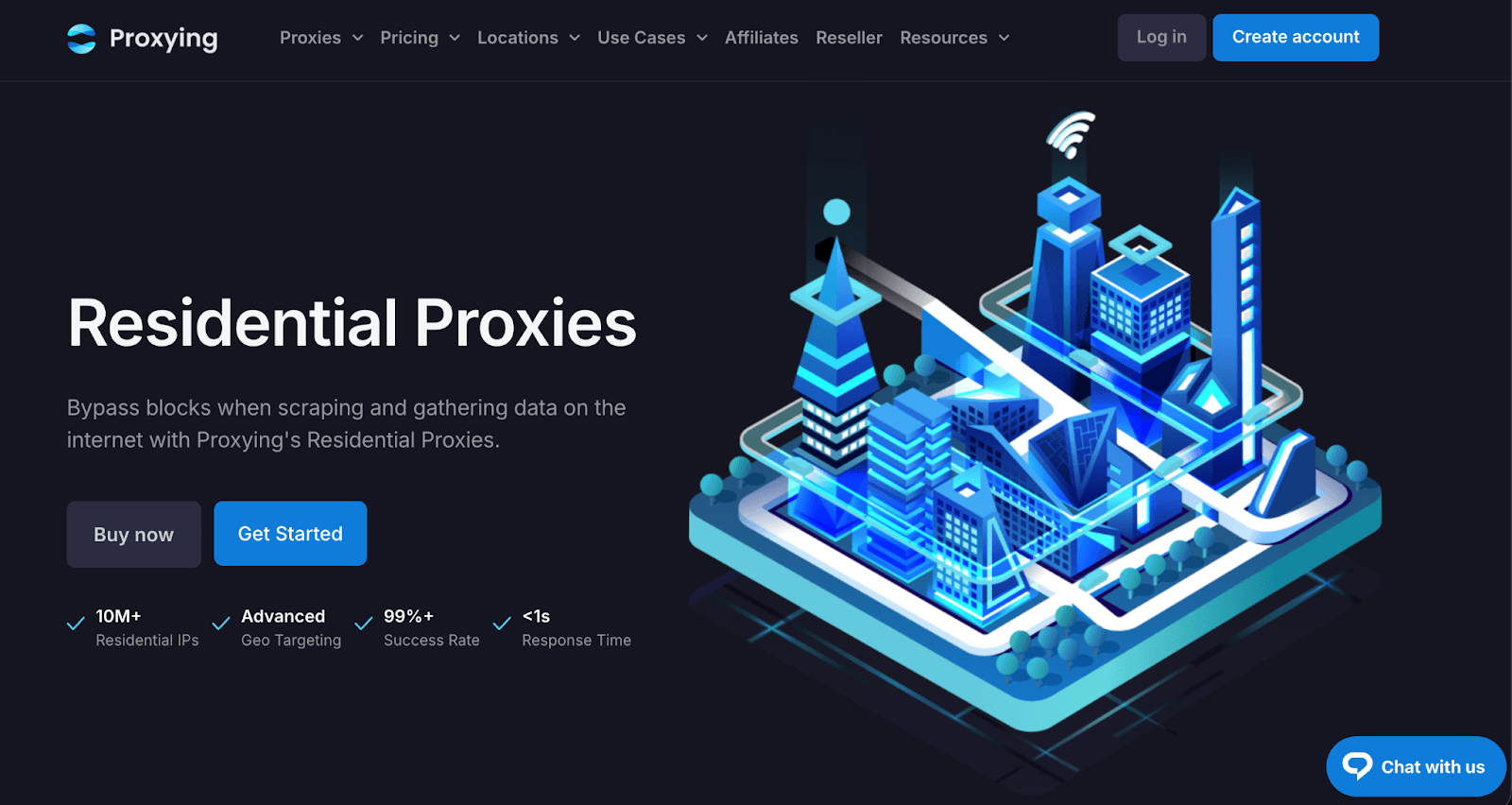
Proxying launched in 2023. Two features stand out on this list: the lowest entry price and non-expiring bandwidth. IPRoyal also offers non-expiring bandwidth – no other provider on this list does.
Pool size is listed as 10M+ IPs. Country-level targeting is available. City-level targeting is listed as coming soon on their residential proxies page.
The residential proxies page lists a 99%+ success rate and under 1s response time, both self-reported.
Pricing:
$1.50/GB promotional rate at time of research (regular price listed as $5/GB; some pages show $3/GB)
Custom pricing available for 1TB+/month
Pay-as-you-go; no subscription required
Free trial available – amount varies, confirm with their team
What stood out:
HTTP(S), SOCKS5, and UDP support
Rotating and sticky session modes. Rotation per request or configurable time to live (TTL) for sticky IPs
Network is opt-in, built through SDK partners under their integration guidelines
Where it falls short:
No independent benchmark data yet
Launched in 2023 – shorter track record than established providers on this list
No standalone documentation portal – integration guides are on product pages
No scraping API or browser automation tools
City-level targeting is not yet available
Best use cases: Web scraping on a budget, price monitoring, and search engine results page (SERP) tracking.
Bright Data
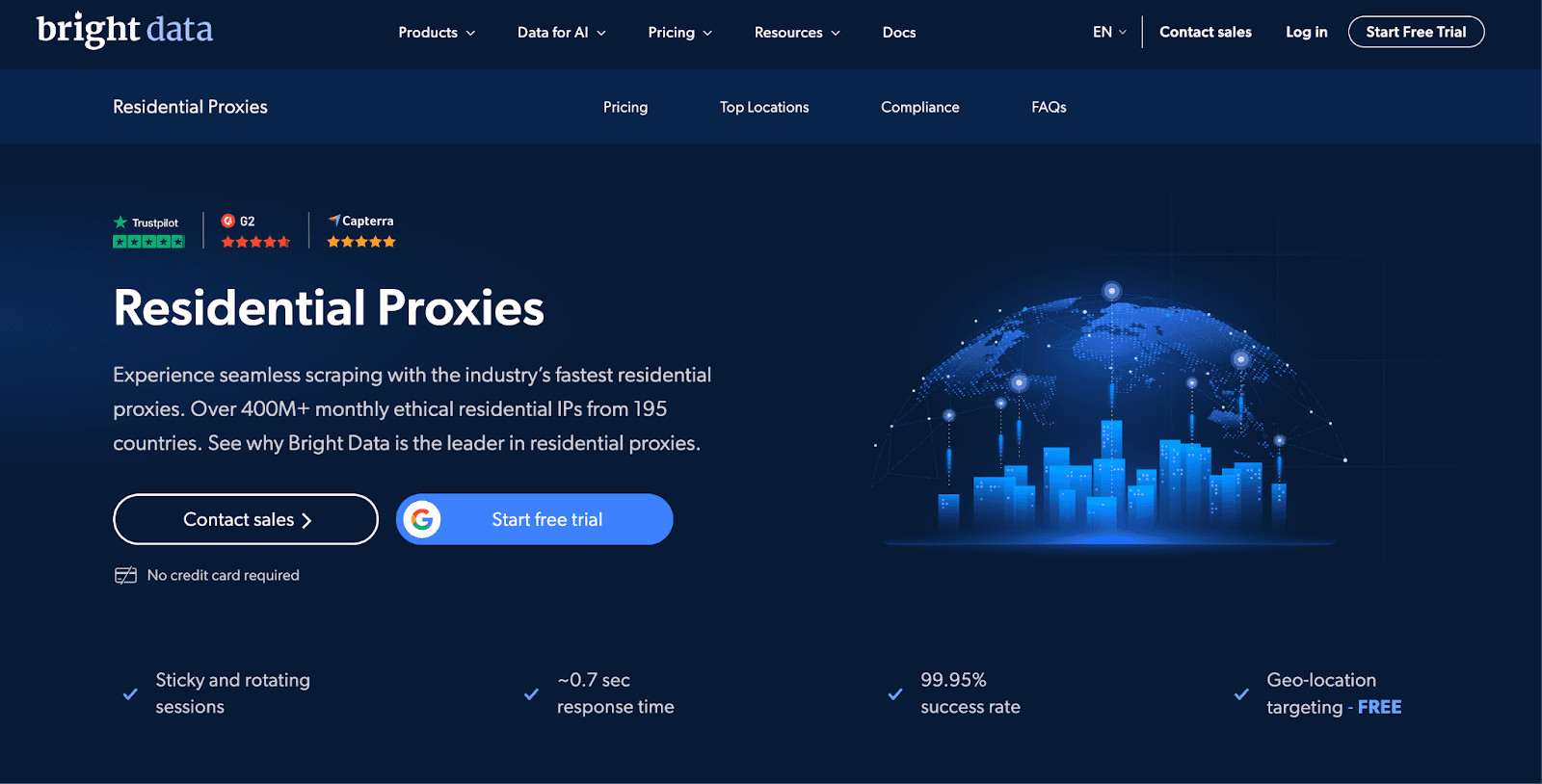
Best for: enterprise-scale data collection with the largest pool on this list
Bright Data launched in 2014 as Luminati Networks and rebranded in 2021. Their site claims the largest residential proxy pool on this list at 400M+ IPs across 195 countries. Their site reports over 20,000 customers including Fortune 500 companies. They also offer a Web Scraper API, Browser API with built-in CAPTCHA solving, and a Proxy Manager for routing and failover configuration.
Proxyway's 2024 benchmarks measured a 98.96% success rate across tested locations. Bright Data participated in Proxyway's 2025 research but withdrew before testing completed – 2024 data is used as reference. Their own site claims a 99.99% success rate.
Pricing:
At time of research, the pricing page showed a 50% promotional discount (code RESIGB50) for 3 months – verify current offers on their site. Standard prices and promo rates from that time are listed below:
Pay-as-you-go: $8.00/GB standard ($4.00/GB with promo)
Starter (141GB): $7.00/GB standard ($3.50/GB with promo, $499/month)
Professional (332GB): $6.00/GB standard ($3.00/GB with promo, $999/month)
Enterprise (798GB): $5.00/GB standard ($2.50/GB with promo, $1,999/month)
Custom pricing for 1TB+ (contact sales)
Deposit match: they match your first deposit dollar-for-dollar up to $500
Free trial available - check current offer on signup, trial traffic does not count toward your bill
What stood out:
400M+ residential IPs per their site – largest pool on this list
Geo-targeting down to country, city, state, ZIP code, and ASN level – included free on all plans
Full protocol support: HTTP(S), SOCKS5, and QUIC (HTTP/3)
IP whitelisting available through the Proxy Manager
ISO 27001, SOC 2, SOC 3, and CSA STAR certifications
99.99% uptime service-level agreement (SLA) with 24/7 engineer support and 15-minute priority support response per their site
Proxy Manager for advanced routing logic, waterfall rotations, and failover rules
Opt-in network – participants explicitly consent per their current policy
Where it falls short:
The Zones configuration system involves more initial setup than most providers on this list
Standard entry price of $8.00/GB ($4.00/GB with promo) is the highest on this list
Know Your Customer (KYC) verification is required before you can start using residential or mobile proxies
Proxyway noted performance has remained largely flat over recent years while some competitors have improved
Best use cases: Large-scale enterprise data collection, price intelligence platforms, ad verification at scale, and operations where compliance certifications are a procurement requirement.
Oxylabs
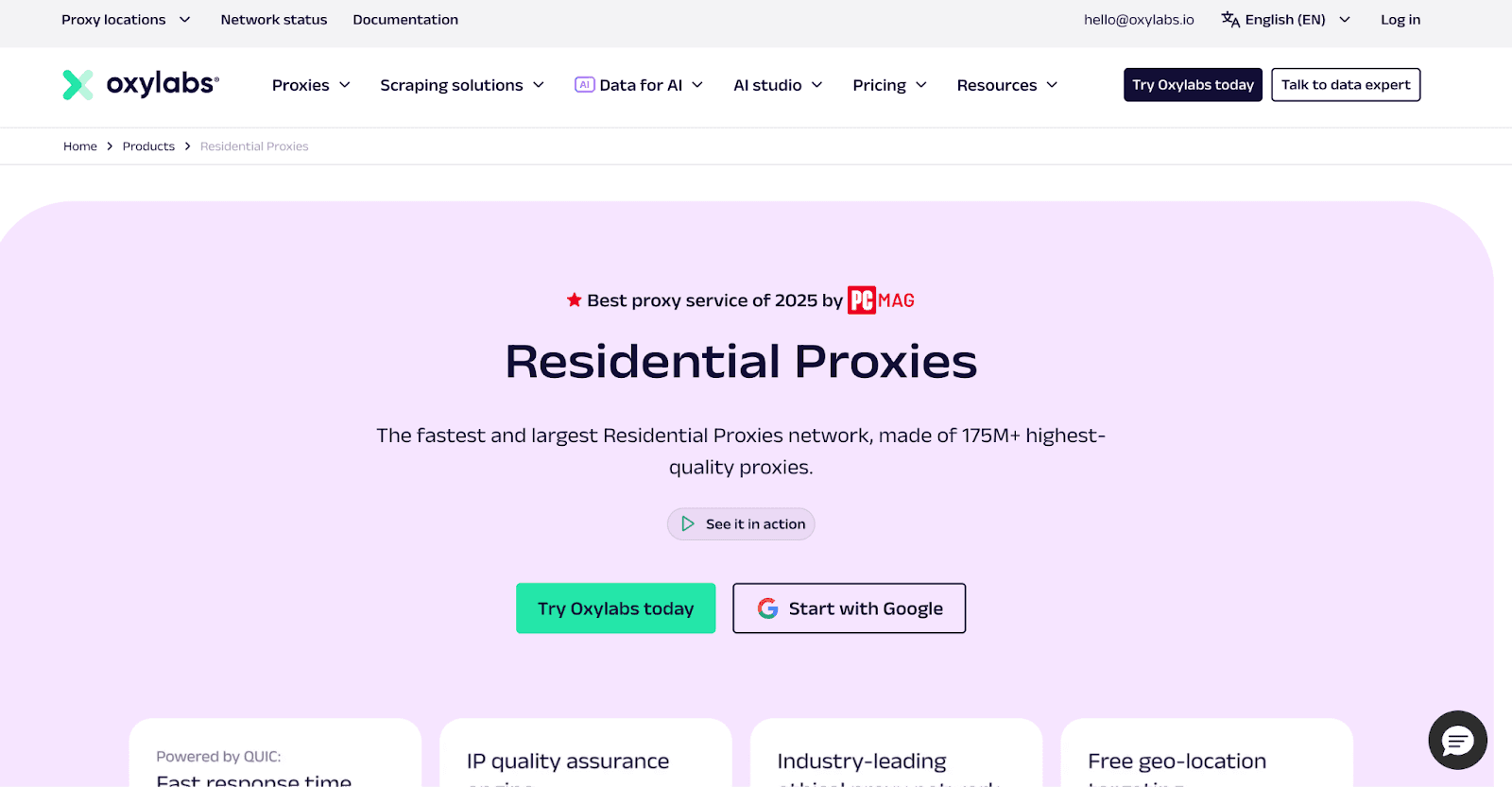
Best for: highest independent success rate and advanced proxy filtering
Proxyway measured Oxylabs at 99.82% success rate with 0.41-second response times in 2025.
Pricing:
Starter: $6/GB (5GB, $30/month)
Basic: $5/GB (20GB, $100/month)
Advanced: $4/GB (125GB, $500/month)
Corporate: $2.50/GB (1TB, $2,500/month)
No promotional pricing detected at time of research – verify current rates on their site
Free trial available once per account – requires contacting their team
What stood out:
Proxy filtering by latency, bandwidth, and IP scraping history
OS/platform filtering and IPv4/IPv6 selection available on all plans (enabling may require KYC verification)
Sticky sessions with configurable TTL up to 30 minutes
IP whitelisting – 10 IPs included on all plans
ISO/IEC 27001:2022 certified. SOC 2 Type 2 certified for select products – see their Trust Center for full scope
Ethical Web Data Collection Initiative (EWDCI) founding member and accredited
175M+ residential IPs across 195 countries
Where it falls short:
$6/GB for a 5GB starter plan is among the higher entry prices on this list
Monthly commitment required on all plans per the public pricing page – no self-service pay-as-you-go option visible
Free trial requires contacting their team - no instant self-service trial
Best use cases: Operations where the highest possible success rate matters (real-time pricing, inventory monitoring), competitive intelligence platforms, and SERP monitoring at scale.
Froxy
Best for: broad geo-coverage with multi-type proxy access under one account
Froxy operates a pool of 120M+ IPs across 200+ countries. What sets it apart is that residential, mobile, and datacenter proxies all run under a single account, so you can switch between proxy types within one workflow without changing providers.
Froxy does not appear in Proxyway's Proxy Market Research, so there is no independent success rate or response time to reference here; the details below are based on the provider's own documentation.
Pricing:
Residential proxies — from $5.50/month.
Mobile proxies — from $7.50/month.
Datacenter proxies — from $24/month (or from $0.96 per GB).
What stood out:
120M+ IPs across 200+ countries — the largest geo in this comparison.
Three proxy types under one account — residential, mobile, and datacenter, without switching providers mid-workflow.
HTTP(S) + SOCKS5 — full protocol support, unlike several competitors, limited to HTTP only.
Simultaneous connections — 1,000 ports for residential proxies, up to 600 ports for mobile and datacenter proxies.
Flexible rotation — 90 to 3600 seconds, adjustable per use case.
City and ISP-level geo-targeting — more granular than the country-level filtering.
Built-in Scraping API — SERP and e-commerce scraping tools included, no separate rotation setup required.
Where it falls short:
No independent benchmark data — Froxy doesn't appear in Proxyway's Proxy Market Research, making it hard to compare response times objectively.
No dedicated ISP proxy product — datacenter proxies serve the same function, but the positioning differs from what ISP proxy buyers typically look for.
Traffic-based billing on residential plans — worth calculating total cost against per-IP unlimited bandwidth models before committing to high-volume workloads.
Best use cases: broad geo-coverage with SOCKS5 support, mobile access, scraping via a built-in API, or workflows that require switching between proxy types within a single account.
Decodo (formerly Smartproxy)
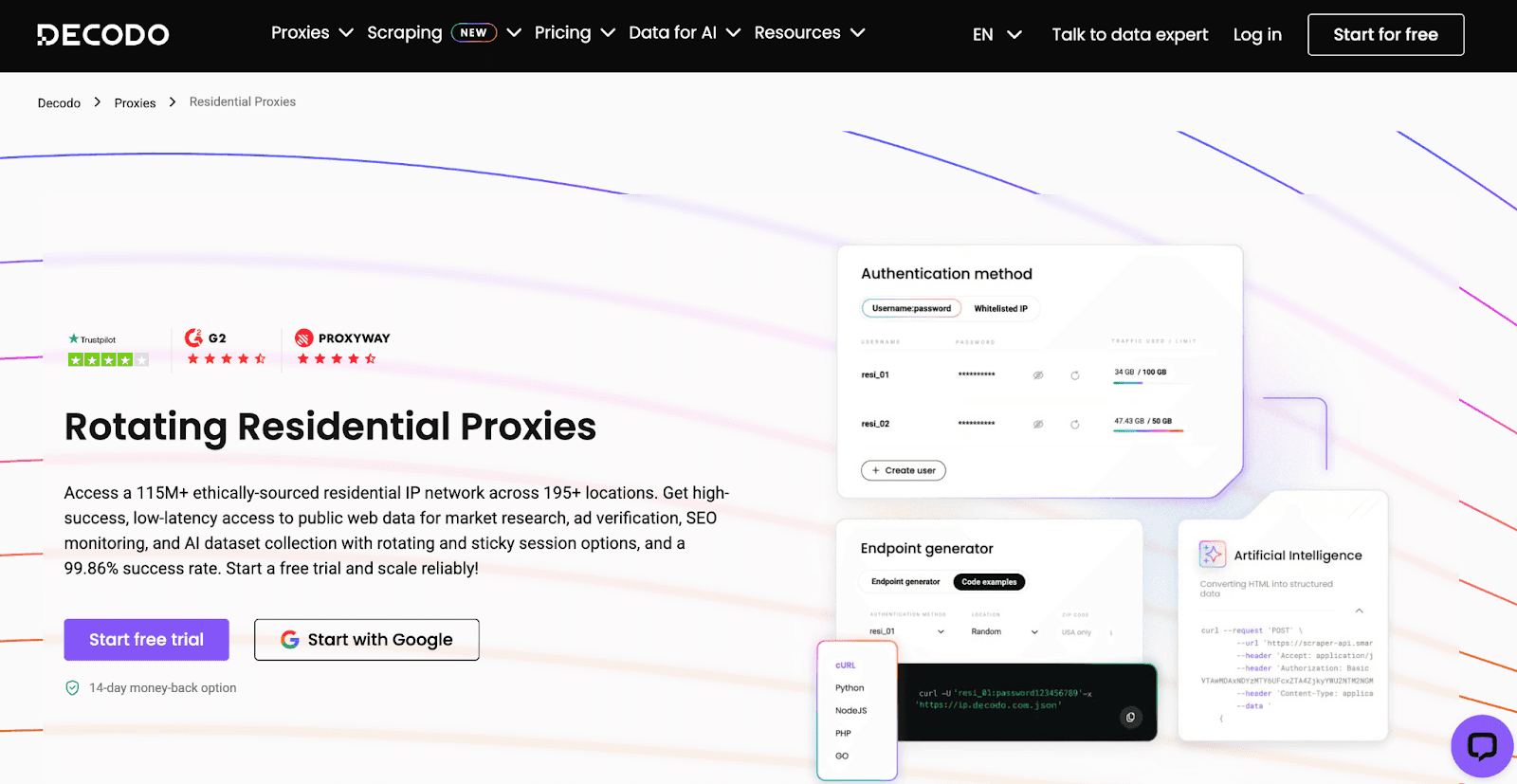
Best for: fastest response time with strong value
Smartproxy rebranded to Decodo in April 2025. The company was founded in 2018. Proxyway measured a 99.86% success rate with 0.63-second response times in 2025.
G2 recognized them for ease of use and onboarding experience – per their site. Proxyway named them Best Value Provider for the fourth consecutive year.
Pricing:
Subscription plans at time of research: $3.00/GB (5GB), scaling to $1.50/GB (1TB) – verify current rates on their site as pricing changes frequently
Pay-as-you-go available - price varies across their own pages ($3.50/GB, $4/GB, and $8.50/GB appear on different official sources). Confirm the current rate before committing
Enterprise plans with custom pricing and dedicated account manager
3-day free trial with 100MB
14-day money-back guarantee on first purchase (conditions apply)
What stood out:
99.86% success rate in Proxyway's 2025 independent testing
0.63s average response time in Proxyway's 2025 benchmarks
115M+ residential IPs across 195+ locations
Targeting by continent, country, city, state, ZIP code, and ASN – city/state/ZIP and ASN cannot be used simultaneously per their documentation
ISO/IEC 27001:2022 certified. Founding member of EWDCI
Where it falls short:
Pay-as-you-go price is inconsistent across their own official sources – verify before using for budget planning
14-day money-back guarantee has conditions – usage must stay under 20% (10% for enterprise), first purchase only, does not apply to free trial conversions
Best use cases: Mid-scale scraping operations, SEO agencies, eCommerce price monitoring, and any project where response time is a priority alongside cost.
IPRoyal
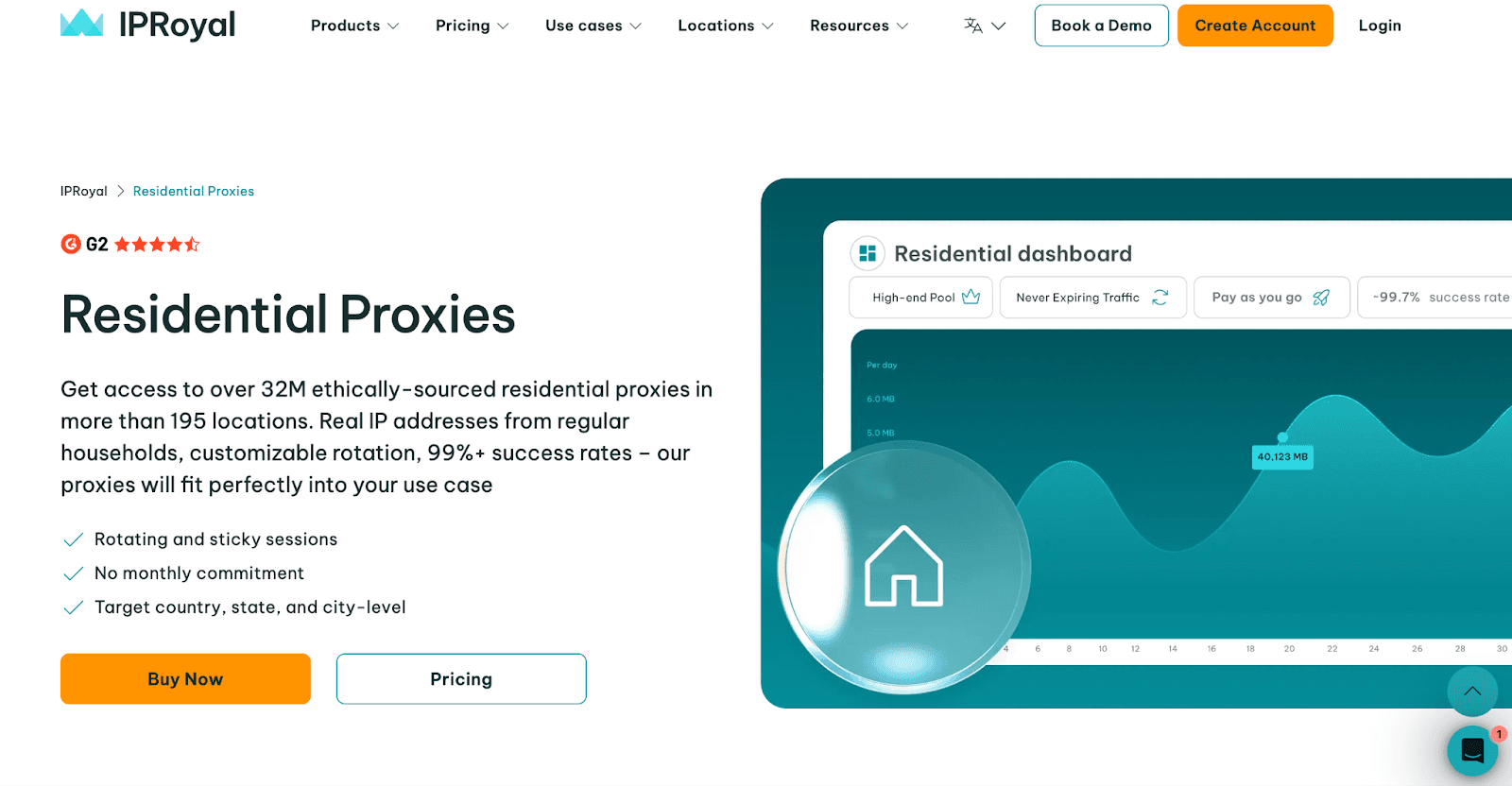
Best for: irregular usage patterns and very long sticky sessions
IPRoyal (founded 2020) targets users whose proxy usage does not follow a monthly pattern. Two differentiators: bandwidth that never expires and sticky sessions with a TTL of up to 7 days – the longest on this list.
Proxyway tested IPRoyal in their 2025 benchmark and measured a 99.56% global success rate with a 1.06-second response time.
Pricing:
Starts at $7.00/GB (subscription, includes 5% discount) and $7.35/GB (pay-as-you-go) at the lowest volume
Bulk pricing goes as low as $1.75/GB – exact volume threshold not publicly listed
No monthly commitment
Bandwidth never expires
Promotional pricing may be available – check their site for current offers
No money-back guarantee. Pay-as-you-go fees are non-refundable except for a narrow 24-hour technical fault window per their Terms of Service and refund policy FAQ
What stood out:
7-day sticky session TTL – the longest on this list
Rotation configurable per request or at 1, 10, or 30-minute intervals
32M+ residential IPs across 195+ countries per their product pages.
Where it falls short:
$7.00/GB entry price is among the higher entry prices on this list
Proxyway describes the pool as small relative to competitors and "seriously abused" – meaning a higher share of flagged or already-blocked IPs from shared usage
Proxyway's 2025 benchmark showed IPRoyal struggled with popular targets (Amazon, Google, Instagram) despite a 99.56% global infrastructure success rate
The ~0.5s response time on their site does not match Proxyway's independently measured 1.06s
Without KYC verification, users access only 40% of the pool per Proxyway's review
ISO certifications not yet completed – their site states they are "always working towards official ISO certifications"
Best use cases: Project-based scraping with irregular schedules, freelancers and agencies who cannot predict monthly usage, and operations that need sessions up to 7 days. Less suited for heavily protected targets given the gap between infrastructure and real-world benchmark performance.
SOAX
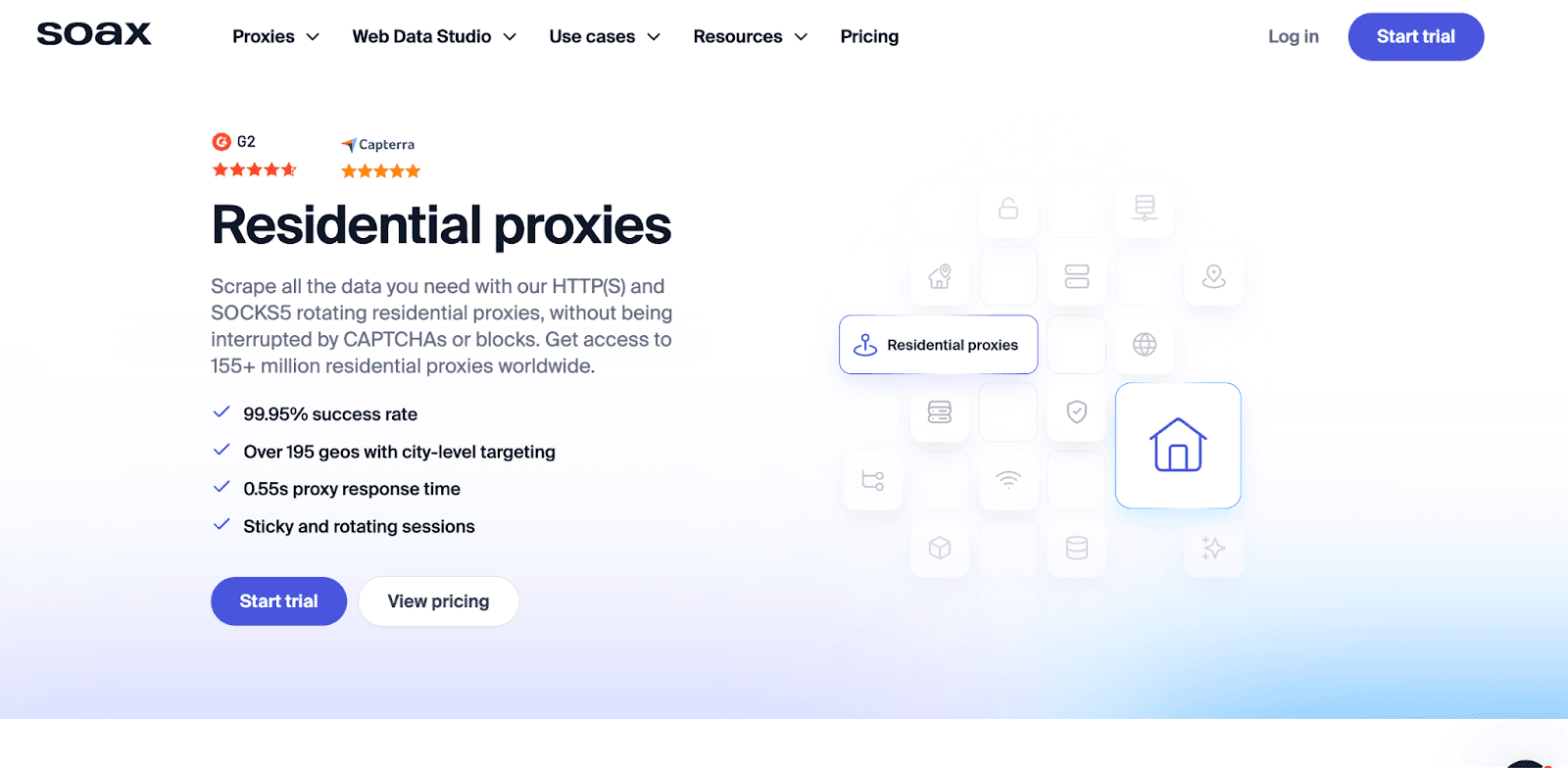
Best for: ASN-level geo-targeting precision
SOAX scored 99.73% success rate with 0.90-second response times in Proxyway's April 2025 testing. Proxyway named them "Contender of the Year" in 2025. Their own site claims 99.95% success rate and 0.5s response time - both self-reported.
The standout feature is ASN-level targeting - you can select proxies from specific ISP networks, not just countries or cities. Bright Data and Oxylabs also offer ASN targeting, but at higher entry prices.
Their pool is listed as 155M+ IPs per their site – larger than Decodo (115M+) and IPRoyal (32M+), but behind Oxylabs (175M+) and Bright Data (400M+).
Pricing:
Pay-as-you-go: $4.00/GB (no commitment)
Starter: $3.60/GB ($90/month, 25GB)
Advanced: $3.40/GB ($170/month, 50GB)
Professional: $2.46/GB ($740/month, 300GB) – marked as "Most Popular"
Business: $2.00/GB ($1,600/month, 800GB)
Enterprise: custom pricing from $0.32/GB at high volumes (contact sales)
$1.99 trial for 400MB over 3 days
Eligible startups can receive 50% off an Enterprise plan for one year
What stood out:
ASN-level targeting as a core feature, combined with country, region, city, and state-level geo-targeting
99.73% success rate, 0.90s response time (Proxyway Global gateway benchmark)
155M+ residential IPs across 195+ locations per their site
HTTP(S), SOCKS5, UDP, and QUIC protocol support
Flexible session management: rotating, sticky (up to 60 minutes), and custom duration
Where it falls short:
Higher latency in Asia-Pacific. Proxyway measured 2.14s in India and 2.30s in Australia, versus 0.55s in the US and 0.48s in the UK
Throughput drops on larger payloads – Proxyway noted performance on 2MB content landed in the middle of the pack despite strong standard page results
No proxy support in Texas due to what SOAX describes as "the intricate regulatory landscape concerning IP address usage and anonymity in Texas"
SOC 2 and ISO 27001 certifications are in process, not yet completed
Best use cases: Ad verification requiring ISP-level precision, regional market research, and high-volume operations where enterprise pricing drops to $0.32/GB at volume.
NetNut
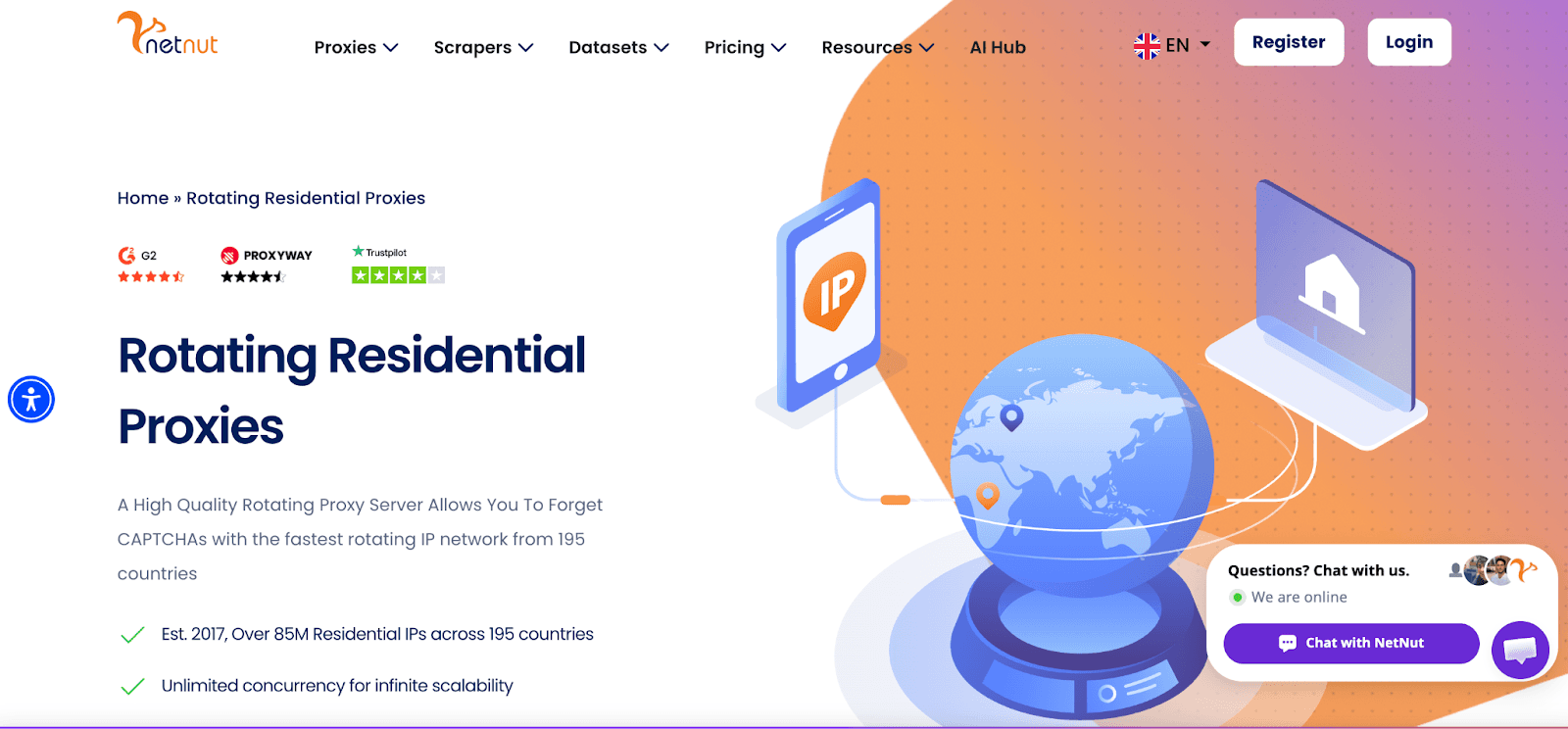
Best for: static residential proxies with ISP-grade connection stability
NetNut (operational since 2017, headquartered in Tel Aviv, Israel) is a subsidiary of Alarum Technologies Ltd (NASDAQ: ALAR).
Proxyway tested NetNut in April 2025 and measured a 98.40% global success rate with a 1.22-second response time – both lower than most other providers on this list. NetNut's own site claims a 99% success rate.
Their architecture uses a hybrid model: rotating residential proxies combine ISP and peer-to-peer (P2P) networks, while their static residential proxies use direct ISP connectivity with one-hop routing. No end-user device dependency on the static side. They operate across over 200 ISPs and internet exchange points worldwide.
Their static residential proxy pool includes over 1 million always-on IPs available 24/7. Rated #1 Web Data Provider on G2 in 2025 per their site.
Pricing (monthly billing):
Starter: $99/month (28GB, $3.53/GB)
Plans scale to 2TB/month at the highest tier
Annual billing available – enterprise tier drops to $1.59/GB at the highest volume
Monthly commitment required on all plans, no pay-as-you-go option
No formal money-back guarantee – contact sales for refund eligibility
7-day trial available – contact sales to activate
What stood out:
1M+ static residential IPs available 24/7
85M+ rotating residential IPs per their FAQ and product pages. Their about page lists a lower figure – the discrepancy is not explained on their site
ISO 27001 certified
Additional products: Website Unblocker, SERP Scraper API, B2B Data Scraper API
Fortune 500 clients including Lenovo and Sterling Check per their site
Where it falls short:
98.40% global success rate and 1.22s response time trail Decodo (99.86%, 0.63s) and Oxylabs (99.90%, 0.65s) on both metrics in Proxyway's 2025 testing
Proxyway's 2025 residential benchmark noted NetNut still has catching up to do on popular targets, with the market now broadly exceeding 99% global success rates
Monthly commitment required – no pay-as-you-go option
Best use cases: Operations that need always-on static residential IPs and US-focused data collection where connection stability matters more than raw success rate.
What makes a residential proxy "the best" in 2026?
The answer depends on your use case. But these are the criteria that separate providers that perform from providers that just market well.
IP cleanliness and reputation
Pool size does not tell you how many IPs are clean right now. Before committing, run a sample through a fraud score API, check rDNS resolution (residential IPs resolve to ISP hostnames, not hosting providers), and confirm geolocation is stable. Ask the provider about subnet diversity and IP sharing these matter more than headline numbers.
Success rate on protected targets
Provider-claimed success rates are self-reported. Use Proxyway's independent benchmarks as the reference point. The differences are meaningful — at 10 million requests, 98.40% means 160,000 failures versus 14,000 at 99.86%. Test against your actual target sites during the trial, not just generic benchmarks.
Latency and throughput
Proxyway measured response times ranging from 0.63s (Decodo) to over 1.2s (NetNut) in 2025. At high request volumes, 200-300ms of extra latency per request compounds into hours of difference in total crawl time. Test under concurrent load some providers look fast on isolated requests but degrade under scale.
Pricing model and bandwidth metering
Almost all residential proxies bill per GB of data transferred both request and response. The real metric is cost per successful request, not price per GB. Failed requests still consume metered bandwidth. Formula: (price per GB) ÷ (success rate) = effective cost per GB.
The extraction method also matters. For targets that don't require JavaScript rendering, a direct HTTP request uses a fraction of the bandwidth of a headless browser. Optimizing this can save more than switching providers.
Pool size vs pool quality
Pool size figures often count every device that has ever connected to a P2P network, including inactive ones. Proxyway's 2025 testing found providers where claimed pool size vastly exceeded unique IPs encountered in actual testing. Ask about IP isolation, rotation logic, and how often flagged IPs are removed.
Geo coverage
"195+ countries" means very little without knowing the depth. A provider might have strong US and Western Europe pools but a handful of IPs in Southeast Asia or Africa. Verify actual IP availability for your target locations before buying.
Uptime and reliability
Production workloads need at least 99.9% uptime backed by an SLA. Check how the provider handles traffic spikes — some throttle throughput or increase timeouts under load. If you plan to scale, test under realistic concurrency during your trial.
Ethical sourcing and IP origin
Providers sourcing through P2P SDK bundles can face IP reputation problems when other apps using the same SDK engage in abusive behaviour; an IP can get flagged through no fault of your usage. The same sourcing model carries a bigger risk than flagging: in July 2026, Google and the FBI disrupted NetNut's network, taking millions of those IPs offline overnight. Providers sourcing directly from ISPs have more control over IP reputation, but typically smaller pools. Ask any provider to explain their sourcing model.
Types of residential proxies
Rotating residential proxies route each request through a different IP from a backconnect gateway. Billed per GB. Good for high-volume scraping and SERP monitoring where IP diversity matters more than session continuity. Detection risk is low per request, but at very high concurrency, the rotation pattern itself can become detectable.
Static residential proxies (ISP Proxies) assign a single dedicated IP that stays the same for as long as you need it. Typically billed per IP. Good for account management, checkout flows, and any workload where a consistent IP identity matters. Latency is lower because the exit node is datacenter-hosted. The tradeoff: a fixed IP builds history over time, which can work for or against you depending on the target.
Quick checklist before buying
Watch for data expiration policies. Some providers reset unused bandwidth monthly. Proxying and IPRoyal offer non-expiring bandwidth
Match proxy type to workload: rotating residential for high-volume scraping (per-GB), static ISP for account management and sessions (per-IP, often high bandwidth allowances), datacenter for low-sensitivity targets where detection risk is lower. To learn how datacenter and residential proxies differ, see the full comparison in the blog.
Calculate cost per successful request, not just price per GB. Failed requests still consume metered bandwidth
Verify IP quality independently before committing. Run fraud score, rDNS, and geolocation checks using any fraud detection API or proxy checker tool before purchasing
Which residential proxy provider should you choose?
It depends on your volume, budget, target sites, and whether you need rotating or static IPs.
Decision framework:
Lowest cost, light usage: Proxying at $1.50/GB (promotional rate at time of research) with non-expiring bandwidth. No independent benchmarks yet.
Enterprise scale, compliance required: Bright Data at $8/GB standard ($4/GB promo). Largest pool (400M+), ISO 27001, SOC 2, SOC 3, CSA STAR. Withdrew from 2025 testing.
Highest success rate: Oxylabs at $6/GB. 99.90% success, 0.65s response in Proxyway 2025. Advanced proxy filtering on all plans.
Fastest and best value: Decodo from $3/GB (subscription). 99.86% success, 0.63s response (fastest tested). Proxyway Best Value four consecutive years.
Irregular usage, long sessions: IPRoyal at $7/GB with non-expiring bandwidth and 7-day sticky sessions.
ASN-level targeting: SOAX at $3.60/GB (Starter). Enterprise pricing drops to $0.32/GB at volume.
Static residential IPs: NetNut with 1M+ always-on IPs. Strong US performance per Proxyway's 2025 data. Proxyway notes room to improve on popular targets.
For session-based workloads - account management, checkouts, long-running monitoring - static ISP proxies with per-IP pricing are worth evaluating alongside the rotating residential options above.
You can audit any proxy setup with the HypeProxies proxy checker: fraud score, DNS leaks, WebRTC exposure, and speed. No login needed.
We recently also written the best ISP proxy providers, that you can check if that is where your use case lies.
Share on

No credit card required. Request your free trial today.
Stay in the loop
Subscribe to our newsletter for the latest updates, product news, and more.
No spam. Unsubscribe at anytime.