A Complete Guide to the 10 Types of Proxy Servers in 2026
Welcome to the definitive 2026 guide on the different types of proxy servers. The term 'proxy' is broad, covering a vast landscape of technologies, each with unique strengths, weaknesses, and ideal use cases. Choosing the wrong type can lead to instant blocks, failed requests, and wasted resources, while the right one unlocks unparalleled data collection capabilities. This roundup demystifies the entire ecosystem, breaking down the technical nuances that determine success or failure in automation projects.

Hype Proxies
Last updated -
Jan 24, 2026
Proxies

This guide provides a clear, practical comparison of the most critical proxy categories available today. We'll move beyond simple definitions to explore the tangible trade-offs between latency, reliability, and block risk associated with each type. For instance, you will learn why a high-legitimacy residential proxy is essential for mimicking real user behavior on social media platforms, whereas a blazing-fast datacenter proxy might be the perfect fit for high-volume, low-security data extraction.
Understanding these distinctions is crucial for anyone involved in web scraping, SEO monitoring, or e-commerce intelligence. Optimizing your strategy means knowing how different proxy types integrate with various lead scraping features to ensure both efficiency and anonymity. This article delivers the actionable insights needed to select the optimal proxy for any project, from competitive market analysis to high-stakes sneaker botting. We will cover everything from residential and ISP proxies to the more specialized SOCKS and reverse proxies, equipping you with the knowledge to navigate the complex proxy maze confidently. Let's explore the 10 proxy types you need to know to succeed.
1. Residential Proxies
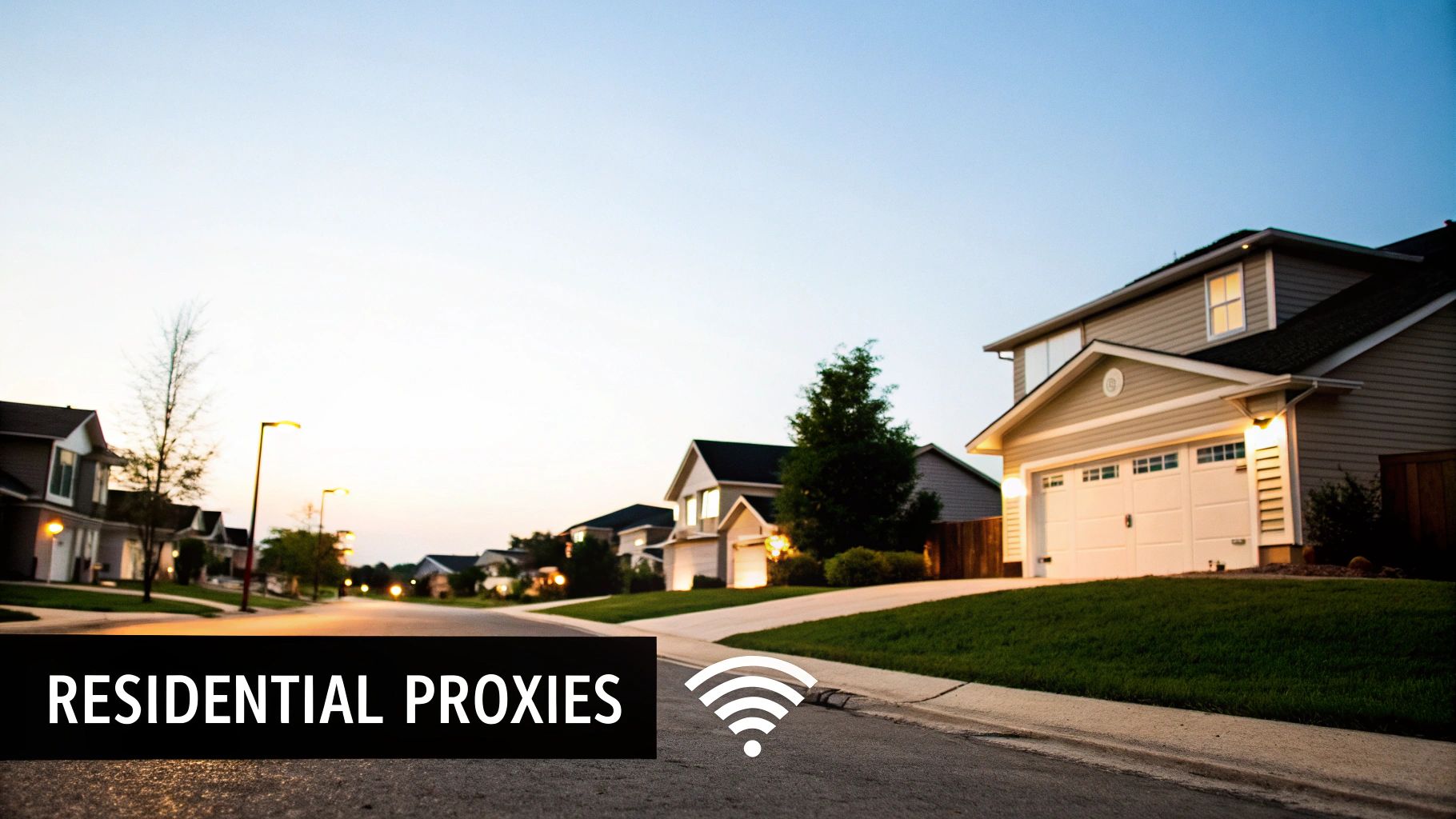
When it comes to appearing as a genuine, everyday user, residential proxies are in a class of their own. This type of proxy server routes your internet traffic through a real IP address assigned by an Internet Service Provider (ISP) to a homeowner's device. Instead of originating from a commercial server farm, your requests look like they are coming from a legitimate desktop computer or mobile device in a suburban home, making them incredibly difficult for websites to distinguish from organic traffic.
This authenticity is their core advantage. While other proxy types can be flagged by sophisticated anti-bot systems, residential IPs blend in seamlessly. This makes them the gold standard for tasks where avoiding detection is paramount.
Why Use Residential Proxies?
Residential proxies are essential for use cases that require high levels of anonymity and legitimacy. Their ability to bypass aggressive geo-restrictions and sophisticated bot detection makes them indispensable for large-scale operations.
Large-Scale Web Scraping: Market research firms use rotating residential proxies to gather competitor pricing data from e-commerce sites like Amazon across all 50 U.S. states without getting blocked.
Ad Verification: Digital marketing agencies verify ad placements and track campaigns from different geographic locations to ensure compliance and performance.
Sneaker Copping: Resellers use residential IPs to enter multiple raffles on limited-edition sneaker release sites like SNKRS and Shopify, which have stringent bot detection.
Social Media Management: Teams managing hundreds of social media accounts use residential IPs to avoid platform restrictions and bans on platforms like Instagram and TikTok.
Actionable Tips for Implementation
To maximize the effectiveness of residential proxies, a strategic approach is key.
Choose Rotation vs. Sticky Sessions: For tasks like scraping product listings, use rotating residential proxies to distribute requests across a vast pool of IPs. For managing an account or completing a multi-step checkout process, select a sticky session to maintain the same IP for a set duration (e.g., 10 or 30 minutes).
Implement Smart Throttling: Even with a legitimate IP, sending too many requests too quickly will get you blocked. Implement delays and vary your request patterns to mimic human behavior.
Monitor IP Health: Not all residential IPs are equal. Use a provider like HypeProxies that monitors IP reputation scores and automatically rotates out underperforming or flagged addresses from your pool.
2. ISP Proxies
ISP proxies, also known as static residential proxies, offer a powerful hybrid solution, blending the high speed and stability of datacenter servers with the authenticity of IP addresses assigned by real Internet Service Providers (ISPs). This type of proxy server routes traffic through IP addresses leased directly from ISPs but hosted on powerful datacenter infrastructure. Your requests appear to originate from a legitimate ISP-assigned address, yet you benefit from the 10 Gbps speeds and uptime typically associated with server farms.
This unique combination makes them a formidable tool. While residential proxies offer unparalleled legitimacy and datacenter proxies provide raw speed, ISP proxies strike a balance that makes them ideal for performance-critical tasks where both speed and a trustworthy IP reputation are essential. They avoid the "datacenter IP" flag while delivering sub-millisecond latency.
Why Use ISP Proxies?
ISP proxies are built for high-stakes, time-sensitive operations where speed is a competitive advantage and a low-risk IP profile is non-negotiable. Their static nature ensures you maintain the same high-reputation IP for as long as you need, which is critical for consistent performance.
High-Speed Retail Botting: Sneaker botting teams leverage ISP proxies for limited-edition drops on sites like Foot Locker and Size?, where checkout speed is the deciding factor.
Ticketing Automation: Businesses automating ticket purchases for high-demand concerts and events use ISP proxies to secure inventory faster than competitors without getting blocked by platforms like Ticketmaster.
Large-Scale SEO Monitoring: SEO agencies use dedicated ISP subnets to perform thousands of daily rank tracking queries across Google without triggering CAPTCHAs or IP blocks.
Performance-Based Web Scraping: E-commerce intelligence platforms use ISP proxies to scrape real-time pricing data where latency directly impacts data freshness and value.
Actionable Tips for Implementation
To get the most out of ISP proxies, focus on optimizing for speed and consistency.
Leverage Dedicated Subnets: For large-scale operations requiring consistent performance across a block of IPs, use a dedicated /24 subnet. This ensures your IPs share a clean reputation and are not affected by other users.
Prioritize for Time-Sensitive Tasks: Reserve your ISP proxies for missions where every millisecond counts, such as checking out a limited-stock item. For general browsing or less urgent scraping, residential proxies might be more cost-effective.
Combine in a Tiered Approach: For complex scraping jobs, use ISP proxies for initial site access and critical data points, then switch to rotating residential proxies for broader data collection to optimize both cost and success rates. For an in-depth look, learn more about what ISP proxies are and how they fit into a modern proxy strategy.
Configure for Maximum Throughput: Ensure your software is configured for connection pooling and can handle the high throughput of 10 Gbps infrastructure to avoid creating a bottleneck on your end.
3. Datacenter Proxies
Where speed and affordability are the top priorities, datacenter proxies are the go-to solution. Unlike their residential counterparts, these proxies are not associated with an ISP or a physical home. Instead, they are artificially created IP addresses hosted on powerful servers in datacenters around the world. This infrastructure allows them to offer blazing-fast connection speeds and high bandwidth at a fraction of the cost.
The primary trade-off is authenticity. Because these IPs originate from commercial server blocks, they are relatively easy for sophisticated websites to identify and block. Their IP addresses are publicly listed as belonging to datacenters, making them unsuitable for tasks that require stealth.

Why Use Datacenter Proxies?
Datacenter proxies excel in scenarios where the target website has minimal security or when the user controls the environment, making the risk of detection irrelevant. Their raw performance is ideal for high-volume, speed-dependent tasks that don't involve strict anti-bot measures. For a deeper dive into the technical differences, you can explore the full comparison in our datacenter vs. residential proxies guide.
API Integration Testing: Developers use datacenter IPs to test API endpoints without needing the legitimacy of a residential address.
Internal Quality Assurance: QA teams perform load testing and functional checks on web applications within a controlled development environment.
Massive Data Downloads: Researchers download large, unrestricted public datasets where the source IP's origin is not scrutinized.
Website Performance Monitoring: SEO agencies quickly check website loading times and availability from various global locations without triggering security flags on simple monitoring tools.
Actionable Tips for Implementation
Using datacenter proxies effectively means understanding their limitations and playing to their strengths.
Reserve for Low-Security Targets: Only use datacenter proxies on websites with basic or no bot detection. They are a cost-effective choice for scraping simple HTML sites, public directories, or unprotected APIs.
Implement as a Fallback: Configure your system to use datacenter proxies for initial, non-critical tasks. Switch to more robust proxy types like ISP or residential only when a block or CAPTCHA is encountered.
Use for Development Environments: Leverage their low cost and high speed for testing your scraping or automation scripts in a staging environment before deploying them with higher-cost residential proxies for production.
Configure Strict Rate Limiting: Despite their speed, avoid overwhelming the target server. Set conservative request limits to prevent triggering IP-based bans, even on less secure sites.
4. Static Residential Proxies
Static residential proxies offer a powerful hybrid solution, combining the high-trust factor of a residential IP with the stability of a fixed address. Unlike rotating proxies that change with every request or after a short time, these proxies provide a single, persistent residential IP address assigned by an ISP to a real device. This address remains unchanged for extended periods, from days to months.
This unique combination delivers the best of both worlds. Your activity appears to originate from a legitimate home network, bypassing the strict filters that often flag datacenter IPs. At the same time, the static nature ensures your digital identity remains consistent, which is crucial for tasks that require session persistence and building trust with a target platform over time.
Why Use Static Residential Proxies?
This type of proxy server is ideal for long-term operations where a consistent identity is as important as appearing authentic. They are the preferred choice for managing valuable online accounts and performing tasks that require an established, stable presence from a specific geographic location.
Social Media Account Management: A growth agency uses a dedicated static residential IP for each client's Instagram account, allowing them to perform actions like posting and engaging without triggering security alerts caused by fluctuating IP addresses.
E-commerce Seller Account Management: Resellers managing multiple Amazon or eBay seller accounts assign a unique static residential IP to each to avoid linking the accounts and risking a mass ban.
SEO Rank Tracking: An SEO agency uses static residential IPs from specific cities to consistently monitor keyword rankings on Google from a fixed, authentic-looking location, ensuring accurate local search results.
Online Banking and Financial Services: Users access financial accounts from a consistent IP to avoid triggering fraud detection systems that are sensitive to logins from new or untrusted locations.
Actionable Tips for Implementation
To leverage static residential proxies effectively, focus on maintaining a credible and consistent operational footprint.
Assign One IP Per Account: For maximum security and to avoid creating a detectable pattern, dedicate a single static residential IP to each high-value account you manage. This mimics the behavior of a genuine user.
Warm Up New Accounts: Before launching any automated activity, use the static IP for a "warming" period of manual, human-like browsing on the target site. This helps build a history of trust associated with the IP.
Monitor Blacklist Status: Even residential IPs can get flagged. Periodically check your static IP's reputation against common blacklists and have backup IPs from a provider like HypeProxies ready to deploy if an address is compromised.
5. Rotating Proxies
For tasks that require immense scale and a low detection footprint, rotating proxies offer a dynamic solution. This type of proxy server automatically assigns a new IP address from a vast pool for each connection or at set time intervals. Instead of sending thousands of requests from a single IP address, your traffic is distributed across countless unique IPs, making it nearly impossible for target servers to identify and block your activity based on request volume.
This constant cycling of IPs is the core principle behind successful, large-scale data operations. By ensuring no single IP address becomes overused or flagged, rotating proxies can sustain high-volume requests against even the most sophisticated anti-bot systems, a crucial feature for many modern proxy server applications.

Why Use Rotating Proxies?
Rotating proxies are the backbone of operations that cannot afford to be rate-limited or blocked. Their ability to mask activity by spreading it across a large address pool makes them ideal for breadth-focused tasks that involve interacting with many different pages or websites.
Large-Scale Data Extraction: Market research firms use rotating residential proxies to collect competitor pricing and product data from millions of e-commerce pages without triggering security measures.
SEO Monitoring: SEO agencies deploy rotating proxies to perform thousands of keyword ranking checks across different search engines and global locations without being served captchas or inaccurate results.
Web Scraping: Data platforms leverage rotation to continuously extract information from thousands of diverse websites simultaneously for news aggregation or financial analysis.
Survey and Market Research: Companies gather unbiased consumer sentiment and survey data by routing requests through a diverse set of IPs, appearing as genuine local users.
Actionable Tips for Implementation
Effectively using rotating proxies requires more than just turning them on; it demands a strategic configuration.
Configure Rotation Frequency: Adjust the rotation setting based on your target. For aggressive sites, use per-request rotation to get a new IP for every connection. For less sensitive targets, you might rotate every few minutes to maintain efficiency.
Combine with User-Agent Rotation: To maximize stealth, pair IP rotation with the rotation of other browser headers, such as the
User-Agent. This makes each request appear to come from a completely different device and user.Implement Smart Throttling: Even with rotation, sending requests too quickly can strain a target’s infrastructure. Implement logical delays between requests to mimic human browsing speed and avoid causing issues.
Use for Breadth, Not Depth: Rotating proxies excel at breadth-focused tasks (scraping one page from 10,000 sites). For depth-focused tasks that require a consistent identity (like a multi-step checkout), use sticky sessions instead.
6. Forward Proxies
A forward proxy is the most classic and widely understood type of proxy server, acting as an intermediary for requests from a client to the broader internet. It sits between a user (or a group of users, like in an office network) and the servers they are trying to reach. When a user sends a request, it first goes to the forward proxy, which then forwards that request to the target server on the user's behalf.
This setup grants the network administrator a central point of control. All outbound traffic can be monitored, filtered, and logged, providing both security and policy enforcement. Essentially, it acts as a gateway that manages how an internal network interacts with the outside world, making it a cornerstone of corporate IT infrastructure.
Why Use Forward Proxies?
Forward proxies are primarily used for internal network management, security, and content filtering rather than for external data acquisition tasks that require anonymity. Their value lies in controlling and optimizing outbound traffic from a known environment.
Corporate Content Filtering: Enterprises use forward proxies like Squid or Fortinet appliances to block employees from accessing non-work-related sites, social media, or malicious domains, enforcing acceptable use policies.
Bandwidth Optimization: Internal IT teams in schools or businesses cache frequently accessed web content (like software updates) on a forward proxy to reduce internet bandwidth consumption and speed up access for users.
Security and Monitoring: A regulated financial institution might log all outbound web traffic through a forward proxy to meet compliance requirements and monitor for potential data exfiltration.
Bypassing Simple Geo-blocks: A user within a country with certain internet restrictions can use a forward proxy located in another country to access blocked content.
Actionable Tips for Implementation
Properly configuring a forward proxy is crucial for achieving security and performance goals without creating bottlenecks.
Set Appropriate Cache Policies: To optimize bandwidth, configure your proxy's cache-control headers to store static assets (images, CSS, JS) from frequently visited internal or external sites. This significantly reduces redundant downloads.
Configure a PAC File: For seamless deployment across an organization, use a Proxy Auto-Config (PAC) file. This allows client browsers to automatically determine when to use the proxy, simplifying setup for end-users.
Implement Robust Logging: Ensure your forward proxy is configured for detailed logging of all requests. This is critical for security audits, troubleshooting connectivity issues, and ensuring compliance with company policies.
Combine with Other Proxy Types: For external web scraping, use your corporate forward proxy for internal infrastructure, but route the actual scraping requests through an external service like HypeProxies to leverage residential or datacenter IPs for anonymity and block avoidance.
7. Reverse Proxies
Unlike the other types of proxy servers discussed, which manage outbound requests from a client, reverse proxies operate on the other side of the equation. They sit in front of one or more web servers, intercepting requests from the internet before they reach the backend. Instead of protecting the client's identity, a reverse proxy protects the server's identity, providing a crucial layer of security, performance, and reliability.
When you connect to a high-traffic website, you are likely interacting with a reverse proxy without even knowing it. This intermediary server accepts your request and intelligently forwards it to an appropriate backend server. This process is fundamental to modern web architecture, enabling load balancing, SSL encryption offloading, and content caching to deliver a faster, more secure experience for the end-user.
Why Use Reverse Proxies?
Reverse proxies are not a tool for client-side tasks like web scraping or managing social media accounts. Instead, they are an essential piece of server-side infrastructure for anyone operating a web service, API, or data collection platform that serves multiple clients. They are designed to manage and protect inbound traffic.
Load Balancing: An e-commerce site like Shopify uses reverse proxies (such as Nginx) to distribute millions of incoming shopper requests evenly across its fleet of backend servers, preventing any single server from becoming overwhelmed during a flash sale.
Security and Anonymity for Servers: A company can hide the IP addresses and characteristics of its origin servers behind a reverse proxy, protecting them from direct attacks like DDoS.
Content Delivery (Caching): Content Delivery Networks (CDNs) like Cloudflare act as a global network of reverse proxies. They cache static content (images, CSS) on servers closer to the user, dramatically speeding up page load times.
API Gateways: A business with a microservices architecture uses an API gateway (a form of reverse proxy) to route incoming API calls to the correct internal service, simplifying the client-side logic.
Actionable Tips for Implementation
For those managing web infrastructure, implementing a reverse proxy correctly is critical for performance and security.
Choose the Right Tool: Select a tool based on your needs. Nginx and Apache HTTP Server are excellent all-rounders for web serving and load balancing, while HAProxy is purpose-built for high-performance load balancing.
Implement Robust Caching: Configure your reverse proxy to cache static assets aggressively. This reduces the load on your backend servers and significantly improves response times for users.
Secure with SSL Termination: Offload the work of encrypting and decrypting SSL/TLS traffic to the reverse proxy. This simplifies certificate management and frees up backend server resources to focus on application logic.
Configure Health Checks: Set up health checks to allow the reverse proxy to monitor the status of backend servers. If a server goes down, the proxy can automatically stop sending traffic to it until it recovers, ensuring high availability.
8. SOCKS Proxies
Moving beyond web-specific traffic, SOCKS proxies are a versatile and powerful type of proxy server that operates at a lower level of the network model (Layer 5). Unlike HTTP proxies that only handle HTTP/S requests, SOCKS proxies are protocol-agnostic. This means they can forward any type of internet traffic, including TCP and UDP, making them compatible with a vast range of applications beyond just web browsers.
The current standard, SOCKS5, adds crucial features like authentication, making it a secure and flexible choice. By working at a lower level, these proxies simply pass data between the client and the destination without interpreting it, which can offer performance benefits for specific, non-web-based tasks.
Why Use SOCKS Proxies?
SOCKS proxies are the go-to solution when you need to route traffic from applications that do not use the HTTP protocol. Their ability to handle diverse traffic types like FTP, SMTP, and torrents makes them indispensable for tasks where general web anonymity is not the only goal.
Gaming: Gamers use SOCKS5 proxies to reduce latency by connecting to a server closer to the game's host or to access geo-restricted game servers and content.
Peer-to-Peer (P2P) File Sharing: Torrent clients are often configured with SOCKS proxies to mask the user's real IP address from peers in the swarm, enhancing privacy.
Streaming Media: Users can bypass regional blocks on streaming platforms or applications that rely on protocols other than standard web traffic for content delivery.
Direct Database or Server Connections: Developers and IT administrators use SOCKS proxies for secure SSH tunneling and to manage remote servers without exposing their direct IP address.
Actionable Tips for Implementation
To get the most out of SOCKS proxies, proper configuration is essential for both performance and security.
Always Opt for SOCKS5: When configuring your application, always choose the SOCKS5 option over the older SOCKS4. SOCKS5 supports authentication, provides UDP support, and offers better security, making it the modern standard for virtually all use cases.
Use for Non-Web Protocols: While SOCKS can handle web traffic, HTTP proxies are often more optimized for it. Reserve SOCKS proxies for their intended strength: handling protocols like FTP, SSH, or custom TCP/UDP application traffic.
Configure Application-Specific Timeouts: Applications like P2P clients or gaming require persistent connections. Adjust the timeout settings in your proxy client to prevent connections from dropping during critical, long-running tasks. For a complete breakdown, our SOCKS proxy guide covers these technical configurations in more detail.
9. Dedicated Proxies
For operations that demand complete control and unwavering stability, dedicated proxies offer an exclusive solution. This type of proxy server assigns a specific IP address solely to one user or organization. Unlike shared proxies where you compete with unknown others for resources and reputation, a dedicated IP is yours alone. Your traffic is completely isolated, ensuring that another user's problematic activities won't get your IP blacklisted or throttled.
This exclusivity is the core strength of dedicated proxies. It guarantees that the IP's history and reputation are entirely under your control, providing a clean slate and predictable performance. This makes them ideal for mission-critical tasks where consistency and reliability are non-negotiable.
Why Use Dedicated Proxies?
Dedicated proxies are the go-to choice for use cases where performance cannot be compromised by the "bad neighbor" effect common with shared IPs. Their stability and private nature are essential for long-term, high-stakes projects.
Enterprise Web Scraping: Large-scale data operations use dedicated proxy subnets (like /24) to build isolated and highly controlled scraping infrastructures.
E-commerce Account Management: High-revenue Amazon or eBay sellers use dedicated IPs to manage their storefronts, ensuring a consistent and trusted login history to prevent account flagging.
High-Stakes Sneaker Copping: Serious botting groups assign dedicated IPs to specific tasks or users to maximize success rates during highly competitive drops, avoiding shared IP blocks.
SEO Auditing: Digital marketing agencies use dedicated proxies for consistent rank tracking and site audits, ensuring that search engine results are not skewed by a tainted shared IP.
Actionable Tips for Implementation
To get the most out of dedicated proxies, a careful and strategic management approach is crucial.
Implement an IP Warming Period: Before launching high-volume automated tasks, "warm up" your new dedicated IPs with low-volume, human-like activity for several days. This builds a positive history and reduces the risk of initial flagging. For dedicated datacenter proxies, understanding the hardware they run on is beneficial; consider digging deeper into understanding bare metal servers to optimize performance.
Rotate IPs Strategically: Even dedicated IPs can develop a predictable footprint. For long-term projects, plan to rotate your dedicated IPs on a weekly or monthly basis to avoid pattern-based detection by sophisticated security systems.
Monitor Blacklist Status Daily: Use tools to continuously monitor your dedicated IPs against common blacklists. Maintain a pool of backup IPs to swap in immediately if one gets flagged, ensuring zero downtime for your critical operations.
10. Rotating /24 Subnets
For enterprise-level operations that demand immense scale without sacrificing control, rotating /24 subnets represent the pinnacle of proxy infrastructure. This advanced method provides a dedicated block of 256 consecutive IP addresses (a "/24 subnet") that rotates on demand or at set intervals. It combines the consistency of a dedicated IP block with the dynamic nature of rotation, enabling massive-scale tasks that other proxy types simply cannot support.
This approach gives you a private pool of IPs from the same subnet, allowing requests to appear clustered yet varied. When one IP faces increased scrutiny, the entire subnet can be swapped out for a fresh one, providing an unparalleled level of agility and resilience for the most demanding data gathering operations.
Why Use Rotating /24 Subnets?
Rotating /24 subnets are designed for organizations running billions of requests per month, where standard proxy pools become a bottleneck. Their power lies in providing predictable, high-performance IP blocks that can be managed strategically to overcome the most sophisticated anti-bot systems on a massive scale.
Enterprise-Scale Data Collection: Major e-commerce intelligence platforms leverage rotating subnets to execute over 100 billion monthly requests, gathering pricing and stock data without interruption.
Financial Market Research: Investment firms use dedicated /24 blocks to monitor market data and alternative data sources globally, ensuring data integrity and consistency for their algorithms.
Large-Scale Ticketing Automation: High-volume ticketing operators deploy multiple /24 subnets to run concurrent operations across various platforms, securing inventory for high-demand events.
Web Health Monitoring: Global corporations monitor website performance and availability from hundreds of distinct IP addresses within a controlled block to simulate regional user traffic.
Actionable Tips for Implementation
Deploying /24 subnets effectively requires a sophisticated technical strategy to maximize their potential and avoid predictable patterns.
Reserve for Massive Scale: Only consider /24 subnets for operations exceeding billions of monthly requests. For smaller tasks, other types of proxy servers like residential or ISP proxies are more cost-effective.
Strategize Rotation Timing: Configure your subnet rotation schedule based on the target website's detection patterns. Some targets may require hourly rotation, while others may allow for longer static periods.
Distribute Requests Intelligently: Avoid sending sequential requests from sequential IPs (e.g., .1, .2, .3). Distribute your traffic randomly across all 256 addresses within the block to mimic organic activity.
Rotate Between Multiple Subnets: For maximum evasion, advanced users rotate between several /24 blocks. This tactic makes it nearly impossible for targets to block your entire operation by flagging a single subnet.
10-Point Comparison of Proxy Server Types
Proxy Type | Implementation Complexity 🔄 | Resource & Cost ⚡ | Expected Outcomes ⭐📊 | Ideal Use Cases 📊 | Key Advantages & Tips ⭐💡 |
|---|---|---|---|---|---|
Residential Proxies | Moderate — session & rotation management | High cost; moderate latency; large IP pool | Highest stealth; low block/CAPTCHA rates | Sneaker botting, social media, market research | High legitimacy; use rotating for broad scraping, sticky for logins; monitor IP reputation |
ISP Proxies | Moderate — datacenter + ISP integration | Moderate–high cost; sub-ms latency (10Gbps) | Fast with good stealth; suitable for time‑sensitive ops | Ticketing, sneaker drops, high‑freq scraping | Balance of speed & authenticity; combine with residential for stealth |
Datacenter Proxies | Low — easy deployment & scaling | Low cost; ultra‑high bandwidth; minimal latency | Very fast and cheap but easily detected | Internal testing, API access, load testing | Best for testing/dev; use as fallback; avoid on restrictive sites |
Static Residential Proxies | Moderate — provisioning fixed residential IPs | High cost per IP; stable latency | Persistent sessions with strong stealth for accounts | Account management, social growth, SEO tracking | Session persistence + residential legitimacy; rotate periodically and warm accounts |
Rotating Proxies | High — rotation logic & pool orchestration | High resource use; moderate–high cost; slight latency | Low blocking; ideal for massive-scale scraping | Large-scale web scraping, market research, surveys | Reduces IP-level blocking; tune rotation frequency and UA/header rotation |
Forward Proxies | Moderate — client configuration & auth | Low–moderate; can reduce bandwidth via caching | Controlled outbound traffic; poor stealth for public scraping | Corporate browsing control, internal scraping | Useful for corporate control and caching; use PAC and logging; not for external stealth ops |
Reverse Proxies | High — server-side deployment & routing | Moderate–high infra cost; backend resources needed | Improved performance, security, and load distribution | CDNs, API gateways, high‑traffic websites | Load balancing and SSL termination; not applicable for client-side evasion |
SOCKS Proxies | Moderate — app-level configuration (SOCKS5 recommended) | Low–moderate; protocol-agnostic support | Protocol-neutral forwarding; good for non‑HTTP tasks | FTP/SSH, gaming, torrents, specialized apps | Supports TCP/UDP and auth; prefer SOCKS5 and secure endpoints |
Dedicated Proxies | Moderate — provisioning exclusive IPs | Very high cost; exclusive resources; limited diversity | Consistent, reliable results; single‑IP reputation risk | Mission-critical ops, enterprise account management | Isolation and predictability; warm IPs, rotate periodically, monitor blacklists |
Rotating /24 Subnets | Very high — subnet rotation orchestration | Extremely high cost; dedicated /24 blocks | Massive scale with coordinated IP blocks; detectable if misused | Enterprise-scale scraping, 100B+ monthly requests | Combines scale + some consistency; use only for massive operations and distribute requests across the block |
Making the Right Choice: Your Next Steps in Proxy Strategy
Navigating the diverse landscape of proxy servers can feel like learning a new language, but as we've journeyed through the various types, a clear picture emerges. The "best" proxy doesn't exist in a vacuum; its value is defined entirely by your mission. The power lies not in finding a single perfect solution, but in understanding the specific strengths and trade-offs of each option to build a robust, effective, and resilient data acquisition strategy.
We've explored the fundamental building blocks, from the high-trust, human-like footprint of Residential Proxies to the lightning-fast, scalable architecture of Datacenter Proxies. We've seen how ISP Proxies bridge the gap, offering the speed of a datacenter with the authority of a residential IP. This core trio represents the foundational pillars of any serious proxy infrastructure.
But the real strategic advantage comes from understanding the more nuanced operational models. The distinction between a single, unchanging Static Residential Proxy and a constantly shifting Rotating Proxy is the difference between managing a long-term, trusted online identity and executing a high-volume data scraping task that requires evading rate limits. Similarly, knowing when to deploy a high-performance SOCKS Proxy for non-HTTP traffic versus a standard HTTP(S) Proxy is a critical technical decision that directly impacts your project's success.
Key Takeaways: From Theory to Action
Mastering the different types of proxy servers is the first step. The next is translating that knowledge into a concrete action plan. Let’s distill our extensive exploration into a few core, actionable principles that will guide your selection process:
Legitimacy vs. Speed: This is the primary trade-off. For tasks requiring the highest level of trust and the lowest chance of being blocked, such as social media account management or e-commerce checkouts, residential proxies are non-negotiable. For large-scale, less sensitive data gathering where velocity is king, datacenter proxies often provide the most cost-effective performance.
Statefulness vs. Anonymity: Do you need to maintain a consistent session, or do you need to cycle through thousands of unique IPs? A Dedicated Proxy or a "sticky" session residential proxy is essential for multi-step processes like filling out a form or navigating a shopping cart. In contrast, a rotating proxy pool is the engine for massive web scraping, where each request benefits from a fresh, unflagged IP address.
Scale and Infrastructure: For enterprise-level operations, thinking about individual proxies is inefficient. This is where concepts like Rotating /24 Subnets become critical. Controlling an entire block of IPs provides unparalleled control and predictability, ensuring that your infrastructure can handle immense data demands without compromising on IP quality or diversity.
Strategic Insight: Your proxy choice is not just a technical detail; it is a direct investment in your project's data quality, success rate, and operational longevity. A cheap, unreliable proxy can cost you far more in failed requests, blocked accounts, and corrupted data than a premium service ever will.
Ultimately, the journey from a novice to a proxy expert is about moving from "what is a proxy?" to "which proxy configuration will achieve my specific goal?" It's about architecting a solution where each component, from the IP source to the rotation protocol, is deliberately chosen to overcome the unique challenges of your target. Whether you are an SEO analyst tracking keyword rankings, a data engineer building a market intelligence platform, or a reseller securing limited-edition goods, this strategic approach is your competitive edge.
Understanding the many types of proxy servers is the first step, but partnering with the right provider is what turns that knowledge into results. HypeProxies specializes in engineering elite-tier residential and ISP proxy networks designed for the most demanding use cases, from web scraping to e-commerce automation. With our meticulously maintained IP pools and robust 10 Gbps infrastructure, we provide the performance and reliability your mission-critical operations require. Explore the HypeProxies difference and elevate your strategy today.
Share on

$1 one-time verification. Unlock your trial today.
Stay in the loop
Subscribe to our newsletter for the latest updates, product news, and more.
No spam. Unsubscribe at anytime.

![Sticky vs Rotating Proxies: When Each Type Actually Matters [2026]](https://framerusercontent.com/images/niUCJcnGDYczz6ugAbYodpK0kg.png?width=3840&height=2160)