What Are Residential Proxies? Uses, Benefits & Examples
Learn what residential proxies are, how they work, and when to choose rotating residential, datacenter, or static ISP proxies for your data collection needs.

Gunnar
Last updated -
Tutorials

If you’ve ever tried to scrape product details or other information from websites, chances are you’ve run into a CAPTCHA block or Cloudflare wall at some point. It’s a frustrating rite of passage for anyone trying to collect web data at scale.
Proxy services can help distribute automated web requests across different IP addresses, but choosing the right proxy type matters. Websites use several methods to identify unwanted automation, including IP reputation checks, browser fingerprinting, and traffic analysis.
Residential proxies route requests through IP addresses associated with consumer internet connections. Unlike traditional datacenter proxies, these requests originate from residential networks, which can be useful when accessing location-specific content or collecting data from websites that restrict certain hosting networks. However, residential IPs don’t guarantee protection against CAPTCHAs or other security measures.
To bypass their security measures, you need to blend in with normal daily web activity. Residential proxies are one of the most effective solutions here, as they route requests through real household connections assigned by consumer ISPs like AT&T and Verizon.
Here’s everything you need to know about how residential proxies work, their top use cases, how they differ from other proxy types, and a few leading proxy providers that help keep your data flowing without interruption.
What Are Residential Proxies?
A residential proxy is an intermediary server that routes web requests through a home internet connection. Put simply, it lets you access an IP address assigned by a consumer internet provider like AT&T, Comcast, or Verizon for your automated requests.
In a typical residential pool, people allow a proxy provider to route traffic through their internet connections, usually through specialized sharing apps. As a proxy user, you simply pay for access to this massive pool of real-world connections. Here’s how one proxy expert clarifies the difference between residential and other proxy types:
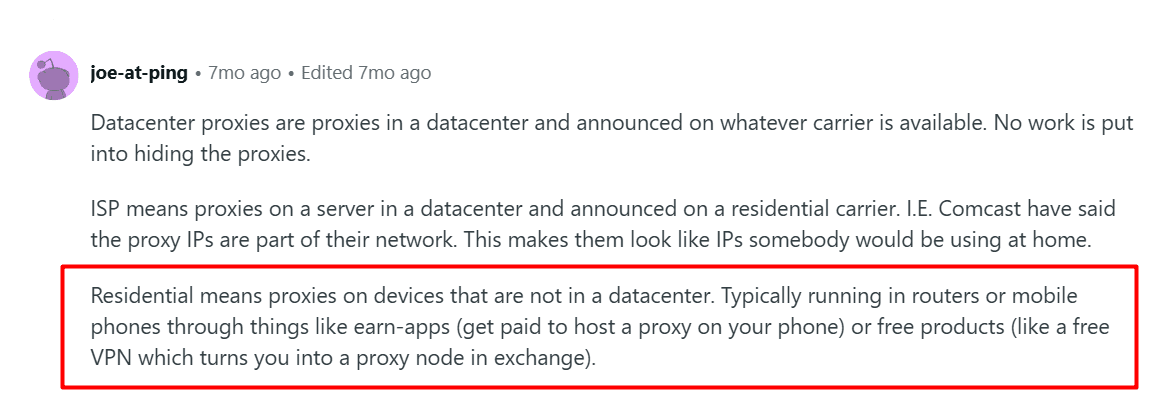
Source: Reddit
Residential proxies make web requests through IP addresses associated with consumer internet connections rather than conventional cloud hosting networks. This distinction can affect how a website classifies incoming traffic, but it doesn’t automatically make the request appear human.
One factor security systems may evaluate is the IP address’s Autonomous System Number (ASN). An ASN identifies the network responsible for announcing a range of IP addresses, such as an internet service provider or cloud hosting company.
For example:
AT&T: Associated with AT&T’s network infrastructure, which includes consumer internet services. However, belonging to this ASN doesn’t prove that a request comes from a residential customer or a legitimate human visitor.
Amazon: Associated with Amazon’s network infrastructure, including AWS services. Websites may apply additional scrutiny to traffic from hosting networks, but these IP addresses aren’t automatically blocked.
Modern anti-bot systems can also examine IP reputation, request frequency, browser fingerprints, and session behavior. Residential proxies can help with certain network-based restrictions, but they don’t guarantee successful access to every website.
How Do Residential Proxies Work?
Residential proxies work through an intelligent intermediary gateway that manages IP allocation, connection protocol handshakes, and session persistence behind the scenes.
Here’s how a web request travels through the system from start to finish:
Authentication & Gateway Entry: Your application or browser connects to the proxy provider’s gateway. Depending on the service, access is authenticated using login credentials or an approved client IP address.
Endpoint Selection: The provider selects an available residential IP based on your location preferences, rotation settings, and session requirements.
Request Routing: The gateway forwards your request through the selected residential device or connection. The target website sees the residential IP address as the source of the request.
Response Delivery: The target website returns its response through the proxy connection, which passes the data back to your application or browser.
When you configure a proxy inside a particular application, only that application’s supported traffic will use the proxy. System-wide proxy settings can affect additional applications, depending on your operating system and configuration.
Residential vs. Datacenter vs. Static ISP Proxies
Navigating proxy terminology can sometimes feel like deciphering a mess of network acronyms. You’ll often hear vendors using different labels like “residential,” “datacenter,” and “static ISP” on their pricing pages, but how exactly do they differ? Here’s a quick breakdown:
| Dimension | Residential Pools | Datacenter Proxies | Static ISP Proxies |
|---|---|---|---|
| Exit Infrastructure | Participating home connections or devices (laptops, home Wi-Fi routers). | Massive corporate data centers (like AWS or Google Cloud). | Data centers using official home internet IPs. |
| Trust Score & Block Rate | May encounter fewer restrictions based on hosting-network classification, but can still be detected. | Often identifiable as hosting IPs; blocking depends on reputation and target-site rules. | Consumer ISP registration may help with IP classification, but blocking remains possible. |
| Speed & Latency | Varies. Relies on a stranger's home Wi-Fi speeds. | Lightning Fast. Runs on corporate-grade fiber optic cables. | Ultra Fast. Blazes through tasks on server backbones. |
| IP Continuity | Short. The address changes when the homeowner disconnects. | Persistent. Stays active and assigned to you as long as you pay. | Usually persistent. Gives you a long-term, unmoving address. |
| Billing Model | Priced per IP or gigabyte consumed, depending on provider. | Usually priced per IP or per bandwidth. | Usually priced per IP with unlimited bandwidth. |
| Best Operational Fit | Sneaking past tough security on highly protected sites across different locations. | High-speed, cheap testing on open websites with little security. | Managing online accounts, buying tickets, or heavy web scraping. |
Swipe horizontally to view the full comparison.
Some providers market ISP proxies as static residential proxies. These services use IP addresses associated with consumer internet service providers but host the connections on data-center infrastructure rather than individual household devices.
This arrangement can provide more consistent IP availability and server performance than rotating residential networks. However, ISP registration alone doesn’t guarantee a particular trust score or immunity from website security checks.
For example, here at HypeProxies, our static residential proxies use ISP-assigned IPs from major US carriers, but instead of running on a slow home router, they sit on our own high-speed server infrastructure.
HypeProxies operates its own server infrastructure, giving the company greater control over network performance and availability without relying on consumer devices to relay traffic.
Infrastructure ownership can also reduce dependence on third-party residential proxy networks. This became particularly relevant in July 2026, when Google and the FBI coordinated action against NetNut’s residential proxy network, disrupting access to millions of participating devices.
While no provider can eliminate every operational risk, using dedicated server infrastructure can make long-term IP availability and performance easier to manage.
Why Do Data Teams Build with Residential Proxies?
Residential IPs become necessary when you run into aggressive security walls, strict location filters, or platforms that penalize multi-account activity. Here are a few primary use cases where data teams and developers deploy residential proxy networks.
#1 Smart Web Scraping at Scale
Major consumer websites protect their database, product catalogs, user reviews, and public listings with advanced anti-bot firewalls like Cloudflare and DataDome. These systems evaluate the reputation of every connecting IP address in milliseconds.
Websites may use network classification, IP reputation, request patterns, and browser fingerprints to identify automated traffic. Requests from known hosting networks can face additional restrictions, particularly on websites with advanced bot protection.
Residential proxies allow requests to originate from consumer IP addresses, potentially reducing certain restrictions associated with datacenter traffic. Rotating across multiple residential IPs can also distribute request volume, although success rates still depend on the target website’s security controls and how the scraper behaves.
#2 Ecommerce Price Monitoring
Retail prices change fast. Brands and marketplace sellers adjust discounts, shipping fees, and stock levels multiple times a day. What’s more, a store might show completely different prices depending on whether a shopper clicks from California or Tokyo.
If you check your competitors from a single office server, you get a skewed picture of the market. But by using residential proxies, your tracking tools see the web through local home internet connections.
Residential proxies let businesses check how prices, availability, and shipping information appear from different geographic locations. However, results can also depend on cookies, account status, currency settings, and personalized promotions. For accurate comparisons, keep these factors consistent and validate the returned data before using it to make pricing decisions.
#3 Localized SEO & Search Tracking
Search engine results are no longer universal. Google’s rankings, for example, constantly shift based on a user’s city, device, and local intent.
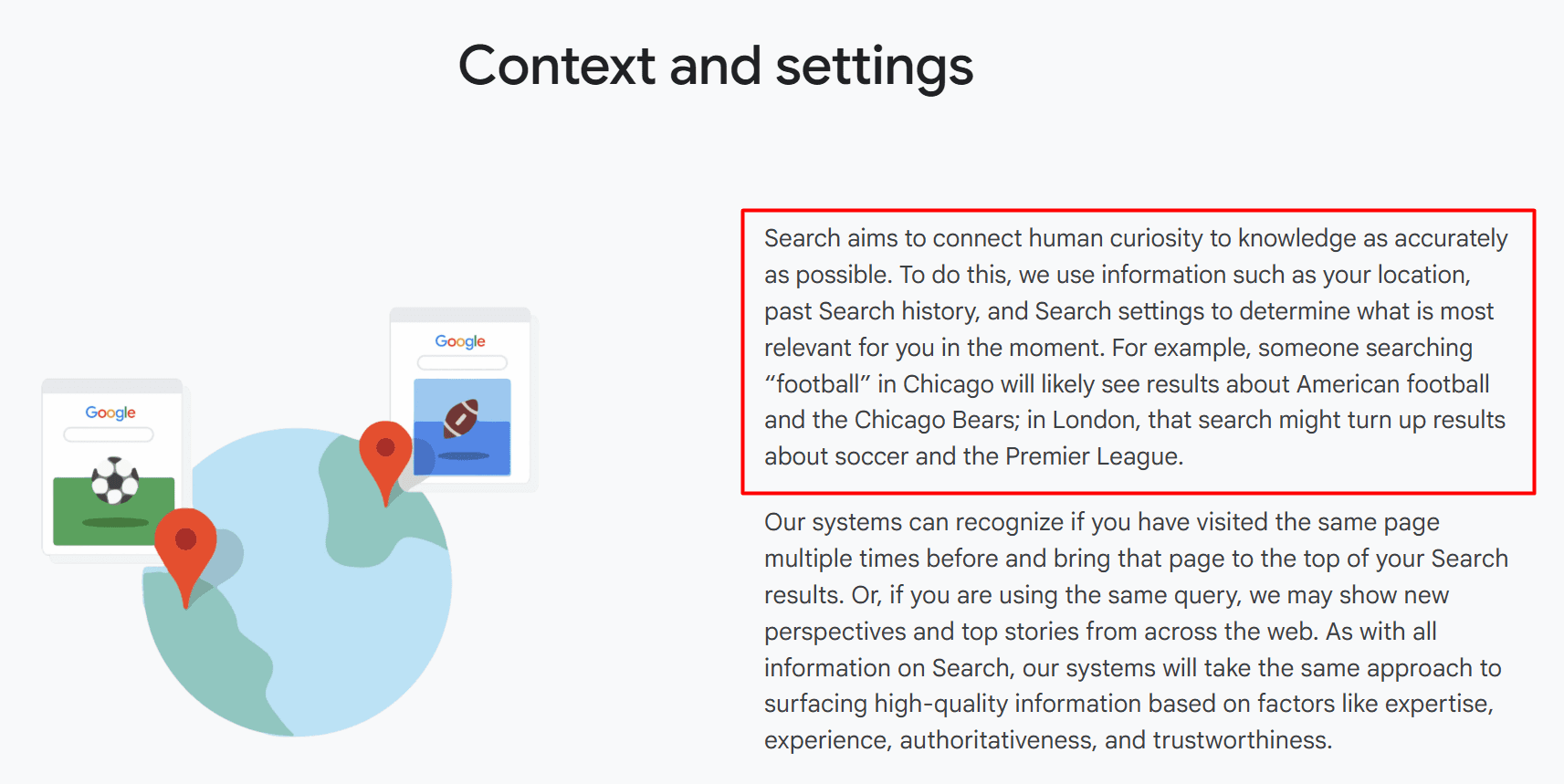
Source: How Search Works
In other words, checking your keyword rankings from a corporate network gives you little to no insight into what a customer sees even just three states away.
SEO teams can use geographically targeted residential proxies to check how search results and local search features appear in different markets. For more reliable comparisons, they should also control device type, language, search settings, and personalization where possible.
Residential proxies make it easier to collect location-specific search data without maintaining physical connections in every market. However, they don’t guarantee an exact reproduction of an individual user’s search results or prevent rate limiting.
#4 Ad Verification & Campaign Compliance
Digital advertising burns through massive budgets, which makes global campaigns a prime target for ad fraud. Shady publishers can show a perfectly clean ad to corporate compliance bots, but serve broken links or inappropriate content to everyday users in specific cities.
Residential proxies can help ad verification teams inspect how advertisements and landing pages appear from different geographic locations. This is useful for identifying incorrect targeting, broken landing pages, unauthorized placements, or potential brand safety concerns.
However, an IP address alone doesn’t reproduce a complete consumer browsing experience. Ad delivery may also depend on cookies, device characteristics, account data, and audience targeting. Effective verification combines geographic testing with consistent browser configurations and documented review criteria.
#5 Brand Protection & Counterfeit Tracking
Global brands constantly battle unauthorized resellers and fake product listings on international marketplaces. The problem is that hunting down scammers from corporate headquarters rarely works, as perpetrators tend to block corporate IP addresses.
To catch trademark violations, companies must blend in with normal shoppers. Deploying automated monitoring tools through residential proxies allows brands to quietly audit regional storefronts worldwide and flag fake products or sketchy pricing across multiple countries.
A great example of this is the luxury audio brand Bang & Olufsen (B&O). To protect its high-end tech, B&O partnered with BrandShield to launch continuous, automated web scrapers across major marketplaces and social networks.
These tools gathered vast amounts of listing data for instant machine-learning analysis. And by using residential proxies to scale its operations beyond human limits, B&O successfully automated the detection of grey-market dealers and fakes. Ultimately, the brand achieved a 98% success rate in scrubbing infringing content from the web.
#6 Running Multiple Accounts Without Hassle
Managing several client social profiles or store accounts from one office computer is a quick way to get locked out. Major platforms watch login locations closely to stop spam, and they often flag a single internet connection handling dozens of accounts.
Sticky residential proxies and static ISP proxies can provide consistent IP addresses for account workflows that require stable connections. Assigning an appropriate connection to each authorized account may help reduce unexpected location changes, but it doesn’t eliminate security checks or guarantee that accounts won’t be restricted.
Teams should follow each platform’s account-management policies and use appropriate authentication and security measures.
What Are the Benefits of Residential Proxies?
Residential proxies are worth the cost when their connection options solve a problem you actually have. Here’s where that value comes from.
Fewer Restrictions Based on IP Origin: Residential proxies use IP addresses associated with consumer internet connections rather than conventional cloud hosting networks. This can help with certain IP-based access restrictions, although websites may still identify and block unwanted automated traffic.
Location-Specific Market Insights: Providers with broad geographic coverage allow businesses to check regional pricing, search results, advertisements, and other localized content. Accuracy depends on available IP locations and the target website’s other personalization settings.
Flexible Rotation and Sessions: Many residential proxy services support both automatic IP rotation and temporary sticky sessions. Rotation is useful when individual requests don’t require a consistent address, while sticky sessions help maintain continuity during multi-step workflows. Session availability varies by provider.
Simplified Connection Management: Residential proxy providers typically manage their IP pools, gateways, and routing infrastructure. Users can configure supported locations and session settings without maintaining individual residential devices, making geographically distributed data collection easier to manage.
Residential Proxy Providers and Static ISP Alternatives
Residential proxy providers differ in geographic coverage, IP rotation, session controls, and pricing. Some specialize in large networks of rotating consumer IPs, while others, such as HypeProxies, focus on dedicated static ISP addresses hosted on server infrastructure. The best choice depends on whether your workflow needs geographic variety or consistent long-term connections.
| Proxy Provider | Core Offering | How It Bills & Fits Your Work |
|---|---|---|
| HypeProxies | Dedicated static ISP proxies hosted on server infrastructure. | Flat-rate pricing per IP, with advertised unlimited bandwidth subject to its Acceptable Use Policy. Suitable for recurring tasks requiring stable addresses. |
| Bright Data | Large rotating residential network with geographic targeting and session controls. | Bandwidth-based pricing, including pay-as-you-go options. Suitable for collecting location-specific data across many markets. |
| Oxylabs | Large residential proxy network with rotation and session management. | Per-GB subscription tiers. Suitable for large-scale data collection across multiple regions. |
| Decodo | Rotating residential proxy network with geographic targeting and sticky session support. | Per-GB subscriptions and pay-as-you-go options. Suitable for flexible residential proxy workloads. |
Swipe horizontally to view the full comparison.
Your first move should always be to check how the connection behaves and how it holds a session. You can then evaluate the price tag. The word “residential” is a broad label, so it helps to know exactly what’s under the hood before you buy.
Build Reliable Data Workflows with HypeProxies Static ISP Proxies
Rotating residential proxies are useful when you need access to consumer IP addresses across multiple regions. However, they aren’t always the best fit for workflows that require the same IP address over an extended period.
HypeProxies offers dedicated static ISP proxies that combine consumer ISP-registered addresses with data-center infrastructure. Rather than routing requests through individual household devices, the service provides stable IP allocations hosted on its US-based infrastructure in Ashburn, Virginia, and Dallas, Texas.
Why Data Teams Choose HypeProxies
Dedicated, Static IP Addresses: Each customer receives dedicated IP addresses that remain assigned throughout the active service period. This makes them suitable for recurring tasks where maintaining a consistent IP address matters.
Predictable Monthly Pricing: Standard ISP proxy plans start at $65 per month for 50 addresses, equivalent to $1.30 per IP. Plans include advertised unlimited bandwidth, subject to HypeProxies’ Acceptable Use Policy, without traditional per-GB billing.
10 Gbps Network Infrastructure: HypeProxies operates server infrastructure with 10 Gbps network capacity, supporting data-intensive workloads. Actual response times depend on the target website, network conditions, and application configuration.
Common Proxy Protocol Support: HypeProxies supports HTTP, HTTPS, and SOCKS5 connections with username-and-password authentication, allowing integration with compatible scraping tools, browsers, and automation software.
HypeProxies also offers a 48-hour free trial without requiring a credit card. Test your target websites, measure request success rates, and confirm that dedicated static IPs meet your workload requirements before scaling.
Explore HypeProxies ISP proxies and find the right plan for your project.
Key Takeaways
No single proxy type is perfect for every situation. Paying premium prices to scrape basic, unprotected public data makes as much sense as buying a Ferrari just to drive it in a school zone.
Consider this quick decision matrix as your rule of thumb before you start gathering data:
Datacenter Proxies: Best for speed and tight budgets. Use these for basic public pages, price tracking, or websites with loose security. They give you blazing-fast speeds at a fraction of the cost.
Rotating Residential Proxies: Best for strict anti-bot security and global reach. Use these for major ecommerce stores and localized search engine results. They route your requests through real home internet connections for maximum stealth.
Static ISP Proxies: Best for steady accounts and flat-rate billing. Use these when you need to stay logged into an account, handle multi-step checkouts, or run long-lasting tasks without worrying about expensive per-gigabyte data fees.
Before you scale up, always test a small sample against your target website. Keep a close eye on your success rates and connection speeds to build a reliable pipeline that keeps your data flowing smoothly. Explore our static residential proxies.
Share on
No credit card required. Request your free trial today.
Stay in the loop
Subscribe to our newsletter for the latest updates, product news, and more.
No spam. Unsubscribe at anytime.


