Best Proxies for Web Scraping in 2026: The Economics of Ownership vs. Renting
In 2020, a scraper could fetch a lightweight HTML page (50KB) for pennies. In 2026, extracting data requires headless browsers like Playwright or Nodriver to render complex React/Next.js applications. For AI agents requiring vision (screenshots) or full rendering, the average payload per request has increased to 2MB+, a 40x increase.

Gunnar
Last updated -
Why Hype Proxies

Most "Best Proxy" lists ignore this reality. They recommend metered residential proxies that charge $8 to $15 per gigabyte. At that size, a single scraper can burn through the budget in hours.
This guide analyzes the 2026 proxy landscape through the lens of real-world costs, network performance, and practical engineering. Whether you're running large-scale data extraction or powering AI agents, understanding these fundamentals will help you choose high-trust ISP IPs that actually deliver ROI, not just impressive marketing numbers.
Proxy types compared: datacenter vs residential vs ISP
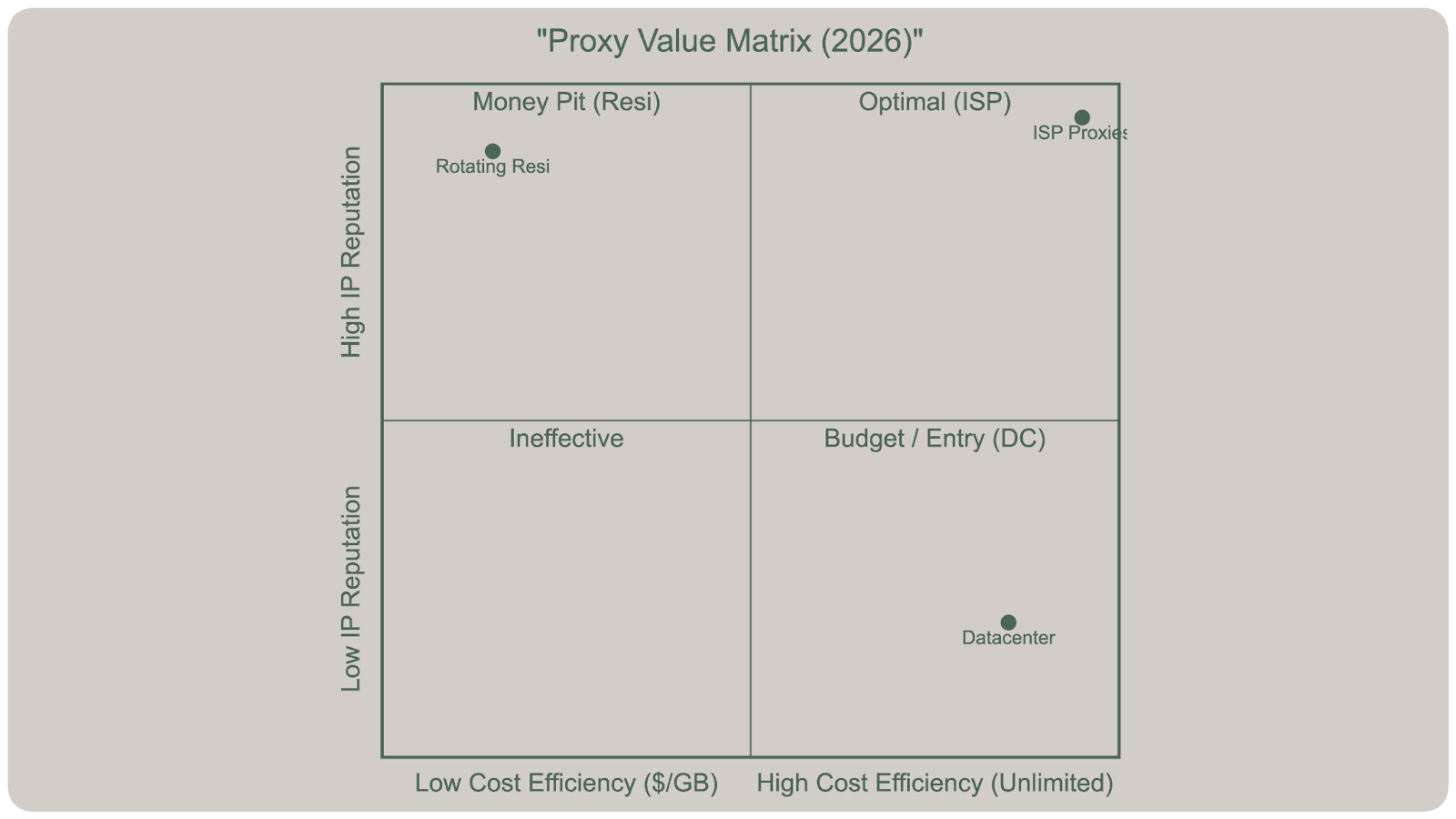
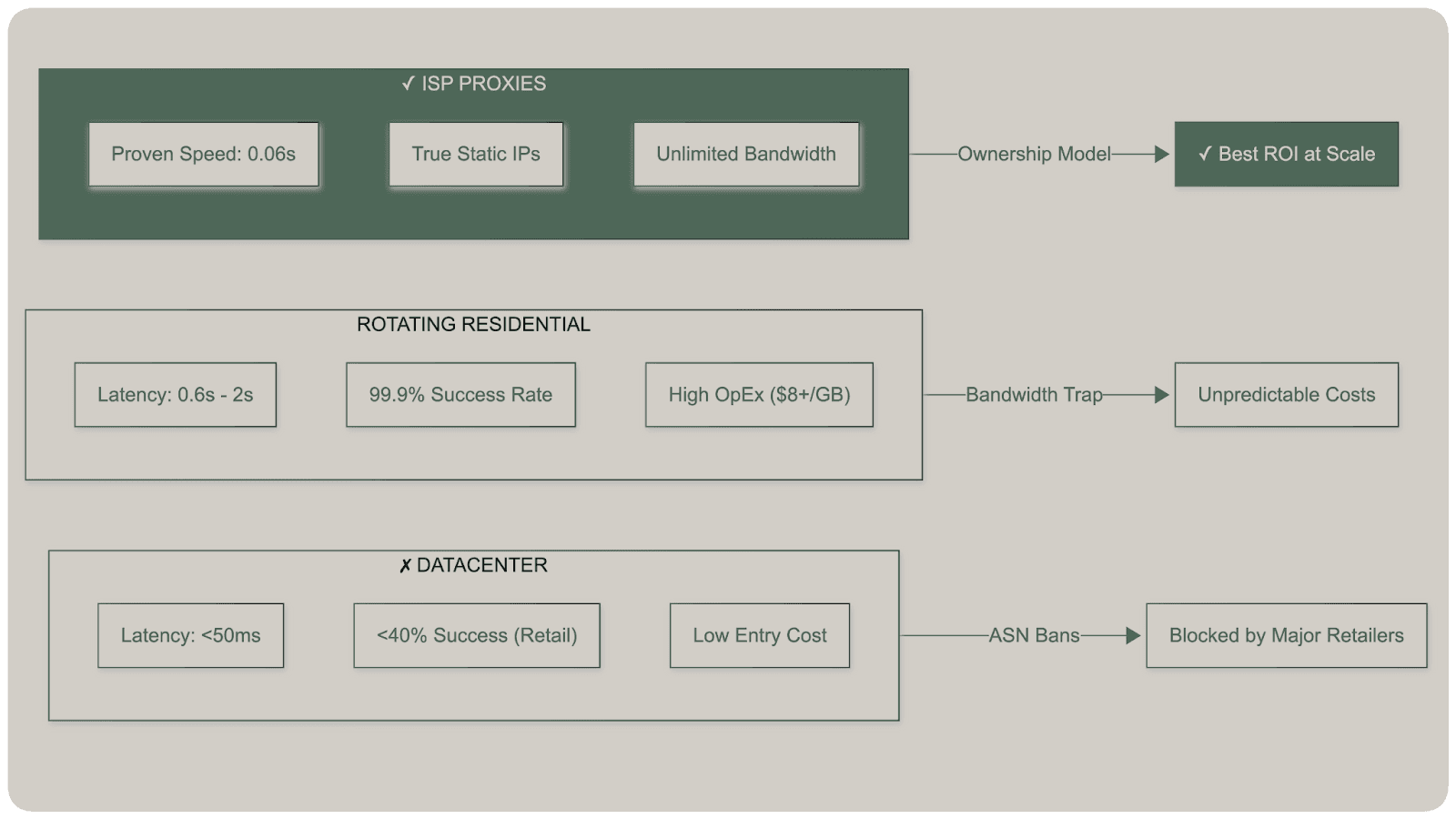
There are really only three options worth considering for web scraping: datacenter, rotating residential, and ISP proxies. Each has a distinct tradeoff profile, and understanding those tradeoffs will save you from learning them the expensive way.
1. Datacenter proxies: fast and cheap, but flagged
Datacenter proxies are fast and cheap, but they come with baggage. Major retail sites like Amazon and Nike block cloud provider ASNs on sight. If your IP traces back to AWS or DigitalOcean, you're rejected before your request even hits the server.
That said, they're far from useless. For scraping news sites, B2B directories, or APIs without aggressive anti-bot fingerprinting, datacenter proxies still offer the best ROI. The key is knowing where they work and where they don't.
2. Rotating residential proxies: the evasion standard
When a target is heavily protected, rotating residential proxies are often the only way in. By routing traffic through millions of real consumer devices, your requests look indistinguishable from normal users. Cloudflare, Akamai, and PerimeterX all have a harder time blocking traffic that genuinely originates from a Comcast subscriber's home WiFi.
The tradeoff is cost and speed. Traffic hops through real user devices, which adds latency (typically 200ms–600ms). And pricing is almost always per-GB, usually $8–15. On modern pages that load 2MB+ of assets, that adds up fast. Smart teams work around this by blocking images, fonts, and media before the request fires, but it requires engineering effort that not everyone wants to invest.
3. ISP proxies: the best of both worlds (with a caveat)
ISP proxies sit in a unique position for web scraping workloads. They're hosted in datacenters, so you get the speed and reliability of enterprise infrastructure, but they're registered to real ISPs like Verizon or AT&T. To anti-bot systems, they look residential. To your scraper, they feel like datacenter.
Most ISP proxies are sold as static IPs with flat-rate or unlimited bandwidth, which makes budgeting predictable. But "static" means they don't rotate automatically. That's a feature, not a bug. It makes them ideal for logged-in sessions, AI agents, or any workflow that needs a consistent identity. If you're hammering a single target with thousands of requests, though, you'll need to build rotation logic yourself or risk burning the IP.
The "pool size" reality: why 50M IPs is a vanity metric
When evaluating providers, the industry has trained us to ask, "How big is the pool?" This is the wrong question. In web scraping, cleanliness beats count.
When a provider advertises "50M IPs", they're counting every device that has ever touched their network. Most are offline, slow, or already burned by other users. You don't need a massive pool to scrape at scale; you need IPs that stay online and stay clean.
We process billions of requests monthly on a static infrastructure of verified ISP IPs. That performance isn't luck; it's physics. A dedicated ISP IP hosted in a Tier-1 datacenter delivers significantly more throughput and stability than a fluctuating residential connection running through someone's home WiFi.
The real question isn't "how many IPs do you have?" It's "do I have true ownership of the infrastructure, or am I fighting for scraps in a shared pool?"
AI agents and proxies: why static IPs matter
This is where a lot of teams are getting burned right now.
Bots don't just "scrape" anymore; they "browse". They log in, navigate complex interfaces, and execute multi-step tasks that mirror human behavior. Scraping has evolved from simple request-response patterns to sophisticated autonomous workflows.
This creates a conflict with traditional proxy architectures. Most rotating proxies try to solve state persistence with "sticky sessions": holding an IP for 10 to 30 minutes. But for an AI agent performing a long-running task, 30 minutes isn't enough. If the residential peer goes offline mid-task (which happens constantly), your agent loses its session, its cookies, and its progress.
With HypeProxies ISP IPs, you can assign a specific IP to an agent for days or weeks, not just minutes. The agent builds trust with the target site over time, performing multi-step tasks without the risk of a mid-workflow disconnect.
Consider an AI agent monitoring competitor pricing. It needs to log in, handle 2FA, and navigate dynamic pages. With a rotating proxy, a sudden IP change triggers "Impossible Travel" flags. The system sees you jump from London to New York in one second, and the account gets locked. With a static ISP proxy, the agent operates from a consistent identity. It looks like a human user returning to the site, not a botnet cycling through random connections.
Proxy provider comparison: Bright Data vs Oxylabs vs HypeProxies
In Proxyway's independent benchmark, HypeProxies achieved one of the fastest response times (0.06s) in the ISP category, validating what we'd seen internally: owned infrastructure outperforms shared pools.
Here's how the major players stack up for high-volume operations:
Provider | Best For | Tradeoff |
Bright Data / Oxylabs | Global Geo-Targeting (195+ Countries) | Overkill Costs. You pay a premium ($8+/GB) for global reach, even if you only need US IPs. |
Decodo (formerly Smartproxy) | Entry-Level Scraping | Shared Resources. Their cheap ISP IPs (~$0.27/IP) are often shared/semi-dedicated, leading to lower IP Reputation. |
HypeProxies | High-Velocity Ops, AI Agents | Dedicated Performance. You pay for clean, private US infrastructure with unlimited bandwidth, avoiding global bloat. |
For teams requiring global coverage across 195+ countries with enterprise SLAs, the premium providers justify their costs. But for US-focused operations prioritizing throughput and predictable budgets, the unlimited bandwidth model eliminates the variable cost concerns that affect metered alternatives.
For detailed comparisons, see our proxy provider comparisons.
Proxy pricing comparison: per-GB vs unlimited bandwidth
Per-GB pricing looks cheap until you see actual data volumes.
Let's run the numbers on a real scenario: continuously monitoring 100,000 product pages monthly using a headless browser. At 2MB per page (full asset load), that's 200GB of bandwidth.
Provider Type | Pricing Model | Unit Cost | Monthly Cost |
Rotating Residential | Per GB | ~$8.00/GB | $1,600.00 |
HypeProxies ISP | Per IP (Flat) | ~$1.25/IP | $125.00 (for 100 IPs) |
By owning your IPs, you can save up to 90% on costs, provided you manage them responsibly.
While rotating residential proxies allow for "lazy" scraping (changing IP every request), owning high-trust ISP IPs allows for efficient scraping. With the right session management, you can extract the same amount of data for a fraction of the price, turning a variable operating expense into a predictable flat fee. Running the headless browser behind that scraping is CPU-heavy, so teams doing it at volume run it on a bare metal server to keep throughput steady. If you want to push costs down even further, these tips to reduce proxy bandwidth costs are worth applying.
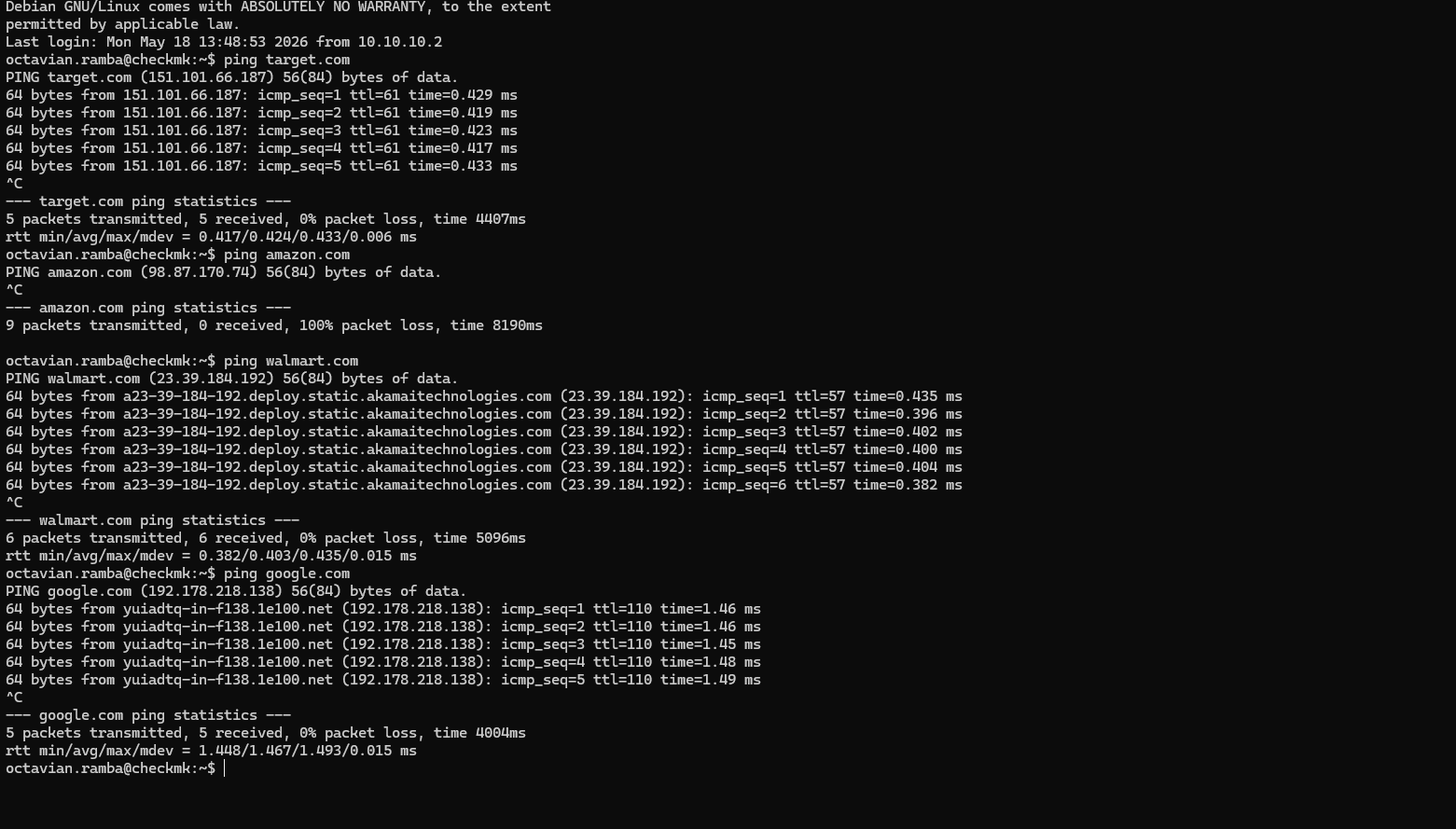
Live latency check from Hypeproxies's newly opened datacenter in Dallas showing <1ms response time to Amazon, Walmart, and Target. Lower latency means quicker requests during checkouts, queue entries, and high-demand drops.
Validating your setup: testing proxy quality
Before deploying any proxy infrastructure at scale, validation is critical. A proxy that works in testing may fail under production load, and issues like slow response times or "Impossible Travel" flags can silently degrade your entire operation.
It's tempting to skip validation and trust the provider's word. Then you hit production volume and wonder why your accounts are getting locked. This isn't hypothetical. In January 2026, Google disrupted IPIDEA's proxy network, knocking 9 million devices offline. Providers like LunaProxy and ABCProxy saw their infrastructure collapse overnight. The reason? IPIDEA recruited devices through hidden SDKs in consumer apps, and Google finally shut it down.
Here are 3 quick tests worth running before you go live:
First, check the fraud score. Run your IPs through detection APIs like Scamalytics. Clean IPs typically score under 30. If you're seeing scores above 70, you're likely getting abused botnet devices or renamed datacenter IPs sold as "residential".
Second, verify the reverse DNS. Real ISP IPs resolve to ISP-affiliated hostnames like Verizon, Comcast, or AT&T. If the rDNS points to AWS or OVH, it's not an ISP proxy, no matter what the provider claims.
Third, test for session stability. If you're running AI agents, watch for "teleportation". When an IP jumps from Texas to Germany within a single session, you'll trigger Impossible Travel flags. Real users don't teleport; your proxies shouldn't either.
Use our proxy speed & fraud score check to verify these metrics before committing to any large-scale deployment. This single step can prevent hours of debugging failed requests.
Key takeaways
ISP proxies offer unlimited bandwidth vs $8-15/GB for rotating residential, with up to 90% cost savings at scale
Pool size is a vanity metric: 1,000 clean dedicated IPs can outperform 50M dirty shared ones
AI agents perform best with static IPs for session persistence; rotating proxies break multi-step workflows
Verify before you buy: check fraud score (<30), reverse DNS (real ISP hostname), and geo-consistency
Ownership beats rental: predictable costs and full control over IP reputation
Conclusion: stop renting, start owning
In 2026, the "best" proxy isn't the one with the biggest marketing number. It's the one that performs reliably at scale.
You can pay per GB to rent access to a shared pool of 50M recycled IPs. Or, you can invest in dedicated infrastructure: clean, isolated ISP IPs with 100Gbps headroom that you actually control.
Most vendors sell access. We deliver ownership.
The choice comes down to whether you want to treat proxies as a variable expense that grows with success, or as fixed infrastructure that enables unlimited growth. For serious operations, whether AI agents, retail monitoring, or data pipelines, the ownership model delivers better economics, reliability, and control.
We recently wrote a comparison of top ISP Proxies, so do check that out too.
If this sounds like a better fit for your operation, see our plans and pricing to get started.
Frequently asked questions
What are the best proxies for AdsPower, GoLogin, and Multilogin?
ISP proxies (Static Residential) are the safest choice. These browsers rely on a consistent digital fingerprint. If you use a standard rotating proxy that jumps locations (e.g., Texas to Germany) while your browser profile stays the same, you trigger "Impossible Travel" flags. A static ISP IP ensures your network identity matches your browser's stability.
Can I test the proxies before buying?
Yes. We offer a trial with a nominal verification fee ($1). We charge this small amount to verify identity and keep our IP pool clean from abusers, ensuring better performance for professional users.
Why is unlimited bandwidth critical for AI scraping?
Modern AI data collection involves downloading heavy HTML, images, and videos for multimodal training. If you pay per GB (standard residential pricing), your costs will explode. Unlimited bandwidth allows you to feed your models continuously without watching the meter.
How do I know HypeProxies IPs are legitimately sourced?
Our ISP proxies resolve to authentic ISP hostnames (like Verizon, AT&T, or Comcast) via reverse DNS lookup. We work directly with ISPs through real partnerships, so every IP is ethically sourced and verifiable.
How do I integrate HypeProxies with my existing stack?
We support all major frameworks and tools. Check our integration guides for step-by-step setup with Playwright, Puppeteer, Scrapy, Requests, Selenium, and more.
Share on

$1 one-time verification. Unlock your trial today.
Stay in the loop
Subscribe to our newsletter for the latest updates, product news, and more.
No spam. Unsubscribe at anytime.