7 Things to Look For in a Proxy Server for Web Scraping
Web scraping is a demanding workload for a proxy. If you pick the wrong one, requests get blocked, sessions break mid-checkout, and the bill climbs with your volume. So run any proxy server for web scraping through the 7 checks before you commit.

Gunnar
Last updated -
Why Hype Proxies

TL;DR
The right proxy server for web scraping passes 7 checks: IP type, sourcing, sessions, pricing, threads, location, and proof.
Anti-bot systems check the IP type early and weigh it heavily. Datacenter ranges get blocked far more often, so your IPs need to read as a real ISP.
Sourcing shapes the risk. Proxy pools built on consumer devices can disappear in one takedown. By Google's account, IPIDEA and NetNut went down that way in 2026.
Per-gigabyte pricing ties your bill to your volume. With per-IP pricing and unlimited bandwidth, a heavy month doesn't mean a heavy bill.
The label on a product page won't tell you much on its own. Check any IP's type, ASN, and fraud score in a free proxy checker before you pay.
The 7 checks at a glance
# | Check | What to look for |
|---|---|---|
1 | IP type | Reads as ISP to IPinfo and MaxMind, not datacenter |
2 | Sourcing | IPs on provider-owned infrastructure, not consumer devices |
3 | Sessions | Static IPs that hold through logins and multi-step flows |
4 | Pricing | Per IP with unlimited bandwidth, not per gigabyte |
5 | Threads | Unlimited threads, no connection caps |
6 | Location | Close to your targets, with more than one location |
7 | Proof | A public checker and a small plan that you can cancel |
1. IPs that read as a real ISP, not datacenter
Many sites check your IP's type before they evaluate your request. Databases like IPinfo and MaxMind set that type, and anti-bot systems weigh it heavily.
An IP on a cloud or hosting range gets typed as datacenter. Protected sites block datacenter ranges far more aggressively. An IP on a carrier network gets typed as ISP, and it is blocked far less often.
Speed doesn't change the type. So check the type in a proxy checker before you compare anything else.
2. Sourcing that you can trace to owned infrastructure
Ask one question before you buy: where do these IPs come from? There are 2 common answers. Some providers own their infrastructure, and their IPs sit on carrier networks with their own servers behind them. Others build their pools from consumer devices, enrolled as exit nodes through SDKs inside apps.
Two takedowns in 2026 show why sourcing matters. IPIDEA in January and NetNut in July both went down, and the FBI seized NetNut's domains. By Google's account, both pools ran on consumer devices, and a takedown reached that layer. A pool on owned infrastructure has no such layer, so that kind of takedown has nothing to reach.
3. Static IPs that hold a session
Scraping usually covers many pages. Logins, carts, search flows, and paginated results all need the same identity across many requests. A rotating IP can change in the middle of that flow. The session then breaks at the point that matters most.
A static IP does not change. A login or a multi-step flow runs on the same IP from start to finish. If your scraping touches accounts or checkout, static IPs are close to a requirement. Rotating pools fit wide crawls where no session matters.
4. Pricing that doesn't meter your bandwidth
Per-gigabyte pricing gets expensive at volume. A heavy month means a heavy bill, and the cost rises with every gigabyte.
Look for per-IP pricing with unlimited bandwidth. You pay for the IPs, not the traffic, so the bill stays the same whether you pull a little or a lot. A fixed bill lets you budget for scraping at scale.
5. Unlimited threads
At scale, a scraper opens hundreds of concurrent connections. If a plan caps threads, it throttles your throughput at the proxy, no matter how fast your code is.
So check the concurrency terms. The plan should allow unlimited threads, on a network that can carry them. A 10 Gbps port is one good sign.
A limit can slow you down even if the plan doesn't mention it. Run your real concurrency early and see if throughput flattens.
6. More than one location, close to your targets
In a pipeline that makes millions of requests, the round-trip between your proxy and your target adds up fast. So compare the proxy locations against your targets. From inside our Dallas location, we measured sub-millisecond ping to Walmart and Target, because the proxies sit near those retailers' infrastructure.
In our own test from Ashburn, ping was under 1 ms to Walmart and about 1 ms to Target and Google.
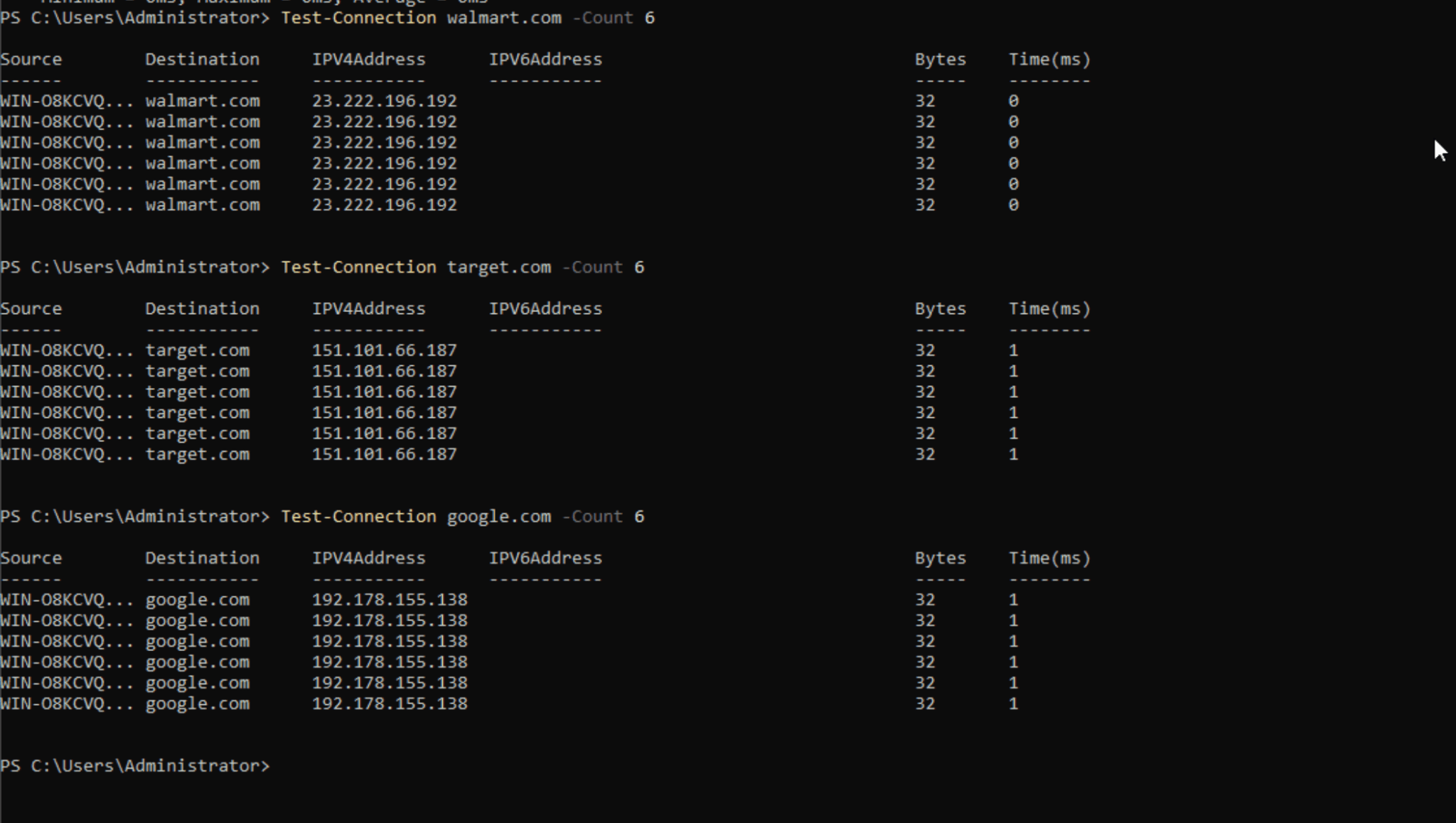
Measured from a HypeProxies server in Ashburn, VA. Amazon isn't included because it blocks ping requests.
A second location matters too. When all of your traffic routes through one network, it's much easier to fingerprint and rate-limit. When the same traffic is spread across separate carrier networks and separate locations, it's much harder to block. A problem in one place doesn't stop everything you run.
7. Proof that you can verify yourself
Clean IPs are easy to claim and hard to verify. The label on the product page might say "residential", "ISP", or "static residential", and the label alone won't tell you much. You can trust a check that you ran yourself.
So verify in this order. First, run an IP through a public checker and read its type, ASN, and fraud score. You can check a pool that you already own right now, or a provider's IP once you have one. Our free checker reads all three with no signup.
The type should not read datacenter. For ISP proxies, it should read "isp". The ASN should belong to a carrier rather than a hosting company, and the checker names it so you can look it up. Fraud scores usually run from 0 to 100, and lower is better.
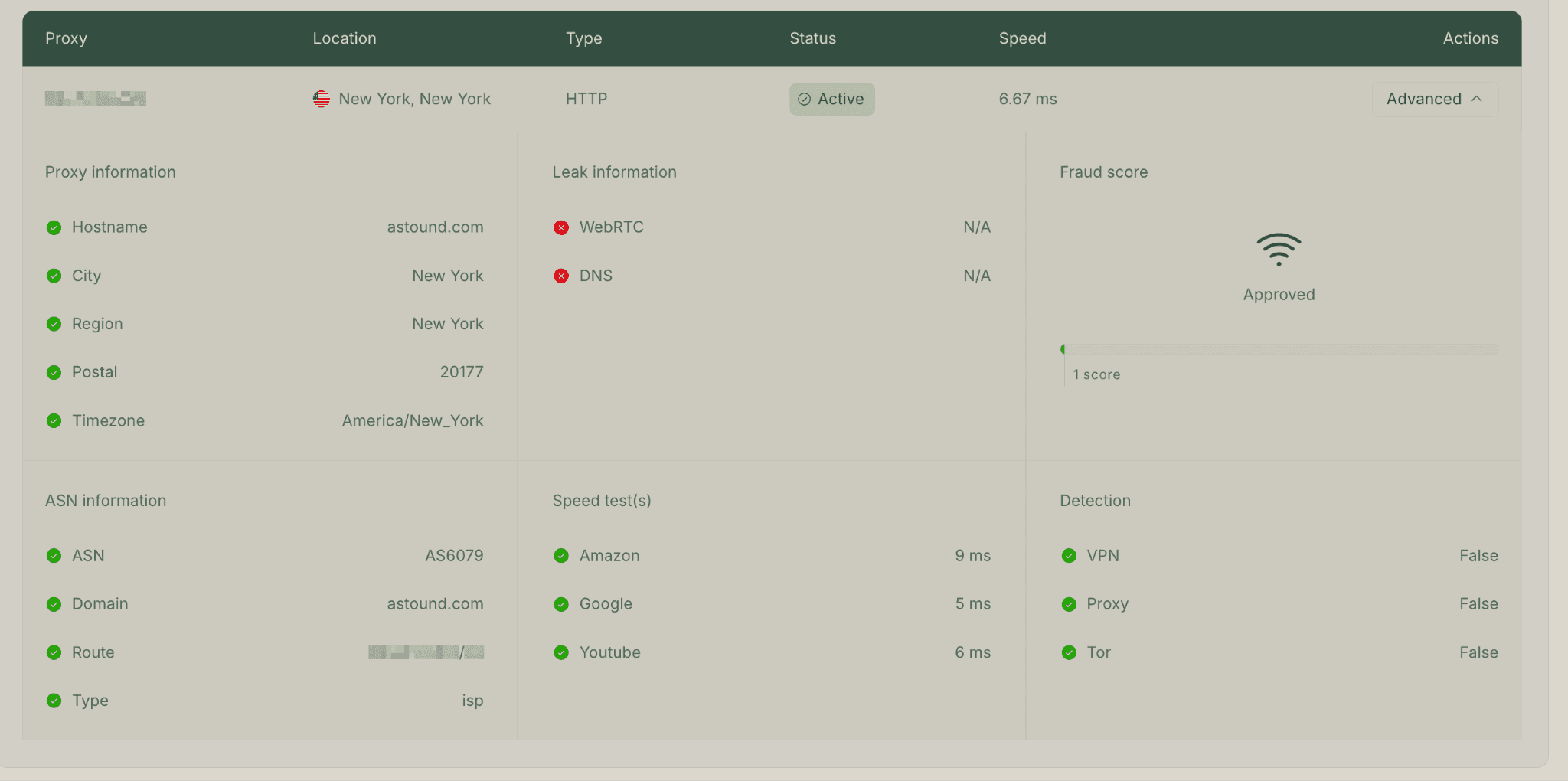
One of our own IPs, checked in our own tool, with the IP and route masked. The type reads "isp". The ASN belongs to a carrier. The fraud score is 1, and Proxy, VPN, and Tor all read False.
Then start with the smallest plan that you can cancel, it’s also worth comparing a few ISP proxies providers before you commit. Run it against your own targets for a few days and watch the block rate. Compare it against whatever you run now, on the same targets and the same jobs. No published block rate tells you as much as your own.
Where our own product fits
We build for some of these checks, not all of them. HypeProxies runs 500K+ static US proxies on our own infrastructure, with per-IP pricing, unlimited bandwidth and threads, and locations in Ashburn and Dallas. The network has run since 2019 and handles more than 60B requests a month at 99.9% uptime. HypeProxies fits if your scraping needs stable sessions on clean US IPs.
We're US-only and ISP-only. A dedicated residential provider is the better tool if you need large rotating pools, mobile IPs, or coverage outside the United States.
Run the checks
Put any IP through the free checker and read the type, ASN, and fraud score for yourself. Then see the plans of ISP proxies, start with the smallest one, and test it against your own targets.
Frequently asked questions
What type of proxy server is best for web scraping?
It depends on the work. Static ISP proxies fit best for stable sessions on protected US sites, in flows like logins, checkout, and account management needed for scraping. They pass the type check and hold a session. Rotating residential pools fit better for wide crawls that need thousands of IPs across many countries. Datacenter proxies fit best on unprotected sites.
Are datacenter proxies good enough for web scraping?
For unprotected sites, yes, and they're cheap. But protected sites block datacenter ranges at the type check, often before the rest of the request is evaluated. If your targets run anti-bot systems, datacenter IPs usually fail first.
What is the difference between ISP and residential proxies for scraping?
The difference is the source. Residential proxies route through consumer devices, usually enrolled through an app, so the IP can vanish when the device goes offline. ISP proxies are static IPs on carrier networks, with provider-run infrastructure behind them. Both pass the type check, but ISP is more stable, because no consumer device can switch it off.
How do I test a proxy server before buying?
In 2 steps. Run an IP through a free checker and confirm the type, ASN, and fraud score. Then buy the smallest plan that you can cancel, and watch its block rate on your own targets for a few days. Your targets and your block rate are the benchmark that matters most.
Share on

$1 one-time verification. Unlock your trial today.
Stay in the loop
Subscribe to our newsletter for the latest updates, product news, and more.
No spam. Unsubscribe at anytime.