ISP Vs Datacenter Proxies For Ticket Sites: Why ASN Beats Speed
Most advice about buying tickets with proxies starts with speed. Get a faster proxy, shave off some milliseconds, click before everyone else. It sounds right, and it costs people real money every year, because on a modern ticket site speed is not the first thing that decides whether you get through. The site decides whether to trust your connection at all, and it does so before your request ever reaches the part where speed matters. It comes down to one thing first: the network your IP sits on, its ASN.

Gunnar
Last updated -
Why Hype Proxies

A datacenter IP is therefore blocked before speed ever matters, and a clean ISP IP is what clears that gate. But the gate is only the first of four or five detection layers that fire at once. The IP gets you in the door, and the rest of your setup decides whether you stay in.
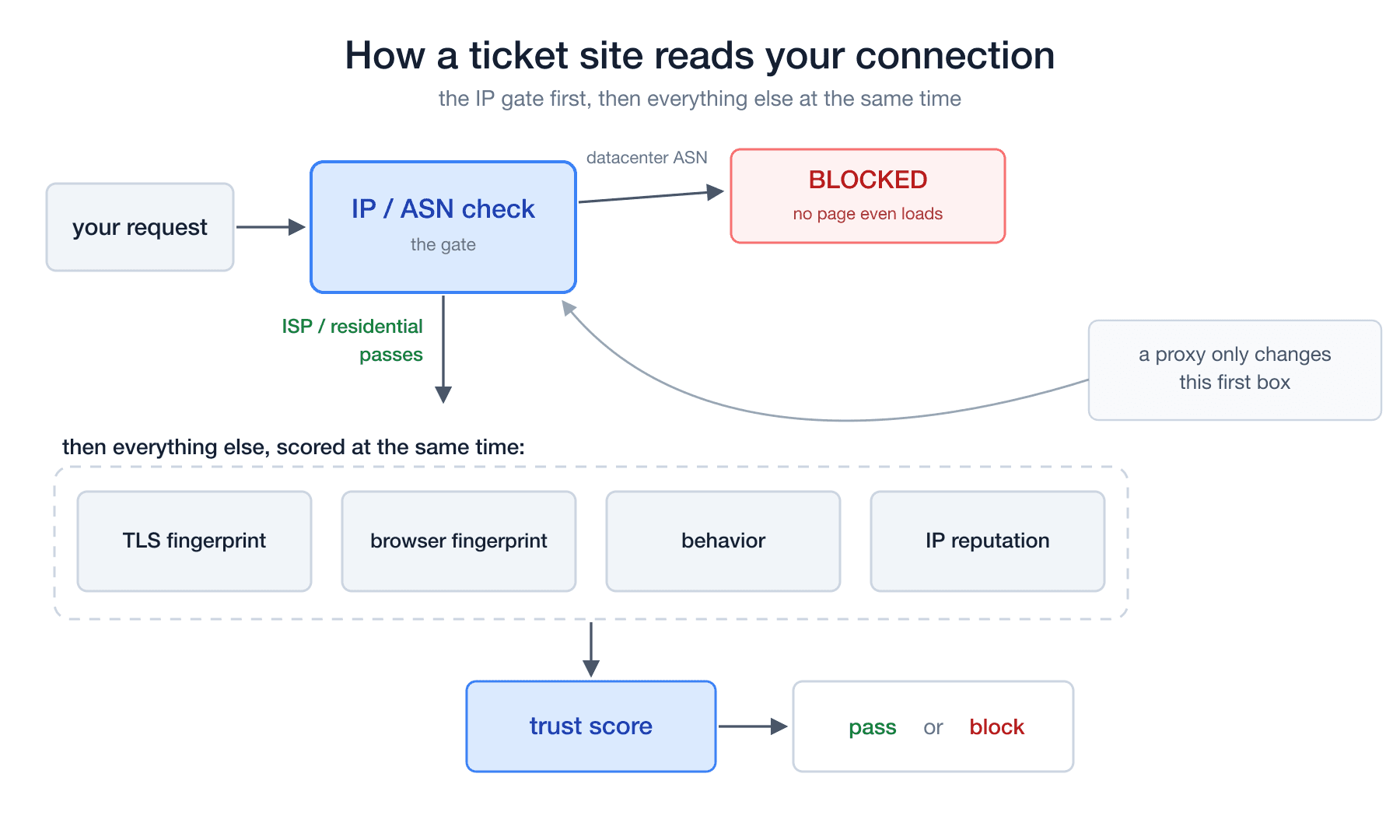
The gate comes first. A datacenter IP is blocked there, before the site scores anything else, and a proxy only changes that first box.
The site checks your ASN before it checks anything else
An ASN, an autonomous system number, is the identifier for the network an IP belongs to. Every IP sits on one. A home connection sits on a carrier's ASN, like Comcast or Verizon. A server you rent from a cloud provider sits on that provider's ASN, like AWS, Google Cloud, or OVH. That difference is the first thing a ticket site checks.
The systems that protect ticket sites (anti-bot engines like DataDome and HUMAN Security, and waiting-room platforms like Queue-it) keep a database of known datacenter ASNs. When a request arrives from one of those ranges, it's flagged as a bot before anything else happens. DataDome describes this plainly: a datacenter IP is blocked at the IP gate, before its behavioral models even run. Queue-it does the same, and rejects datacenter ranges outright while it gives residential and ISP ranges a baseline level of trust.
A datacenter proxy is blocked, no matter how fast it is. Speed can't help an IP that the site never let in. This is why ASN matters more than speed: the ASN decides whether you're in at all, and speed only matters once you are. The IP is also the one part of this you can check for yourself, in seconds, before you ever reach the site.
Why "just be fast" is the wrong lesson
Speed does matter, but it matters later, and in a smaller way than the advice suggests. It counts at checkout, not at the gate, because the gate is not a race but a trust check.
A proxy also does less than most sellers claim. It doesn't win the queue for you, and it doesn't bypass a purchase limit. Modern drops put everyone into a waiting room, and your place in that room is largely out of your hands. What a proxy actually does is narrower and more useful than "winning": it keeps your connection from being flagged as a bot, and it holds a clean session so you don't lose a cart you legitimately reached. That is the real job.
The ASN is the first gate, not the only one
Getting the ASN right is necessary. It is not the whole story, and the rest of the story matters more than it used to.
Modern anti-bot systems check several things in parallel, not one after another. DataDome scores a request across four layers:
The IP and its reputation: the ASN, and whether the address has a history of abuse.
The TLS fingerprint: the shape of the handshake, before a page even loads.
The browser fingerprint: canvas, WebGL, fonts, the details that identify the client.
The behavioral fingerprint: how the session types, scrolls, and moves the mouse.
DataDome runs more than a thousand machine-learning models on every request. HUMAN Security does the same job a different way, with a single trust score built from TLS, IP, HTTP headers, the JavaScript fingerprint, and behavior. All of them have to pass together. A clean IP that fails any one of the others is still a blocked IP.
The research says the same thing. A 2026 study found that a connection's TLS handshake alone can be classified as a bot with about 98 percent accuracy. Another study of AI browsing agents found that an agent's timing and mouse movement give it away even when the browser fingerprint looks clean, and in that test the researchers caught all seven agents while a major commercial system caught one. The IP is the entry ticket, and the fingerprint and the behavior are what settle it.
The IP also carries its own history, separate from the fingerprint. An IP that has been rotated through thousands of sessions, or logged into dozens of accounts, builds up a bad reputation over time, even when it's a residential or ISP IP. Systems like Ticketmaster's weigh exactly this kind of reputation data. Shared pools fail for a related reason: when many people route through the same subnet, one person's flagged behavior can get the whole range flagged, and everyone else on it inherits the block. This is why a cheap shared pool works one day and fails the next.
A clean ASN gets you through the first gate. Clean history, a normal fingerprint, and human-looking behavior get you through the rest.
The rules are being enforced now, too
The other change in 2026 isn't technical. The Better Online Ticket Sales Act, the US law against using software to circumvent a ticket site's purchase limits or security measures, went from a law nobody enforced to a law with live cases. The Federal Trade Commission and seven state attorneys general sued Ticketmaster and Live Nation under it. Part of the complaint was that brokers used software to route through proxy IP addresses and open extra accounts. In April 2026 a federal judge let a separate case against a ticket broker move forward, rejecting the argument that the law only covers fully automated bots.
A proxy is a legitimate tool for reaching a site without being wrongly blocked, and that's how we build ours. Using one to circumvent a purchase limit or a security check is different, and it is exactly what the FTC has taken to court.
What an ISP proxy actually is
The three proxy types are easy to blur, and the difference is exactly what a ticket site is scoring. They compare as follows:
Feature | Datacenter | Residential | ISP |
Where the IP sits | A cloud or hosting ASN (AWS, OVH) | A real home device | A static IP on a real carrier's network |
How the site reads it | Datacenter, flagged | Residential, trusted | ISP, trusted |
Speed | Fast | Slow | Fast |
Stability | Stable | Drops when the device goes offline | Static, holds a session |
At the first gate | Blocked | Passes | Passes |
The residential column is why real-device proxies work but also frustrate: they are trusted, but slow, and they drop. The ISP column is why ISP proxies became the standard tool for ticket sites, with a real carrier ASN, datacenter-grade speed, and a session that doesn't rotate out from under your checkout. That combination clears the first gate a datacenter proxy fails.
That said, an ISP proxy is not a universal key. On the hardest targets, a hot Ticketmaster or AXS on-sale, the strongest anti-bot systems catalog known proxy-provider ranges, ISP ones included, and flag them on sight. There, serious operators add true residential or mobile IPs, which sit on consumer devices the site trusts even more. Even so, ISP is the layer you clear the gate with first, and on its own it handles the large majority of sites.
None of this has to be taken on faith. Run any proxy through a checker before you trust it. If it comes back with a real carrier ASN, an "ISP" type, and a low fraud score, it clears the first gate; if it comes back on a hosting ASN, it doesn't, and no amount of speed will change that.
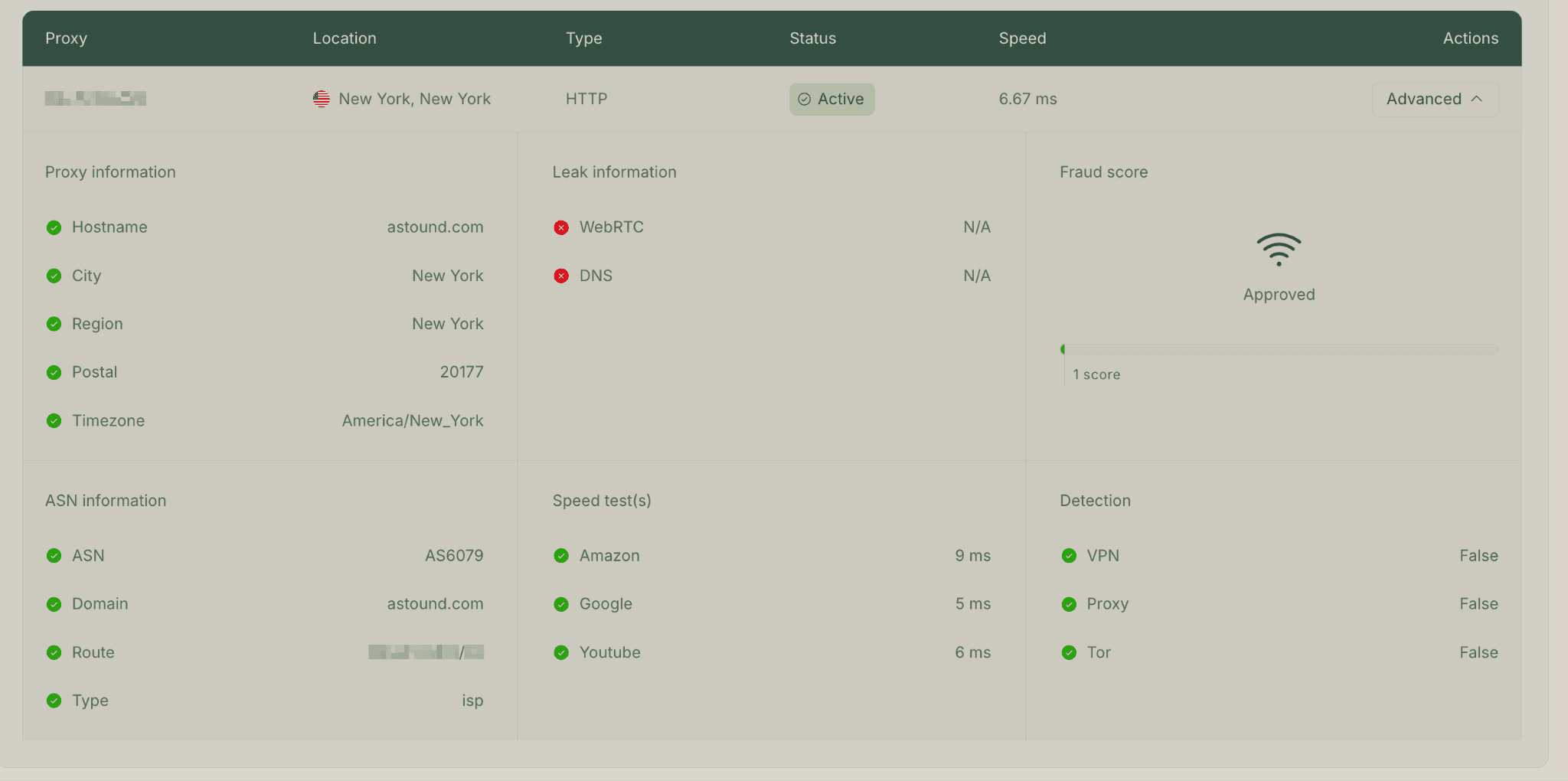
One of our own ISP IPs through our own checker (address masked): a real carrier ASN, an ISP type, a fraud score of 1, and Proxy, VPN, and Tor all reading False. That is what clearing the first gate looks like: the checker itself calling it "not a proxy".
The checker confirms the IP type and its public reputation, not that the proxy will succeed against a given target. The anti-bot systems score against their own data, so the only real proof is a live test against the site you actually care about.
Where HypeProxies fits
We build ISP proxies for exactly this first-layer problem. Our IPs are 500,000+ static US addresses that sit on real carrier networks, so IPinfo and MaxMind read them as a real ISP, not datacenter. That is what clears the first gate. They're static, with no rotation, so a session you start is a session you keep through checkout. You can verify all of it yourself with our free checker before you spend a dollar, and gives you enough clean IPs to test against your own targets.
A clean ISP proxy solves the first layer: it keeps you from being blocked at the gate, and it holds your session. It does not fix your fingerprint or your behavior; it does not win a randomized queue; and it does not bypass a purchase limit, because nothing does. The fingerprint layer is a separate tool entirely, which is why we wrote a setup guide for antidetect browsers. If a provider tells you their IPs alone will "win tickets", that is a claim we won't make.
An emerging anti-bot idea isn't a smarter fingerprint; it's proof of personhood, a biometric check that the buyer is a real human. Sam Altman's Tools for Humanity has already shipped one: artists can set aside seats for fans who verify they are real people, on Ticketmaster, Eventbrite, and AXS. If that spreads, no proxy helps at all, because the site stops checking your network and starts checking that you're a person. A clean IP was never going to be the thing that wins, but it's the price of admission and the one layer you fully control, and everything else fails the moment it does. That is the part to get right, and it is the one part actually in your hands.
Frequently asked questions
Are ISP proxies good for Ticketmaster?
For most ticket sites, yes. An ISP proxy sits on a real carrier ASN, so it clears the IP gate that blocks datacenter proxies, and it's static, so it holds your session. On the very hardest on-sales, known ISP-proxy ranges can be flagged, so operators pair in residential or mobile. Even then, ISP is the layer that clears the gate first, and on its own it handles the large majority of sites.
Why do ticket sites think I'm a bot?
Most often it's the IP. If your proxy sits on a datacenter ASN, like AWS or OVH, the site flags it as a bot before you do anything at all. The other causes are a browser fingerprint or a behavior pattern that looks automated, or an IP with a bad reputation from prior abuse. A clean ISP IP fixes the first of those, not the others.
Why do I keep getting CAPTCHAs on ticket sites?
A CAPTCHA is what a site shows when it is not sure about you, and much of that doubt starts with the IP. A datacenter or flagged IP draws more challenges, because the site already distrusts the connection. A clean ISP IP on a real carrier draws fewer, because it clears the first gate with a good reputation. A clean IP reduces CAPTCHAs; it does not remove them, because your fingerprint and behavior feed the same decision.
What's the difference between ISP, residential, and datacenter proxies?
A datacenter proxy sits on a cloud or hosting ASN and gets flagged on sight. A residential proxy routes through a real home device, which the site trusts but which is slow and drops when the device goes offline. An ISP proxy is a static IP on a real carrier's network, hosted in a datacenter, so it reads as a real ISP and stays fast enough to hold a session.
Do faster proxies win more tickets?
Not the way the advice suggests. On a queue-based drop your place in the waiting room is largely a lottery, not a speed race, and a datacenter proxy is blocked before speed matters at all. Speed only helps at checkout, once you are already trusted and through the queue.
Should ticket proxies rotate, or stay static?
Static. A ticket purchase is one continuous session, from the queue through checkout. A rotating IP that changes mid-session breaks that continuity and can lose your cart. This is the opposite of scraping, where a fresh IP per request is the point. ISP proxies are static, which is why they suit ticket buying; rotating pools suit data collection.
Can a proxy get me past a ticket purchase limit?
No, and no provider can honestly promise it. A ticket proxies keeps you from being wrongly blocked and holds your session; it does not bypass a purchase limit or a security check. Using one to do that is exactly what the Better Online Ticket Sales Act targets, and the FTC has brought cases under it in 2026.
Share on

No credit card required. Request your free trial today.
Stay in the loop
Subscribe to our newsletter for the latest updates, product news, and more.
No spam. Unsubscribe at anytime.