7 Best Features of the NetNut Alternative: HypeProxies
NetNut is gone, seized on July 2, 2026, so if you ran scraping, price monitoring, or data pipelines on it, you need a NetNut alternative now. But most alternatives share the same sourcing model NetNut ran on, so the provider you pick matters more than it looks.

Gunnar
Last updated -
Why Hype Proxies

TL;DR
NetNut isn't coming back safely. The FBI seized it on July 2, 2026, and both its domains show a federal seizure notice.
The best NetNut alternative depends on what you used it for. For stable, US, session-based work, HypeProxies is built for exactly that: 500K+ static US ISP IPs on owned infrastructure, with no consumer-device layer a takedown can seize.
Switching to another residential provider keeps the risk, because most residential IPs come from consumer devices, the same model NetNut ran on.
HypeProxies is US-only and ISP-only. For rotating residential, mobile, or non-US IPs, a dedicated residential provider is the better tool.
Verify before you pay: check any IP's type, ASN, and fraud score on HypeProxies' free checker, then start a trial.
Why another residential provider carries the same risk
According to Google's report on the takedown, NetNut's residential pool was built on consumer devices. These were home connections, enrolled as exit nodes through SDKs bundled into apps. A coordinated takedown shut down that whole layer. Most residential providers source their IPs in the same way. IPIDEA, one of the largest residential networks in the world, was disrupted the same way in January 2026.If you move to another one, the sourcing may be cleaner. But you're still in the same category, a consumer-device pool, and that's what just got disrupted.
HypeProxies is built the other way. It's static US ISP proxies, and we run them on infrastructure that we own. There's no consumer-device layer behind them.
It's not new or small. We've run this network since 2019. It handles more than 60B requests a month, at 99.9% uptime, with 24/7 support. A data pipeline on the same infrastructure pulls 30M records an hour, in real time, from major US retailers. In a 7-day test, our block rates were 0.06% on Cloudflare and 0.02% on DataDome.
Static ISP vs consumer-device residential, side by side
The choice comes down to how the IPs are sourced, and that one difference drives everything else.
Factor | Consumer-device residential | HypeProxies static US ISP |
Where the IPs come from | Home devices enrolled as exit nodes, often through app SDKs | Static IPs on carrier networks, on infrastructure HypeProxies owns |
Takedown exposure | The consumer-device layer can be switched off in a coordinated action | No consumer-device layer in the path for a takedown to reach |
Sessions | Pools usually rotate, so the IP can change mid-session | 100% static, so the IP holds through logins and checkout |
Pricing | Metered per gigabyte | Per IP, with unlimited bandwidth and threads |
Geography | Often many countries | US only, across all 50 states |
How checkers read it | Residential | Real ISP, not datacenter |
Below are the 7 features that make HypeProxies a NetNut alternative you can build on, and one section on where it isn't the right tool.
1. Runs on infrastructure we own, not borrowed consumer devices
We run our network on infrastructure that we own and operate. The IPs sit on real carrier networks, and the servers behind them are ours. There's no consumer-device layer in the path, because we don't operate one. So there's nothing in a stranger's home for a takedown to reach. We started as a reseller years ago. We saw the limits of that model ourselves, so we left it. That's the whole company now.
NetNut ran the other model. By Google's account, its pool was consumer devices, and a takedown could switch them off. The seizure notice named the platform, its administrators, and its subscribers. When your IPs come from someone else's borrowed devices, their problem becomes your problem.
2. 500K+ static US ISP IPs that read as a real ISP, not datacenter
We run more than 500K static US ISP IPs across all 50 states. Because those IPs are on carrier networks, and not on cloud or hosting ranges, IPinfo and MaxMind read them as a real ISP, not datacenter. This is the check that many sites run first, before they look at anything else. It's also the check that blocks datacenter ranges immediately. An ISP proxy gets through that gate. A datacenter proxy doesn't get through, no matter how fast it is.
3. Static IPs that hold a session, so logins and checkout don't drop
Most residential pools rotate. A rotating IP can change in the middle of a logged-in session, or in the middle of a checkout. That's exactly the moment when you need it to stay the same. Our IPs are 100% static. The IP doesn't rotate, so a session persists through logins, carts, and multi-step flows. Static is what makes this work. It matters for account management, for checkout, and for anything that has to look like the same user across several requests.
4. Per-IP pricing with unlimited bandwidth, not per-gigabyte metering
Residential is sold by the gigabyte. A heavy month then produces a heavy bill, and the cost scales with how hard you work. We price per IP instead, and every IP comes with unlimited bandwidth and unlimited threads. You pay for the IPs, not for the traffic and not for the number of connections. So the cost is the same, whether you pull a little or a lot.
This turns a variable bill into a fixed one that you can budget for. It helps most with high-volume work: scraping, price intelligence, and data pipelines. Plans run about a dollar per IP. You pay monthly or quarterly, and you can cancel anytime.
5. A free public checker, so you verify before you pay
You don't have to believe any of this without checking. Our free checker reads an IP and shows you its type, its ASN, and its fraud score, with no signup. You can check any pool you already own, right now. You can check one of ours as soon as you get an IP. Our IP comes back with a real carrier ASN, an ISP type, and a low fraud score.
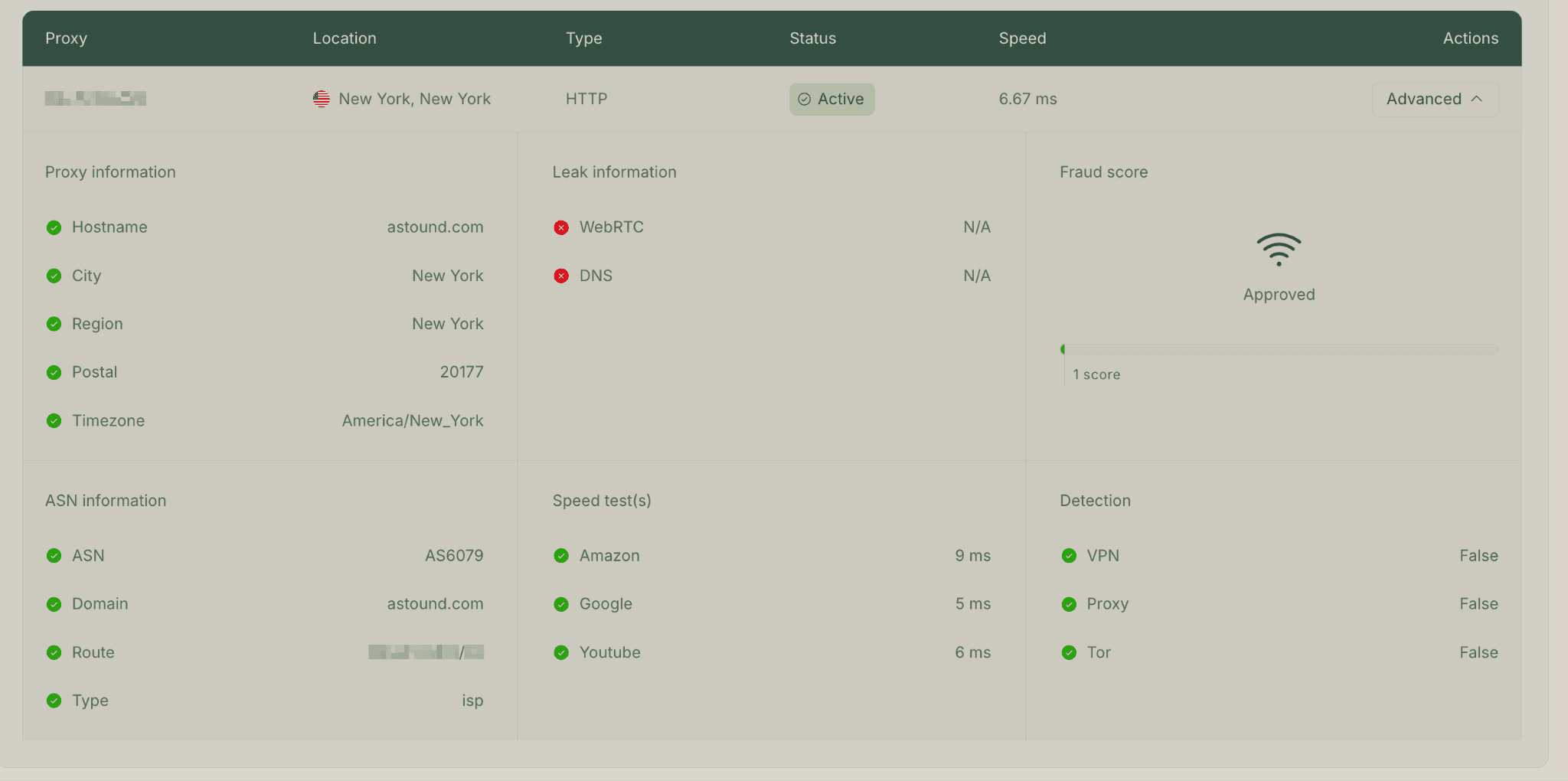
One of our own ISP IPs, checked in our own tool, with the address masked. The ASN belongs to a real carrier, the type reads "isp", the fraud score is 1, and Proxy, VPN, and Tor all read False. This is what you want to see before you pay.
Now run any "residential" pool from somewhere else, and check for yourself whether it matches what the seller describes. The same kind of pool gets sold as "residential", "ISP", or "static residential", so the label alone won't tell you much. The checker shows the classification underneath. If a pool reads as datacenter, that's what it is, whatever the product page calls it. After a takedown, checking the IP yourself is simply good practice.
6. Owned compute you can co-locate in the same cabinet as your proxies
We run our own hardware: AMD EPYC and Intel servers, dedicated bare-metal, NVMe storage, and a 10 Gbps network. That means you can co-locate your own servers in the same cabinet as the proxies. The traffic between your compute and your IPs then stays inside the cabinet, and it doesn't traverse the public internet. That's where the latency drops.
We measured this from inside our Dallas point of presence. Co-location is what makes it possible: with the compute and the proxy IPs in the same cabinet, the traffic never has to leave it. Most providers don't offer that.
7. 2 US locations, in Ashburn and Dallas, for network diversity and redundancy
Almost everyone in this market offers Ashburn. We run a second point of presence in Dallas, at Equinix DA6. It uses separate ISPs from our Ashburn network at NTT VA1. That gives you 2 things a single location can't offer.
The first is diversity. Your traffic routes through different carrier ASNs, in 2 regions and not just one. This matters, and the reason is simple. When all of your traffic goes through one network, it's easy to fingerprint and rate-limit. When the same traffic is spread across 2 networks, it becomes much harder to block.
The second is redundancy. You're not tied to a single location. You can spread your work across both, so a problem in one place isn't a single point of failure for everything you run. Your last provider just went offline. That's exactly why you don't want to be tied to one place now.
Where HypeProxies is not the right fit
We're US only, and ISP only. If your work needs large rotating pools of residential IPs, or real mobile IPs, or coverage outside the United States, then this isn't the tool. That work needs a dedicated residential provider, and we'd rather send you to one than sell you the wrong fit. What we build is narrower on purpose: stable, static, US ISP proxies, on infrastructure that a takedown like NetNut's can't reach.
How to switch from NetNut to HypeProxies
The move itself is small. See our side-by-side comparison for exact performance numbers. Proxies speak standard protocols, so you point your setup at HypeProxies with a change of gateway address and credentials. In most setups, you don't rewrite your code. Here's the safe order:
Start the trial and run it against your own targets
Watch the block rate on those targets before you commit.
Check the IPs on the free checker to confirm the ASN, type, and fraud score.
Switch over, but keep your old configuration until the new one has passed a full run.
If your pipeline is down right now, this whole path can take an afternoon, not a project.
Ready to switch?
Run one of our IPs through the free checker and read the ASN, type, and fraud score for yourself. When it checks out, start a $1 trial and test it against your own targets.
Frequently asked questions
What makes HypeProxies a good NetNut alternative specifically?
The answer is sourcing. By Google's account, NetNut's residential pool was built on borrowed consumer devices. This is what let a takedown degrade it overnight. HypeProxies runs static US ISP IPs on infrastructure it owns, and there's no consumer-device layer. So the same kind of takedown has nothing to reach. That's the difference that matters, after what happened to NetNut.
Can ISP proxies replace residential proxies?
For most use cases, yes, and you get more stability. But some exceptions are worth knowing. If you need large rotating pools of many different residential or mobile IPs, or coverage outside the US, then that's a different tool. If you need stable sessions on clean US IPs, then ISP is the better fit, and it's the safer sourcing.
What is the difference between ISP and residential proxies?
The difference is the source. Residential proxies route through consumer devices, and these devices are usually enrolled through an app. ISP proxies are static IPs on carrier networks, and the provider runs the infrastructure behind them. Both avoid the datacenter label, which gets an IP blocked immediately. But ISP is more stable, and the reason is simple: no consumer device can switch it off.
I was a NetNut customer. Do I need to do anything besides switch?
Switch first. The network is seized, so there's nothing to wait for. Beyond that, keep your own record of what you used NetNut for. And if your usage was heavy, or if it touched anything sensitive, tell your compliance or legal team now, before someone else raises it. None of this is legal advice. If you're worried about your specific situation, that's a question for a lawyer.
Share on

No credit card required. Request your free trial today.
Stay in the loop
Subscribe to our newsletter for the latest updates, product news, and more.
No spam. Unsubscribe at anytime.